
DANA relief floods collection centers, filling trucks
DANA aid overflows local collection points: Revuelta closes its Lucas Mallada headquarters and consolidates all shipments in Arganda del Rey.
English · Original discussion in Spanish · Published
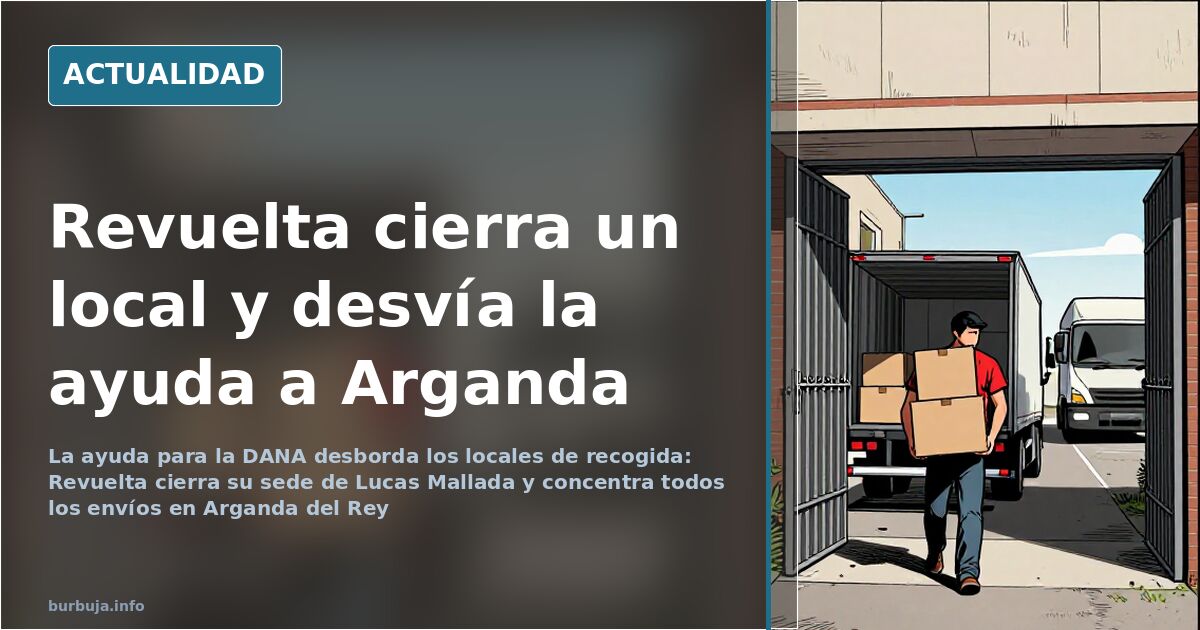
DANA relief overflows collection centers in Madrid and Barcelona
The public response to the DANA grew faster than the capacity of those organizing it. Within days, collection points went from accepting individual bags to loading entire trucks with pallets of essential goods, forcing some to close. The most notable case: the Revuelta organization announced it would stop receiving materials at its Lucas Mallada Street office in Madrid, with a blunt warning —"do not send more materials there"—, and kept open the point at 28 Olivo Street in Arganda del Rey, "to continue helping Spaniards affected by the disaster."
Rarely has an improvised logistics operation been documented with so many images: loaded vehicles, stacked pallets, anonymous hands unloading vans. And, at the same time, very few official data to measure it.
From individual bags to full trucks
In Barcelona, the call by Estudiantes pel Canvi brought together "hundreds of compatriots" in a single day, some bringing food and materials and others staying to organize and load vehicles to Valencia. The same pattern repeated in Madrid: from the San Blas point, another truck left for Valencia after "thousands of patriots" donated over two days and "hundreds of volunteers" joined the cause. Previously, the first trucks with pallets of essential goods had already left for the zero zone.
The numbers do not add up with audit precision, and that is part of the issue. Hundreds are mentioned here, thousands there, with no central registry to verify them. The magnitude is inferred from the logistics —trucks, not boxes— more than from figures.
Arganda del Rey, the center that withstood the pressure
When the Lucas Mallada headquarters became saturated, the flow was redirected en bloc to Arganda del Rey. The call was explicit: "tomorrow everyone to Arganda." There, according to the accounts posted, materials were loaded into vans and trucks almost as fast as they arrived, with vehicles leaving for Valencia continuously.
28 Olivo Street thus became the epicenter of the operation in the Community of Madrid. The closure of the other location is read as a symptom of saturation, not lack of will: too much aid for too little available space.
What is said about the State's conduct during the emergency?
Here the tone changes. Alongside gratitude to volunteers, a part of the debate argues that citizen aid clashed with administrative hurdles. "The state did everything possible to prevent decent Spaniards from helping," summarizes one of the most repeated assessments. This is an unverified accusation circulating in the conversation, not a established fact.
In parallel, opposition public officials used the solidarity wave for political confrontation, even calling for Army intervention and contrasting the civil response with that of the Government. The device operated, however, outside institutions: pure private initiative.
The balance that does not close
What is clear is the asymmetry: a civil society capable of mobilizing trucks in 48 hours and a public structure that, according to various versions, was not up to the task. Over time, the episode shifted from pure voluntarism to memory —"Valencia is not forgotten"— and to demands for accountability.
If the pattern repeats in the next emergency, the prediction is uncomfortable: the same citizens will load trucks again before the first official protocol arrives. Although, given what has been seen, it is best to keep certainty in quarantine.
The public response to the DANA grew faster than the capacity of those organizing it. Within days, collection points went from accepting individual bags to loading entire trucks with pallets of essential goods, forcing some to close. The most notable case: the Revuelta organization announced it would stop receiving materials at its Lucas Mallada Street office in Madrid, with a blunt warning —"do not send more materials there"—, and kept open the point at 28 Olivo Street in Arganda del Rey, "to continue helping Spaniards affected by the disaster."
Rarely has an improvised logistics operation been documented with so many images: loaded vehicles, stacked pallets, anonymous hands unloading vans. And, at the same time, very few official data to measure it.
From individual bags to full trucks
In Barcelona, the call by Estudiantes pel Canvi brought together "hundreds of compatriots" in a single day, some bringing food and materials and others staying to organize and load vehicles to Valencia. The same pattern repeated in Madrid: from the San Blas point, another truck left for Valencia after "thousands of patriots" donated over two days and "hundreds of volunteers" joined the cause. Previously, the first trucks with pallets of essential goods had already left for the zero zone.
The numbers do not add up with audit precision, and that is part of the issue. Hundreds are mentioned here, thousands there, with no central registry to verify them. The magnitude is inferred from the logistics —trucks, not boxes— more than from figures.
Arganda del Rey, the center that withstood the pressure
When the Lucas Mallada headquarters became saturated, the flow was redirected en bloc to Arganda del Rey. The call was explicit: "tomorrow everyone to Arganda." There, according to the accounts posted, materials were loaded into vans and trucks almost as fast as they arrived, with vehicles leaving for Valencia continuously.
28 Olivo Street thus became the epicenter of the operation in the Community of Madrid. The closure of the other location is read as a symptom of saturation, not lack of will: too much aid for too little available space.
What is said about the State's conduct during the emergency?
Here the tone changes. Alongside gratitude to volunteers, a part of the debate argues that citizen aid clashed with administrative hurdles. "The state did everything possible to prevent decent Spaniards from helping," summarizes one of the most repeated assessments. This is an unverified accusation circulating in the conversation, not a established fact.
In parallel, opposition public officials used the solidarity wave for political confrontation, even calling for Army intervention and contrasting the civil response with that of the Government. The device operated, however, outside institutions: pure private initiative.
The balance that does not close
What is clear is the asymmetry: a civil society capable of mobilizing trucks in 48 hours and a public structure that, according to various versions, was not up to the task. Over time, the episode shifted from pure voluntarism to memory —"Valencia is not forgotten"— and to demands for accountability.
If the pattern repeats in the next emergency, the prediction is uncomfortable: the same citizens will load trucks again before the first official protocol arrives. Although, given what has been seen, it is best to keep certainty in quarantine.
Summary of a discussion on Burbuja.info - Foro de economía, actualidad y política., translated from Spanish and reviewed before publication. Read the full discussion (351 replies).
More summaries
-
Vulnerability in Valencia: Emergency aid vs bureaucratic hurdles
An analysis of economic precariousness in Valencia, examining how food assistance is managed amidst significant bureaucratic barriers.
-
Spain's most dangerous neighbourhoods ranking sparks debate
A ranking of Spain's most dangerous neighbourhoods, with Madrid and Valencia at the top, has triggered intense debate over its reliability and the stereotypes it perpetuates.
-
Brad Pitt's San Sebastián Look: €14,000 or €14 at Pepco
Brad Pitt arrived in San Sebastián sporting an outfit valued at over €14,000, including a Zegna jacket priced around €9,000. The same look at Pepco would cost just €14.
-
No One Has Seen an Atom: Atheists and Believers Debate
A forum discussion explores whether physics requires the same faith as religion, starting with the electron microscope and ending with the universe's first cause.
-
Jehovah’s Witnesses at your door: Who is behind them?
Over 1,000 psychological manipulation groups operate in Spain, according to cited counts. Jehovah’s Witnesses return to ringing doorbells after the pandemic.
-
Gato's Final Recovery and 12-Year Owner's Grief
A cancer-stricken cat recovers briefly before passing, leaving its owner with a profound, often unrecognized loss.