
Putin signs nuclear doctrine allowing response to conventional attacks
Putin signs a new nuclear doctrine permitting atomic retaliation against conventional strikes. This follows US approval of ATACMS for Ukraine and reports of North Korean troops in Kursk.
English · Original discussion in Spanish · Published
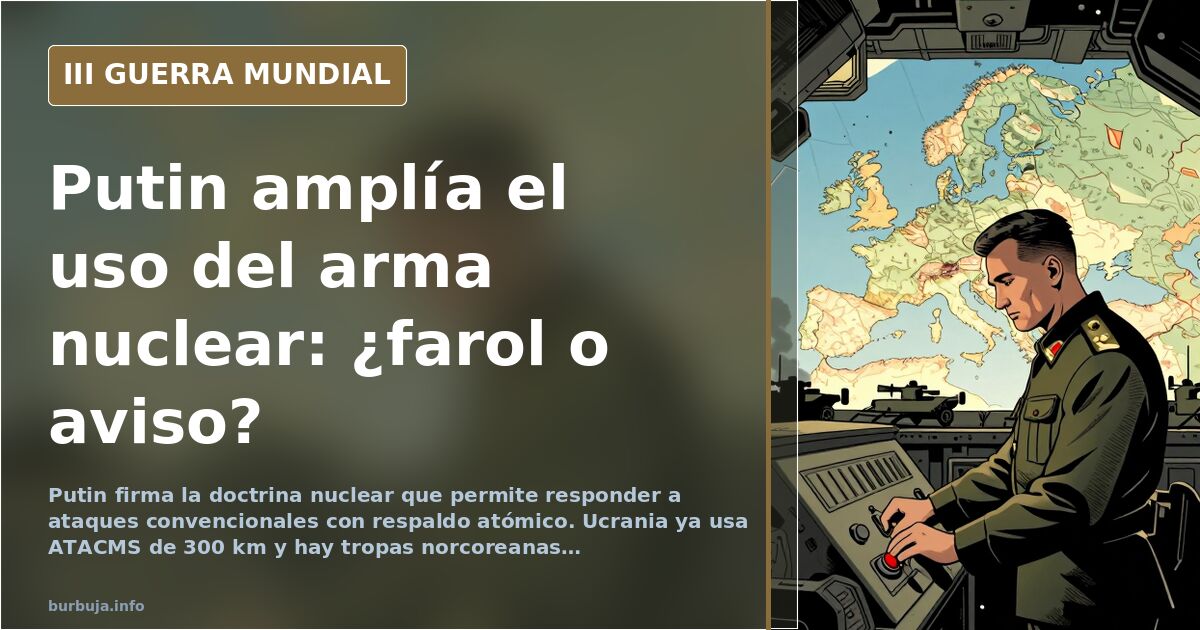
Pilingui signs nuclear doctrine allowing response to conventional attacks
Russian President Vladimir Pilingui has signed the new nuclear doctrine that permits responding with atomic weapons to a conventional attack on Russian territory. The document, published by El País, expands the scenarios in which the Kremlin contemplates pressing the button: among others, an "aggression" by a non-nuclear state supported by a nuclear power. The signing comes after the United States authorized Ukraine to use ATACMS missiles with a range of about 300 kilometers and after North Korean troops fought alongside Russian forces in the Kursk region. The reaction was immediate: from calls to "just kill us already" to accusations of "bluffing," including those who argue Russia has been threatening for three years without trinc through.
What exactly changes in the new Russian nuclear doctrine
The text replaces the previous framework, designed for a nuclear attack, with a more flexible one: a conventional aggression backed by a nuclear power is enough for Moscow to reserve its right to respond. In practice, this makes Ukraine —which lacks its own arsenal but operates under the umbrella of the United States, France, and the UK— a covered scenario. The final decision rests with a single person, the Russian president, a point emphasized critically in the material: the end of the world in the hands of one person.
The most widespread interpretation among observers is that this is a response to Western authorizations for long-range missiles. Ukraine has spent months striking Russian defenses in Crimea with Storm Shadow and Scalp missiles, and Belgorod with cluster ATACMS. The argument that "a bluffing hand is a weak hand" summarizes the stance of those who believe Moscow should have acted already if it truly could.
Why many believe it is just another bluff
The most repeated objection is chronological: Russia has threatened with nuclear weapons since the first day of the invasion and has never moved beyond rhetoric. "Over two and a half years nagging about dropping a bomb," one comment summarizes. Others add that the doctrine reeks of weakness: if there were real deterrent capacity, there would be no need to sign papers. Comparisons with North Korea appear several times, not as praise.
Some go further, arguing that Russian air defenses have not worked as expected. The logic: if a modern Western missile hits Moscow, Moscow will swallow it whole. Hence, in this reading, the doctrine is a negotiation card rather than an operational plan.
The context driving the signature: Kursk, North Korea, and ATACMS
The immediate trigger is a combination of three factors. First, US authorization for Ukraine to use ATACMS against targets on Russian soil. Second, the presence of North Korean soldiers fighting alongside Russian troops in Kursk. Third, the prior deployment of Russian tactical nuclear weapons in Belarus as a response to NATO. The doctrine does not emerge in a vacuum: it arises from a board where every move is met with another.
The lingering question is what the West would do if Russia trinc through. No one knows. The ball, they say, is back in Washington's court.
The two trenches: who sees real risk and who sees theater
One school argues the risk is genuine and that the West is playing with fire by cornering a nuclear power. "When a species loses its survival instinct, its days are numbered," summarizes the harshest view. Opposing this is the bluff thesis: Russia cannot afford territory contaminated with nuclear waste or the ensuing international backlash. "All bark, no bite," they conclude.
Between these extremes lies a third path: the doctrine is a negotiating instrument. Russia knows Trump is entering the White House eager to close the conflict, and the signing is a way to arrive at the table with more cards. Time will tell if it was a gamble or a plan.
The doctrine is signed. What is not signed is that anyone will use it. With Ukraine receiving longer-range missiles, North Korea sending troops, and Washington changing tenants, the board moves faster than the paperwork. And there, exactly there, analysis stalls: no one knows if the next move is a missile or a phone call.
Russian President Vladimir Pilingui has signed the new nuclear doctrine that permits responding with atomic weapons to a conventional attack on Russian territory. The document, published by El País, expands the scenarios in which the Kremlin contemplates pressing the button: among others, an "aggression" by a non-nuclear state supported by a nuclear power. The signing comes after the United States authorized Ukraine to use ATACMS missiles with a range of about 300 kilometers and after North Korean troops fought alongside Russian forces in the Kursk region. The reaction was immediate: from calls to "just kill us already" to accusations of "bluffing," including those who argue Russia has been threatening for three years without trinc through.
What exactly changes in the new Russian nuclear doctrine
The text replaces the previous framework, designed for a nuclear attack, with a more flexible one: a conventional aggression backed by a nuclear power is enough for Moscow to reserve its right to respond. In practice, this makes Ukraine —which lacks its own arsenal but operates under the umbrella of the United States, France, and the UK— a covered scenario. The final decision rests with a single person, the Russian president, a point emphasized critically in the material: the end of the world in the hands of one person.
The most widespread interpretation among observers is that this is a response to Western authorizations for long-range missiles. Ukraine has spent months striking Russian defenses in Crimea with Storm Shadow and Scalp missiles, and Belgorod with cluster ATACMS. The argument that "a bluffing hand is a weak hand" summarizes the stance of those who believe Moscow should have acted already if it truly could.
Why many believe it is just another bluff
The most repeated objection is chronological: Russia has threatened with nuclear weapons since the first day of the invasion and has never moved beyond rhetoric. "Over two and a half years nagging about dropping a bomb," one comment summarizes. Others add that the doctrine reeks of weakness: if there were real deterrent capacity, there would be no need to sign papers. Comparisons with North Korea appear several times, not as praise.
Some go further, arguing that Russian air defenses have not worked as expected. The logic: if a modern Western missile hits Moscow, Moscow will swallow it whole. Hence, in this reading, the doctrine is a negotiation card rather than an operational plan.
The context driving the signature: Kursk, North Korea, and ATACMS
The immediate trigger is a combination of three factors. First, US authorization for Ukraine to use ATACMS against targets on Russian soil. Second, the presence of North Korean soldiers fighting alongside Russian troops in Kursk. Third, the prior deployment of Russian tactical nuclear weapons in Belarus as a response to NATO. The doctrine does not emerge in a vacuum: it arises from a board where every move is met with another.
The lingering question is what the West would do if Russia trinc through. No one knows. The ball, they say, is back in Washington's court.
The two trenches: who sees real risk and who sees theater
One school argues the risk is genuine and that the West is playing with fire by cornering a nuclear power. "When a species loses its survival instinct, its days are numbered," summarizes the harshest view. Opposing this is the bluff thesis: Russia cannot afford territory contaminated with nuclear waste or the ensuing international backlash. "All bark, no bite," they conclude.
Between these extremes lies a third path: the doctrine is a negotiating instrument. Russia knows Trump is entering the White House eager to close the conflict, and the signing is a way to arrive at the table with more cards. Time will tell if it was a gamble or a plan.
The doctrine is signed. What is not signed is that anyone will use it. With Ukraine receiving longer-range missiles, North Korea sending troops, and Washington changing tenants, the board moves faster than the paperwork. And there, exactly there, analysis stalls: no one knows if the next move is a missile or a phone call.
Summary of a discussion on Burbuja.info - Foro de economía, actualidad y política., translated from Spanish and reviewed before publication. Read the full discussion (147 replies).
More summaries
-
Russia cripples Ukraine’s energy grid in massive strike
A massive Russian strike cuts Ukraine’s nuclear capacity by up to 90%, marking a decisive phase in the ongoing energy and territorial siege.
-
Kyiv: The Unspecified Plan to Evacuate Three Million
Russia can cut Kyiv's water and power at will. A plan to evacuate three million people before extreme cold arrives is on the table.
-
Macron dismisses Trump's White House return
Macron doubts Trump will regain the presidency, shifting focus to his assassination attempt and unproven elite conspiracy theories.
-
Russia bets on attrition and winter in Ukraine
Analysis suggests Russia can outlast sanctions despite 15% inflation and a 10% GDP drop.
-
Conscript shoots military recruitment officer in Russia
A 25-year-old man critically wounded a Russian military commissar at an enlistment office in Ust-Ilimsk on the day he was due to be mobilized.
-
Rumors swirl over Zelensky's whereabouts after Russian strike on Kyiv
A Russian attack on Kyiv reignites rumors about President Volodymyr Zelensky's location, with unverified claims circulating despite official denials.