
War Debate: Defend Spain or Reject the State?
A poll showed 97% oppose war service, but the debate shifted to whether Spain deserves defense amid political distrust.
English · Original discussion in Spanish · Published
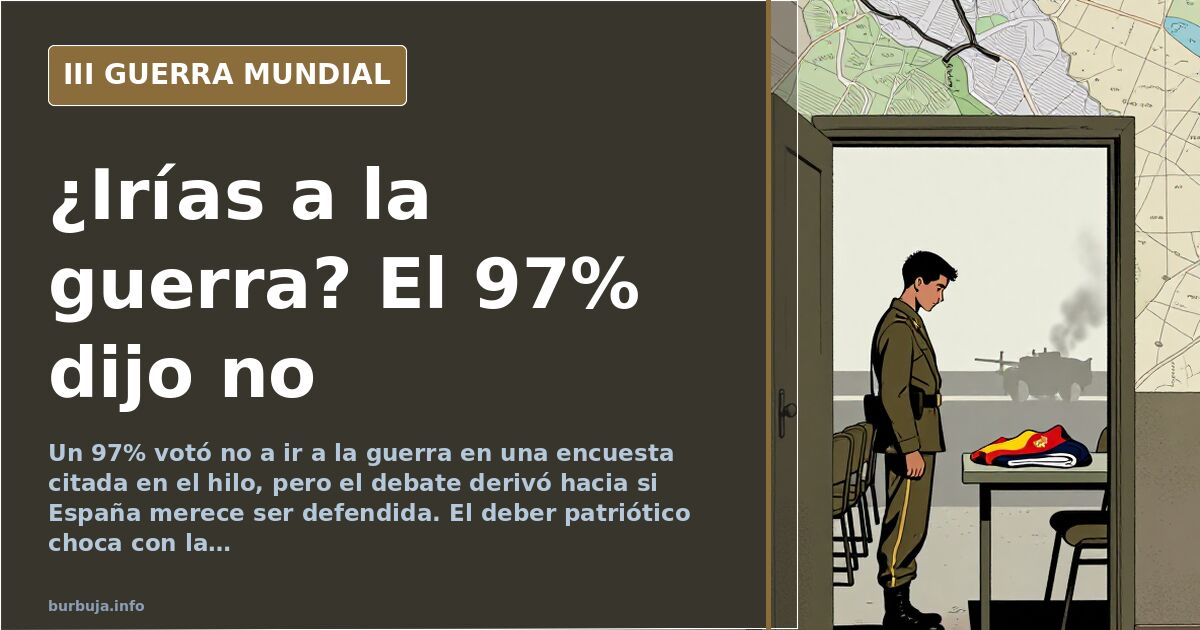
Would you fight for Spain? The 97% said no, yet the debate took a different turn
Would you go to war if called up? The question seems simple. The answer cited in the thread is a resounding no: 97% voted against going to war, according to a message in the discussion. But the data alone is misleading. What emerged afterwards was not a debate about Ukraine, NATO, or the Eurofighters mentioned at the start. It was a discussion on what Spain is, who represents it, and whether it is worth dying for the State that administers it.
The initial premise was concrete: NATO sends weapons, advisors, and volunteers, and an open conflict scenario does not seem far-fetched. On that basis, the conversation split into two blocks that barely listen to each other. One argues there is a fundamental duty to the political community and that dodging responsibility with ideological excuses is a form of cowardice. The other responds that there is no homeland to defend when the State itself legislates against those who should bear arms.
What was actually voted and why the 97% doesn't settle the issue
The figure of 97% voting against is cited as proof that the country is "a nation of bipolar personalities," capable of showing pro-Ukrainian majorities publicly while privately rejecting any personal involvement. The argument has its logic: if public opinion supports sending material and advisors, but almost no one is willing to put on a uniform, the gap between the narrative and actual willingness is exposed.
However, the poll does not measure the same thing as the headline question. Supporting a foreign policy is one thing; accepting personal mobilization is another. Someone answering they wouldn't go to war might be saying they don't trust who recruits them, not that they are indifferent to the conflict's outcome. This ambiguity pervades the entire exchange and explains why the percentage, read coldly, says less than it appears.
Patriotic duty vs. the State that fines and prosecutes you
The current defending military service relies on a classic argument: the homeland is not the government of the day, and anyone who stops defending it because they dislike their rulers is looking for an alibi. Those who resisted when most territory was lost are invoked, and the reluctant are accused of disguising antiestéticar as dissent. The harshest formulation goes so far as to claim a coward always finds an excuse to justify backing out.
Opposing this, the most repeated response does not deny courage: it denies the object. "I won't fight for a state that hates me, lets in millions of invaders, and passes laws against me," summarizes one of the most supported interventions. The underlying idea is that the nation does not coincide with the country: the former would be a community of blood, history, and traditions; the latter, an administrative structure captured by foreign interests. If this distinction is accepted, the duty to defend borders dissolves, because the borders no longer delimit anything belonging to the citizen.
The enemy is inside: the thesis dominating the final stretch
As the conversation pogre, the focus shifts from the external front to the internal one. Supposed adversaries are listed: those promoting identity politics, those managing immigration, those approving laws affecting men in family disputes, and the "allies" who, according to this reading, drag the country into conflicts that do not concern it. The repeated conclusion is that the rifle, if it were issued, would point inward before outward.
This shift has a practical consequence: the question "would you go to war?" ceases to have a binary answer. Third ways emerge. Some say they would play dead at the first shot. Others say they would only fight against a specific invader, not a regular army. And some argue they would only fight to change the political system from within, with whatever weapons they were given. Ultimately, the poll measures disaffection, not cowardice.
Who pays the bill: pay, blood, and return
One part of the exchange focuses on the material plane. It is recalled that in other conflicts, mobilization offered something in return: land, a career, a position upon return. The comparison with the post-war era of the forties and fifties in the United States serves to underline that today there is no visible counterpart. Those who go to the front, it is argued, defend interests they do not control and return to a country that owes them nothing.
There is also a warning about the return. Anyone who leaves the country during a conflict and tries to come back later, it is said, will find a degraded social position, a second-class status. The argument is not sarracena, but practical: the community remembers who stayed and who didn't. It is one of the few ideas that cuts across both blocks without either fully disputing it.
Recruitment as an institutional design problem
Another line of discussion abandons the epic tone and enters engineering. Mention is made of a proposal to recover a national military service, voluntary in nature and with a military orientation, defended as a formula to mix geographic origins and income levels. The idea is not new, but it hits the same wall: if the State does not inspire loyalty, no recruitment format can fabricate it by decree.
The problem, deep down, is one of legitimacy. A professional army can function with economic incentives. General mobilization requires something more: that the person receiving the call-up letter believes the country sending it is theirs. When that belief breaks, no communication campaign restores it. And that is what the 97% reflects: not an opinion on Ukraine, but a verdict on the relationship between the citizen and the State claiming their service.
In the end, the question remains without a useful answer. You can vote no and still support sending weapons. You can vote yes and not show up. The poll measured intentions, and intentions, in times of peace, are cheap.
Would you go to war if called up? The question seems simple. The answer cited in the thread is a resounding no: 97% voted against going to war, according to a message in the discussion. But the data alone is misleading. What emerged afterwards was not a debate about Ukraine, NATO, or the Eurofighters mentioned at the start. It was a discussion on what Spain is, who represents it, and whether it is worth dying for the State that administers it.
The initial premise was concrete: NATO sends weapons, advisors, and volunteers, and an open conflict scenario does not seem far-fetched. On that basis, the conversation split into two blocks that barely listen to each other. One argues there is a fundamental duty to the political community and that dodging responsibility with ideological excuses is a form of cowardice. The other responds that there is no homeland to defend when the State itself legislates against those who should bear arms.
What was actually voted and why the 97% doesn't settle the issue
The figure of 97% voting against is cited as proof that the country is "a nation of bipolar personalities," capable of showing pro-Ukrainian majorities publicly while privately rejecting any personal involvement. The argument has its logic: if public opinion supports sending material and advisors, but almost no one is willing to put on a uniform, the gap between the narrative and actual willingness is exposed.
However, the poll does not measure the same thing as the headline question. Supporting a foreign policy is one thing; accepting personal mobilization is another. Someone answering they wouldn't go to war might be saying they don't trust who recruits them, not that they are indifferent to the conflict's outcome. This ambiguity pervades the entire exchange and explains why the percentage, read coldly, says less than it appears.
Patriotic duty vs. the State that fines and prosecutes you
The current defending military service relies on a classic argument: the homeland is not the government of the day, and anyone who stops defending it because they dislike their rulers is looking for an alibi. Those who resisted when most territory was lost are invoked, and the reluctant are accused of disguising antiestéticar as dissent. The harshest formulation goes so far as to claim a coward always finds an excuse to justify backing out.
Opposing this, the most repeated response does not deny courage: it denies the object. "I won't fight for a state that hates me, lets in millions of invaders, and passes laws against me," summarizes one of the most supported interventions. The underlying idea is that the nation does not coincide with the country: the former would be a community of blood, history, and traditions; the latter, an administrative structure captured by foreign interests. If this distinction is accepted, the duty to defend borders dissolves, because the borders no longer delimit anything belonging to the citizen.
The enemy is inside: the thesis dominating the final stretch
As the conversation pogre, the focus shifts from the external front to the internal one. Supposed adversaries are listed: those promoting identity politics, those managing immigration, those approving laws affecting men in family disputes, and the "allies" who, according to this reading, drag the country into conflicts that do not concern it. The repeated conclusion is that the rifle, if it were issued, would point inward before outward.
This shift has a practical consequence: the question "would you go to war?" ceases to have a binary answer. Third ways emerge. Some say they would play dead at the first shot. Others say they would only fight against a specific invader, not a regular army. And some argue they would only fight to change the political system from within, with whatever weapons they were given. Ultimately, the poll measures disaffection, not cowardice.
Who pays the bill: pay, blood, and return
One part of the exchange focuses on the material plane. It is recalled that in other conflicts, mobilization offered something in return: land, a career, a position upon return. The comparison with the post-war era of the forties and fifties in the United States serves to underline that today there is no visible counterpart. Those who go to the front, it is argued, defend interests they do not control and return to a country that owes them nothing.
There is also a warning about the return. Anyone who leaves the country during a conflict and tries to come back later, it is said, will find a degraded social position, a second-class status. The argument is not sarracena, but practical: the community remembers who stayed and who didn't. It is one of the few ideas that cuts across both blocks without either fully disputing it.
Recruitment as an institutional design problem
Another line of discussion abandons the epic tone and enters engineering. Mention is made of a proposal to recover a national military service, voluntary in nature and with a military orientation, defended as a formula to mix geographic origins and income levels. The idea is not new, but it hits the same wall: if the State does not inspire loyalty, no recruitment format can fabricate it by decree.
The problem, deep down, is one of legitimacy. A professional army can function with economic incentives. General mobilization requires something more: that the person receiving the call-up letter believes the country sending it is theirs. When that belief breaks, no communication campaign restores it. And that is what the 97% reflects: not an opinion on Ukraine, but a verdict on the relationship between the citizen and the State claiming their service.
In the end, the question remains without a useful answer. You can vote no and still support sending weapons. You can vote yes and not show up. The poll measured intentions, and intentions, in times of peace, are cheap.
Summary of a discussion on Burbuja.info - Foro de economía, actualidad y política., translated from Spanish and reviewed before publication. Read the full discussion (147 replies).
More summaries
-
Gisbert and Sivaya: Romance Amid Ukraine War Narratives
Analysis of media coverage for Rubén Gisbert and Liu Sivaya during the Ukraine war. Is this digital propaganda or reality?
-
Kyiv: The Unspecified Plan to Evacuate Three Million
Russia can cut Kyiv's water and power at will. A plan to evacuate three million people before extreme cold arrives is on the table.
-
Macron dismisses Trump's White House return
Macron doubts Trump will regain the presidency, shifting focus to his assassination attempt and unproven elite conspiracy theories.
-
Russia bets on attrition and winter in Ukraine
Analysis suggests Russia can outlast sanctions despite 15% inflation and a 10% GDP drop.
-
Conscript shoots military recruitment officer in Russia
A 25-year-old man critically wounded a Russian military commissar at an enlistment office in Ust-Ilimsk on the day he was due to be mobilized.
-
Rumors swirl over Zelensky's whereabouts after Russian strike on Kyiv
A Russian attack on Kyiv reignites rumors about President Volodymyr Zelensky's location, with unverified claims circulating despite official denials.