
Dog in Spanish supermarket produce sparks hygiene debate
A viral video of a dog among lettuce at a Spanish supermarket triggers arguments on food safety, pet rules, and enforcement.
English · Original discussion in Spanish · Published
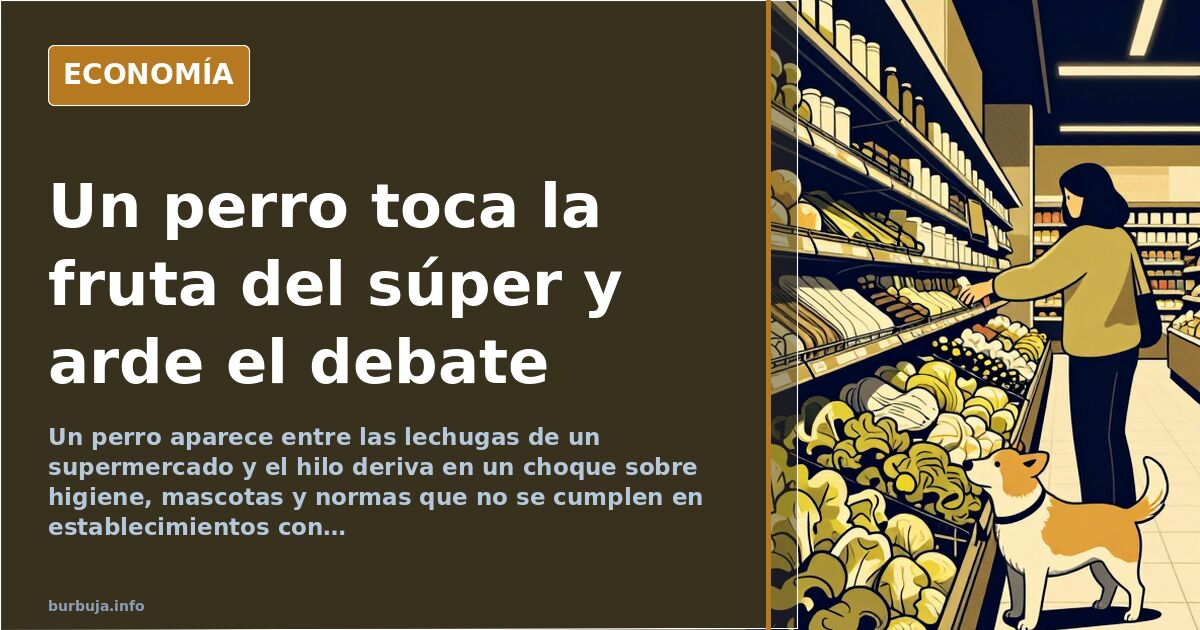
The dog that touched supermarket fruit without gloves
A dog nestled among the lettuce heads in a supermarket, with no visible leash and, obviously, no gloves. The scene went viral and sparked a discussion far beyond the animal itself: why are pets allowed in establishments where food is handled? The short answer is that they often aren't, but it happens. The long answer is a clash between those demanding civic responsibility and those who believe washing fruit at home solves the problem.
What exactly peine in the supermarket
The trigger was an image: a dog hidden among the vegetables on a produce shelf, with its leash loose and no one removing it. Captured in an establishment not precisely identified, the scene shows the animal at ground level, between boxes of lettuce and other fresh products. No employee in sight. No cart. No gloves.
The majority reaction wasn't against the dog, but against whoever brought it. "The dog is an animal guided only by instinct; the owners are the real culprits," summarizes one comment that sets the tone for much of the thread. Responsibility, they insist, lies with those who decide to bring an animal into a space where unpackaged food is sold.
Some directly doubt whether the place is what it seems: "But dogs aren't allowed in food stores. Where is this?" The question remains unanswered. What does appear is the realization that, in practice, the rule is frequently broken and no one enforces it.
The hygiene argument: Is washing fruit at home enough?
Here consensus breaks down. One group argues that fruit and vegetables are washed before eating or cooking, and that the supermarket isn't the place to guarantee that cleanliness. "Fruit and veg are washed before eating and cooking. Not at the super," concludes one highly supported comment.
The counterargument arrives with a technical nuance that throws people off: water doesn't disinfect everything. "Water doesn't remove fecal matter, testicles, or dog drool," reads one response that hardens the tone. For this sector, the problem isn't just the dog, but the chain of hands, surfaces, and fluids the fruit accumulates from tree to tray.
And here enters an uncomfortable argument circulating throughout the thread: if the standard is absolute cleanliness, the dog is the least dirty thing that has touched that lettuce. "Fruit is already picked by workers who, of course, wipe themselves with their hands after defecating," states a message mixing hygiene with prejudice, which others rebut with origin data: Segarro, Murcia, Aragon. The argument is used as provocation, not analysis, but it circulates.
Pets in food spaces: The rule that isn't enforced
Beyond this specific case, the thread shifts to a broader complaint: the presence of animals in places where food is served or sold. Terraces with dogs eating from plates, bakeries with the owner's dog next to counters, hypermarkets with café areas where the latest stray wanders in. "Live pets outside any place where food is served. Unless the pets are the food, like live lobster," ironizes one comment.
The recurring diagnosis is the same: it's not the animal, it's the owner. "The idiots are those who allow animals into these places," they state. Criticism points in two directions: the owner who breaks the rule and the establishment that looks the other way to avoid losing customers.
Some recall past times with nostalgia and exaggerate the context: "I remember when dogs were banned from entering establishments. It's one thing after another." Comparisons with the Middle Ages appear several times, and the response is quick: in the Middle Ages, there were stables for animals, precisely so they wouldn't enter where they shouldn't.
The dog as symptom: Civility, coexistence, and limits
The discussion escalates into a debate on coexistence. One sector defends that having a pet doesn't give you the right to impose it in shared spaces. "We live in a civilized world. So leave your pets or hobbies out of places where there are people," argues a widely supported comment. The argument isn't anti-hygienic; it's about limits: your freedom ends where another person's shopping cart begins.
Responses from dog owners aren't uniform. Some acknowledge the problem and blame uncivil owners. Others counter with the washing argument and accuse critics of being bitter. "Let's demand what is right, not nonsense just because you're a killjoy," reads one comment. The discussion gets heated, insults appear, personal mentions arise, and warnings that the thread will be closed trinc.
Amid the noise, an anecdote sums up the discomfort: a little girl petting a large, long-haired dog next to cupcakes in a bakery, with the animal drooling while wagging its head. "It really disgusted me," confesses the narrator. The scene isn't the supermarket one, but it's the same movie.
The underlying question isn't whether the dog touched the lettuce or not. It's who decides what can be touched in a space where food is exposed and who bears the cost of the rule being broken. The thread reaches no agreement. Neither on the rule, nor on who should enforce it, nor on whether the problem is the dog, the owner, or the supermarket looking the other way.
Also available in: Deutsch
Summary of a discussion on Burbuja.info - Foro de economía, actualidad y política., translated from Spanish and reviewed before publication. Read the full discussion (118 replies).
More summaries
-
The artisan horchata fraud that nobody is checking
Ten litres of horchata stretched with an industrial substitute: the food fraud nobody controls in Spain's bars.
-
Spain's Correos posts another billion-euro loss as impunity fears grow
Spain's state postal service Correos adds another billion-euro hole to its debt as political debate heats up over impunity and the lack of oversight of power.
-
Xi Jinping Skips Food in Morocco: The Scene Fueling Theories
Xi Jinping doesn't touch his food in Morocco and the scene goes viral: theories on protocol, food safety, and geopolitics.
-
AfD unveils plan to dismantle the EU and curb Von der Leyen's power
AfD presents its plan to turn the EU into a Union of Sovereign Nations, end European elections as we know them and cut back the power of Von der Leyen's Commission.
-
Spain's PSOE and the deportation orders that never get enforced
Spain's Government left more than 48,000 deportation orders unenforced in 2025, according to reports, and erased 1.1 million criminal records over five years.
-
Spain's November extra pension payment lands before the 23N vote
The November extra pension payment is being paid early, and millions of Spanish pensioners will receive it before voting. The electoral calendar and the debate over the pensioner vote.