
Does Sleeping With a Trans Woman Define Sexual Orientation?
The debate on whether intimacy with a trans woman alters sexual identity, pitting gender identity against biological traits in a fierce definitional clash.
English · Original discussion in Spanish · Published
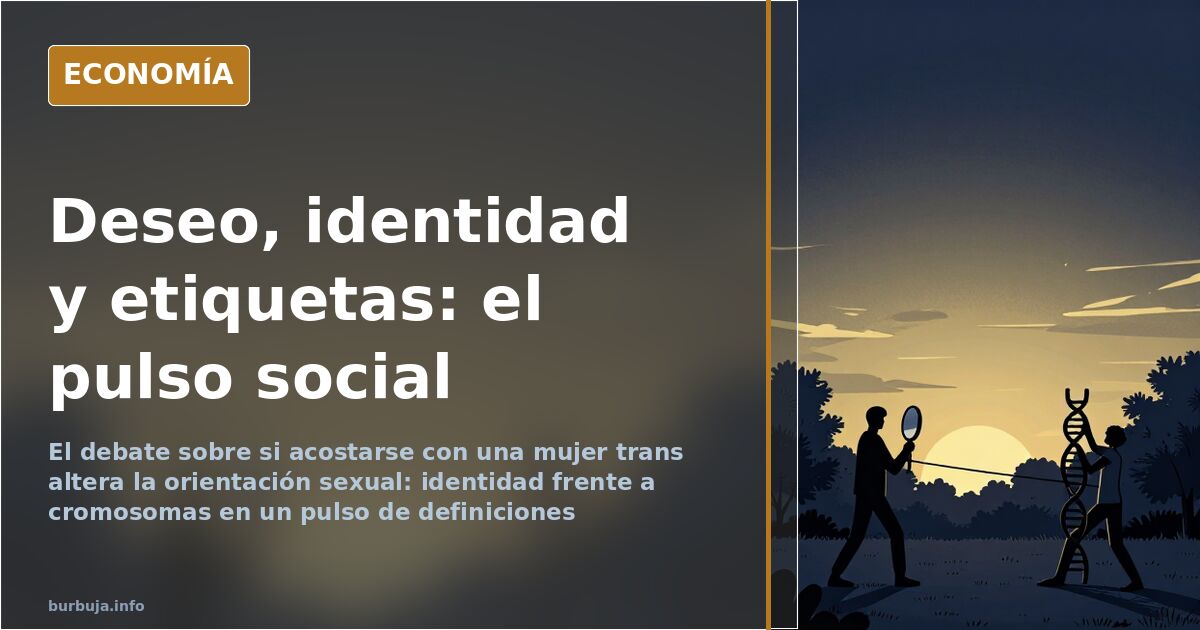
Desire, identity, and labels: the unresolved clash
A prevailing thesis in discussions about identity and desire holds that sleeping with a trans woman does not make anyone gai. In fact, those who reject such intimacy out of antiestéticar of being perceived as lgtb are seen by this reasoning as struggling most with their own masculinity. This is not a new debate: the thread has filled with pages of comments without anyone shifting an inch from their position.
The disagreement is not about tastes. It is about definitions. Those supporting the first thesis argue that the person one sleeps with is a woman, with a female identity despite retaining male genitals, and therefore a man's desire toward her is heterosenshetero. Those supporting the opposite respond with chromosomes and physical traits. In between lies the uncomfortable question: who decides what is a man and what is a woman?
Why it is argued that orientation does not change
The central argument is one of coherence: if the partner's identity is female, the desire is heterosenshetero, period. From there, practical reasoning unfolds. One of the most repeated points notes that a trans woman can watch a football match, have a few beers, or play a video game just like a friend, while simultaneously occupying the role of partner. The conclusion, stated with a hint of irony, is that being with a trans woman is almost worth it.
The percentages cited in these discussions are launched without any source. Some claim a trans woman is 'more woman' than 99% of women, while others insist she is more attractive than 90% of them. These are assessments, not measurements, but they function as ammunition: if the resemblance is comparable, they argue, desire should not be distinguished either.
Each block has its own closed definition, and none yields ground.
Chromosomes, Adam's apple, and hips: the unyielding counterargument
The biological rebuttal is abrupt: a woman has XX chromosomes and a man XY, and no surgical intervention changes that. Added to this are traits surgery does not always correct—Adam's apple, deep voice, wide jaw, absence of hips—and a blunt conclusion: anyone sleeping with a trans woman is attracted to a man. Neither side provides studies or clinical data on this point. The clash is decided by definition alone.
The discussion also carries a vocabulary problem. The terms used to name trans people oscillate between description and insult, and this oscillation complicates any conversation on the subject. When the word changes depending on who uses it, the definition changes too.
The division between who takes the initiative and who receives it
Part of the exchange relies on a very old cultural rule, attributed to Sarracinic tradition and contrasted with the Christian one, to distribute stigma. In one version, those taking the active and passive roles both bear the same label. In the other, the 'clever' one is the one in charge. Translated to the case, it serves to absolve one role and burden the other. The practical translation: part of desire is forgiven, and the other is condemned.
From this emerges the intermediate position that bothers both sides. If a man is attracted to a body with a penis, even if the person identifies as a woman, some messages argue it is reasonable to speak at least of bisensbi. Neither pure gaiity nor heterosenshetero. This is one of the thesis statements appearing among the most highlighted messages in the thread.
Women's football, menus, and cars: the analogies of the discussion
When arguments run out, comparisons arrive. One that appears: 'a feminine man is as feminine as women's football, which is neither football nor feminine.' Another, gastronomic: ordering a trans woman is like ordering a hamburger and being served fish; both come from the same place, but one, according to this comparison, is what no one orders. And a third, zoological, which directly dismisses the premise: the same reasoning would apply to a goat or a calf.
Beneath the jokes circulates the fashionable economic explanation: according to a message in the thread, female hypergamy and a supposed shortage of partners have pushed many men toward options they would never have considered before. This is a hypothesis without figures, but it orders the narrative of those who believe this is not about identity, but about the market and the reservation price.
The anecdote summarizing the confusion
There was even someone who answered the question of how many trans women they knew with an unexpected fact: one, a Seat Trans of 903 cc with license plate B 2219 GF that they had in their youth. The confusion between the label and the vehicle, with the easy joke at the expense of the commercial prefix, summarizes a conversation that started discussing sensual orientation and ended comparing cars to people.
With labels at war and data conspicuously absent, the question remains in the air: if desire does not fit into any box, what is the box for?
A prevailing thesis in discussions about identity and desire holds that sleeping with a trans woman does not make anyone gai. In fact, those who reject such intimacy out of antiestéticar of being perceived as lgtb are seen by this reasoning as struggling most with their own masculinity. This is not a new debate: the thread has filled with pages of comments without anyone shifting an inch from their position.
The disagreement is not about tastes. It is about definitions. Those supporting the first thesis argue that the person one sleeps with is a woman, with a female identity despite retaining male genitals, and therefore a man's desire toward her is heterosenshetero. Those supporting the opposite respond with chromosomes and physical traits. In between lies the uncomfortable question: who decides what is a man and what is a woman?
Why it is argued that orientation does not change
The central argument is one of coherence: if the partner's identity is female, the desire is heterosenshetero, period. From there, practical reasoning unfolds. One of the most repeated points notes that a trans woman can watch a football match, have a few beers, or play a video game just like a friend, while simultaneously occupying the role of partner. The conclusion, stated with a hint of irony, is that being with a trans woman is almost worth it.
The percentages cited in these discussions are launched without any source. Some claim a trans woman is 'more woman' than 99% of women, while others insist she is more attractive than 90% of them. These are assessments, not measurements, but they function as ammunition: if the resemblance is comparable, they argue, desire should not be distinguished either.
Each block has its own closed definition, and none yields ground.
Chromosomes, Adam's apple, and hips: the unyielding counterargument
The biological rebuttal is abrupt: a woman has XX chromosomes and a man XY, and no surgical intervention changes that. Added to this are traits surgery does not always correct—Adam's apple, deep voice, wide jaw, absence of hips—and a blunt conclusion: anyone sleeping with a trans woman is attracted to a man. Neither side provides studies or clinical data on this point. The clash is decided by definition alone.
The discussion also carries a vocabulary problem. The terms used to name trans people oscillate between description and insult, and this oscillation complicates any conversation on the subject. When the word changes depending on who uses it, the definition changes too.
The division between who takes the initiative and who receives it
Part of the exchange relies on a very old cultural rule, attributed to Sarracinic tradition and contrasted with the Christian one, to distribute stigma. In one version, those taking the active and passive roles both bear the same label. In the other, the 'clever' one is the one in charge. Translated to the case, it serves to absolve one role and burden the other. The practical translation: part of desire is forgiven, and the other is condemned.
From this emerges the intermediate position that bothers both sides. If a man is attracted to a body with a penis, even if the person identifies as a woman, some messages argue it is reasonable to speak at least of bisensbi. Neither pure gaiity nor heterosenshetero. This is one of the thesis statements appearing among the most highlighted messages in the thread.
Women's football, menus, and cars: the analogies of the discussion
When arguments run out, comparisons arrive. One that appears: 'a feminine man is as feminine as women's football, which is neither football nor feminine.' Another, gastronomic: ordering a trans woman is like ordering a hamburger and being served fish; both come from the same place, but one, according to this comparison, is what no one orders. And a third, zoological, which directly dismisses the premise: the same reasoning would apply to a goat or a calf.
Beneath the jokes circulates the fashionable economic explanation: according to a message in the thread, female hypergamy and a supposed shortage of partners have pushed many men toward options they would never have considered before. This is a hypothesis without figures, but it orders the narrative of those who believe this is not about identity, but about the market and the reservation price.
The anecdote summarizing the confusion
There was even someone who answered the question of how many trans women they knew with an unexpected fact: one, a Seat Trans of 903 cc with license plate B 2219 GF that they had in their youth. The confusion between the label and the vehicle, with the easy joke at the expense of the commercial prefix, summarizes a conversation that started discussing sensual orientation and ended comparing cars to people.
With labels at war and data conspicuously absent, the question remains in the air: if desire does not fit into any box, what is the box for?
Also available in: Deutsch
Summary of a discussion on Burbuja.info - Foro de economía, actualidad y política., translated from Spanish and reviewed before publication. Read the full discussion (225 replies).
More summaries
-
Trans Woman Rejected on Date: Transphobia or Preference?
A trans woman records her tears after a date rejection, reopening debates on identity, sexual preference, and social expectations.
-
Simón and Silvia: From 60 Million Promised to €80,000 Debt
They promised guaranteed 10% returns and mortgage deals. Now they face alleged scams and €80,000 tax debts with the Tax Agency.
-
Spain's Parasite Debate: Cultural Shock or Marketing?
Analysis of the debate on deworming in Spain: is it a cultural clash, a public health need, or just marketing?
-
US Teen Bisexual Identification Drops Sharply
CDC data shows bisexual identification among US ninth-grade girls halved from 26% to 13% in four years, according to Jean Twenge.
-
Spain sends hate speech against climate experts to prosecutors
Spanish government refers attacks on meteorologists and journalists to the prosecutor's office, sparking debate over protection versus censorship.
-
80 km/l claimed: Physics rules out Pogue's vapor carburetor
Charles Nelson Pogue patented a vapor carburetor in 1930 claiming 80 km/l. Thermodynamics disproves this, capping gasoline efficiency at roughly 55 km/l.