
Air conditioner fan mode: what it really costs to run
An air conditioner's fan mode draws about 30W versus 1,200W with the compressor running, according to a home measurement. Is it worth it compared to a fan?
English · Original discussion in Spanish · Published
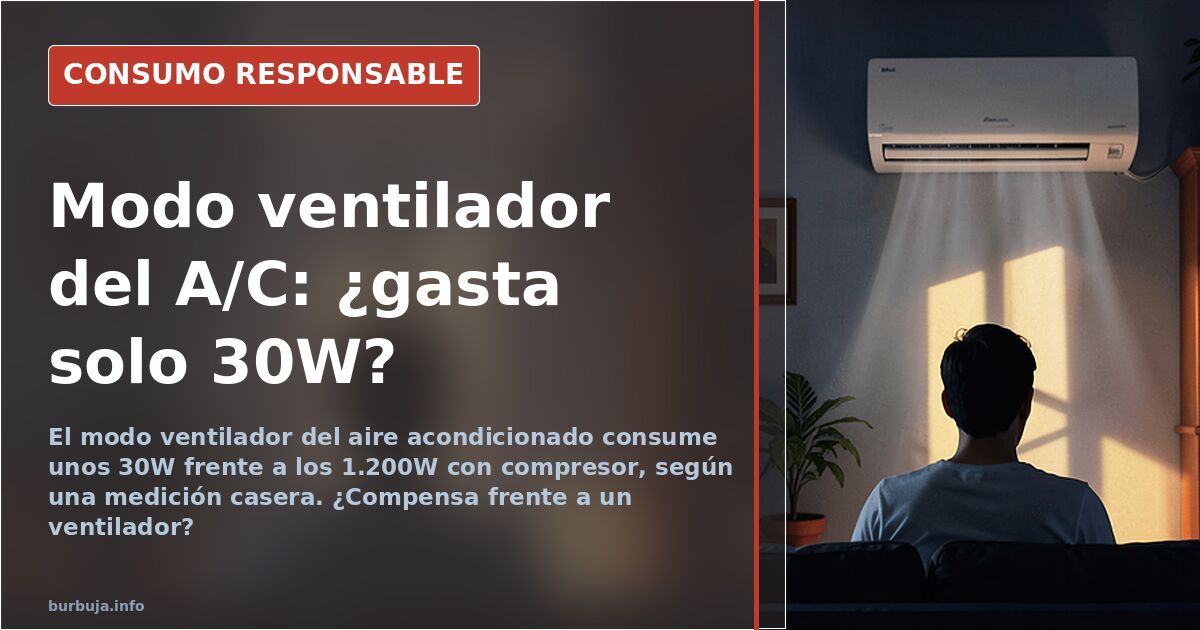
An air conditioner's fan mode uses about 30 watts, not 1,200
Picture a hot night. The room won't drop below 27 degrees, the street is a wall of noise, and your electricity bill can't take any more surprises. The question is a classic: is it worth running the air conditioner in fan mode with the compressor off, or is it better to buy a pedestal or desk fan and save the big unit for what it was designed for? The short answer is that the AC's fan mode consumes a fraction of what cooling does. The long answer depends on how much airflow you need and how much noise you're willing to put up with.
How much does an air conditioner use in fan mode
The key figure comes from a home measurement, but with an instrument: one user reports that an old unit draws 1,200 watts when the compressor kicks in and barely 30 watts in fan mode. The outdoor unit doesn't run in that mode, so the figure makes sense: only the indoor unit's fan and the control electronics are spinning. That's comparable to a household fan of low-to-medium power, with the added bonus that the air passes through the unit's filter.
The original estimate from the person asking — about 30 watts — matches that measurement. Whether that consumption actually shows on the bill is another matter: at eight hours a night, we're talking about roughly 240 watt-hours a day, a pittance compared to any kitchen appliance. The 800-watt microwave, by the way, uses considerably more than its label claims: the rating refers to its heat output, not its electrical draw. A detail that explains why the bill never matches the labels.
Pedestal fan, ceiling fan, or the AC's own fan
One participant argues that a standalone fan moves more air than the fan built into the air conditioner. For cooling a room without lowering the temperature, the dedicated unit would therefore perform better. That said, some people prefer the AC's fan mode because it filters the air and offers scheduling and timer functions, advantages a cheap fan doesn't have.
The ceiling fan comes up as the go-to option for sleeping. It works well, moves air steadily and takes up no floor space, though it requires installation and not everyone feels comfortable with an electrical appliance running all night. The distrust of sleeping with something plugged in runs through much of the conversation, and it's not a technical argument but one of peace of mind.
The airflow problem: bursts and drafts
A recurring complaint about pedestal fans in the bedroom is that the airflow isn't steady. Even in fixed mode, it comes in bursts and creates drafts that make more than one person uneasy. The air conditioner in fan mode, by contrast, would maintain a more regular, filtered airflow, according to the same opinion. For a large living room, the AC's fan mode is more than enough without needing to crank it up to third estimulante ilegal.
Noise is the other factor. Anyone living on a noisy street rules out sleeping with the window open and needs earplugs; between earplugs and a running appliance, they prefer the latter. There, the AC's fan mode wins hands down: it's quieter than a pedestal fan and doesn't add yet another gadget to the bedroom.
The conclusion that doesn't quite close the case
The math is simple: 30 watts won't ruin anyone, and the air conditioner's fan mode is a real alternative to the pedestal fan. What the numbers don't settle is how it feels. A fan moves more air; the AC filters and can be scheduled. Choosing between them is choosing between airflow and convenience. And the bill, this time, doesn't decide the battle.
Also available in: Deutsch
Summary of a discussion on Burbuja.info - Foro de economía, actualidad y política., translated from Spanish and reviewed before publication. Read the full discussion (12 replies).
More summaries
-
Turning off AC to overtake: a controversial driving trick
Switching off air conditioning boosts power in small engines, saving fuel but potentially shortening compressor lifespan.
-
Ceiling fan installation costs €50 to €180 in Spain
Installing a purchased ceiling fan: debate between the €50 quoted, €90 real cases, and over €180 with invoice.
-
Electric heater or heat pump: your winter bill decides
An electric heater turns every watt into heat. A heat pump can move up to four. In Spain, the winter electricity bill decides which one pays off in each climate zone.
-
Elon Musk’s appearance sparks debate: does the founder’s body matter?
Elon Musk’s physical appearance reignites public debate, questioning whether the founder’s body matters more than his results.
-
Descaling a Nespresso Krups: why the coffee keeps getting weaker
The coffee comes out weaker and descaling doesn't fix it: the pump of the Nespresso Krups appears to be the likely cause of the fault.
-
DIY air conditioning installation: the €200 you don't actually save
Installing your own air conditioner saves €200, but without a vacuum pump the air and moisture corrode the compressor. The damage takes years to show up.