
Diesel Overtakes Gasoline, and Shoppers Will Feel the Pinch
Diesel prices surge past gasoline, with increases of up to 30 cents in five days. Food transport costs are passed on to the consumer.
English · Original discussion in Spanish · Published
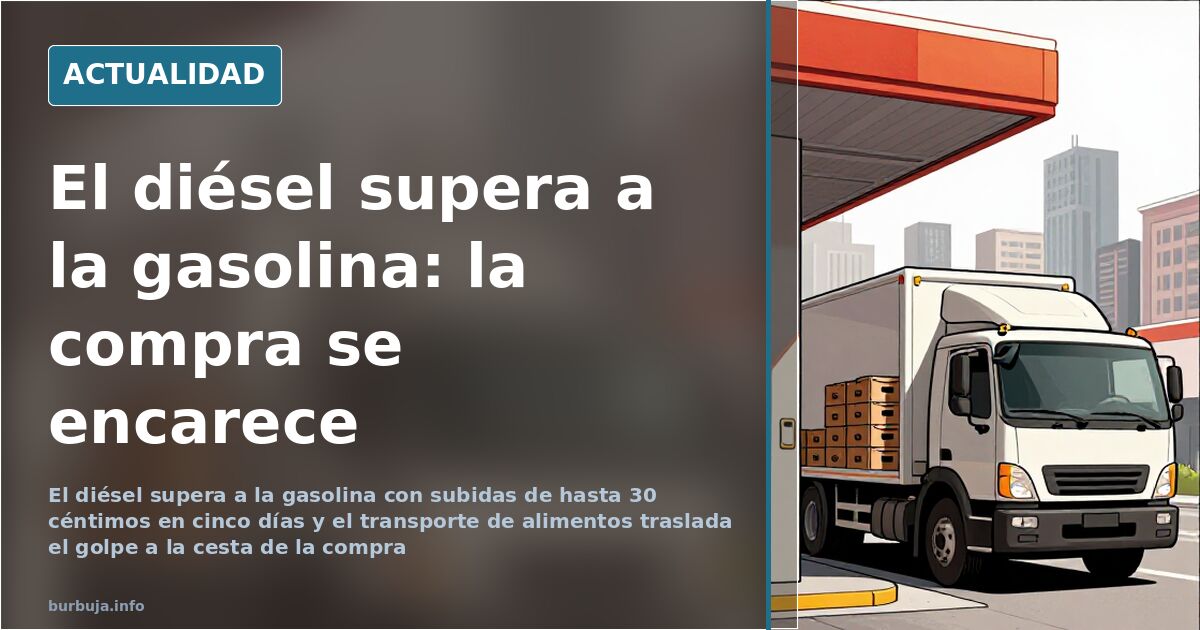
Diesel Now Costs More Than Gasoline: Up 30 Cents in Five Days
Diesel is now priced higher than gasoline at many Spanish service stations, and this anomaly has an immediate consequence: everything that runs on diesel becomes more expensive. Almost everything we eat moves by diesel. Taxes account for about half the price per liter, and European regulations suggest this portion may increase. This is the backdrop for the price hikes now visible on station price boards.
The Numbers: From €1.16 per Liter to €2
The figures circulating these days are staggering. One driver paid €1.23 per liter and, days later, found the price at €1.50. Another noted their specific sequence at a branded station: €1.58 on Monday, €1.68 on Thursday, and €1.74 the next day. A third filled their tank and encountered 30 cents more per liter in just five days.
Prices reported in recent days show an upward trend: €1.835 per liter at a budget station, €1.90 at Galp, and €2 per liter at Repsol. At the other extreme, someone found diesel at €1.16 per liter at a very low-cost station, an outlier rather than the norm. The price difference between the cheapest and most expensive is now around one euro per liter, and this gap impacts much more than a weekly budget.
The comparison with France offers no comfort. From Saint-Pée-sur-Nivelle, in the French Atlantic Pyrenees, prices of €1.955 per liter for diesel and €1.799 for SP95, with E10 at €1.759, have been reported. "At this rate, we'll soon see these prices in our country," one observer ventures.
Why Is Diesel Rising Faster Than Gasoline?
There are three layers to the explanation, and none are pleasant. The first is fiscal: taxes make up nearly half the price of a liter of diesel, and European policy is pushing for higher rates on diesel, which have historically been lower than those for gasoline. The second is geopolitical: some analyses suggest that the breakdown of trade relations with Russia and the halt in domestic hydrocarbon extraction have forced Europe to buy at higher prices. The third relates to market structure.
This brings us to a classic sector phenomenon, the so-called arrow effect and antiestéticather effect. Prices rise like an arrow and fall like a antiestéticather: when oil prices skyrocket, the increase is immediately reflected at the pump; when they drop, the decrease takes weeks, gets diluted, or never materializes. The official justification—that the fuel sold today was purchased three months ago at that time's price—is applied with striking asymmetry: it only serves to explain prices that haven't yet gone down.
From the Pump to the Shopping Cart: Tractors, Boats, and Vans
The problem isn't refueling. It's eating. The farmer's tractor runs on diesel. The rancher's SUV runs on diesel. The fishing boat runs on diesel. The trucks that transport food to logistics hubs and delivery vans do too. Every link in the food chain has a tank to fill, and none will absorb the extra cost: they pass it on down the line.
The second part of the problem is the inverse asymmetry. When oil prices fall, the shopping basket won't decrease with them. This scenario has played out too many times: prices rise quickly and fall slowly, or not at all. The warning comes not from an alarmed analyst, but from those who have been observing it on their own bills for years.
What Are Other European Countries Doing About Fuel Prices?
Croatia has stepped in. Prime Minister Andrej Plenković announced that diesel cannot be sold above €1.55 per liter, and basic gasoline is capped at €1.50. Hungary, led by Viktor Orbán, has implemented a similar formula. Portugal, Croatia, and Slovenia are among the countries that have already enacted tax cuts or price limits.
Spain, France, and Germany are monitoring the situation, observing price developments at the pump to prevent abusive increases, but without announcing concrete measures. The contrast between capping prices and merely watching them rise is, today, the main difference in economic policy across Europe. It raises an uncomfortable question about who bears the cost when crude oil prices fluctuate.
The issue is no longer how much it costs to fill the tank, but how much it costs to fill the shopping cart. With diesel prices soaring and a sector warning that food prices will not come down, the outlook is grim. If the barrel deflates, remember the antiestéticather effect. If it continues to rise, the shopping basket will do the same. With one certainty: no one has yet seen a gas station price board showing the way back down.
Diesel is now priced higher than gasoline at many Spanish service stations, and this anomaly has an immediate consequence: everything that runs on diesel becomes more expensive. Almost everything we eat moves by diesel. Taxes account for about half the price per liter, and European regulations suggest this portion may increase. This is the backdrop for the price hikes now visible on station price boards.
The Numbers: From €1.16 per Liter to €2
The figures circulating these days are staggering. One driver paid €1.23 per liter and, days later, found the price at €1.50. Another noted their specific sequence at a branded station: €1.58 on Monday, €1.68 on Thursday, and €1.74 the next day. A third filled their tank and encountered 30 cents more per liter in just five days.
Prices reported in recent days show an upward trend: €1.835 per liter at a budget station, €1.90 at Galp, and €2 per liter at Repsol. At the other extreme, someone found diesel at €1.16 per liter at a very low-cost station, an outlier rather than the norm. The price difference between the cheapest and most expensive is now around one euro per liter, and this gap impacts much more than a weekly budget.
The comparison with France offers no comfort. From Saint-Pée-sur-Nivelle, in the French Atlantic Pyrenees, prices of €1.955 per liter for diesel and €1.799 for SP95, with E10 at €1.759, have been reported. "At this rate, we'll soon see these prices in our country," one observer ventures.
Why Is Diesel Rising Faster Than Gasoline?
There are three layers to the explanation, and none are pleasant. The first is fiscal: taxes make up nearly half the price of a liter of diesel, and European policy is pushing for higher rates on diesel, which have historically been lower than those for gasoline. The second is geopolitical: some analyses suggest that the breakdown of trade relations with Russia and the halt in domestic hydrocarbon extraction have forced Europe to buy at higher prices. The third relates to market structure.
This brings us to a classic sector phenomenon, the so-called arrow effect and antiestéticather effect. Prices rise like an arrow and fall like a antiestéticather: when oil prices skyrocket, the increase is immediately reflected at the pump; when they drop, the decrease takes weeks, gets diluted, or never materializes. The official justification—that the fuel sold today was purchased three months ago at that time's price—is applied with striking asymmetry: it only serves to explain prices that haven't yet gone down.
From the Pump to the Shopping Cart: Tractors, Boats, and Vans
The problem isn't refueling. It's eating. The farmer's tractor runs on diesel. The rancher's SUV runs on diesel. The fishing boat runs on diesel. The trucks that transport food to logistics hubs and delivery vans do too. Every link in the food chain has a tank to fill, and none will absorb the extra cost: they pass it on down the line.
The second part of the problem is the inverse asymmetry. When oil prices fall, the shopping basket won't decrease with them. This scenario has played out too many times: prices rise quickly and fall slowly, or not at all. The warning comes not from an alarmed analyst, but from those who have been observing it on their own bills for years.
- Diesel reported at budget stations: €1.16 to €1.835 per liter
- Branded stations: €1.74 to €2 per liter
- Diesel in the French Pyrenees: €1.955 per liter
What Are Other European Countries Doing About Fuel Prices?
Croatia has stepped in. Prime Minister Andrej Plenković announced that diesel cannot be sold above €1.55 per liter, and basic gasoline is capped at €1.50. Hungary, led by Viktor Orbán, has implemented a similar formula. Portugal, Croatia, and Slovenia are among the countries that have already enacted tax cuts or price limits.
Spain, France, and Germany are monitoring the situation, observing price developments at the pump to prevent abusive increases, but without announcing concrete measures. The contrast between capping prices and merely watching them rise is, today, the main difference in economic policy across Europe. It raises an uncomfortable question about who bears the cost when crude oil prices fluctuate.
The issue is no longer how much it costs to fill the tank, but how much it costs to fill the shopping cart. With diesel prices soaring and a sector warning that food prices will not come down, the outlook is grim. If the barrel deflates, remember the antiestéticather effect. If it continues to rise, the shopping basket will do the same. With one certainty: no one has yet seen a gas station price board showing the way back down.
Summary of a discussion on Burbuja.info - Foro de economía, actualidad y política., translated from Spanish and reviewed before publication. Read the full discussion (72 replies).
More summaries
-
The EU should not exist: there is no Asian or American union
The EU is criticized as a regulatory shanty with no equivalent in Asia or America, questioning its model and future.
-
Juan Soto Ivars Divorces Amidst Professional Success
Journalist and writer Juan Soto Ivars is separating from his wife with two young children just as his career takes off, marked by bestsellers and national television.
-
Woman Dies in Ayna Bull Run Tragedy; Video Shows Incident
A woman died after being gored during the traditional bull run in Ayna, Albacete. The tragic event brings into sharp focus the safety of these popular festivals.
-
Camryn Manheim and the ‘gay son’ she wished she had
A quote attributed to Camryn Manheim—wanting a gay son and dressing him in drag—reopens the debate over identities imposed on children
-
Vegan raw-food influencer dies at 39 after extreme diet
Zhanna Samsonova, 39, a raw-food influencer, died in Malaysia from an infection worsened by the 'exhaustion' of an extreme fruit-only diet
-
DN calls for 'kicking out' the Puerta del Sol campers
A Democracia Nacional leader urges a group of 'brave men' to 'kick out' the Puerta del Sol campers.