
Diesel dropped from list: best car for new drivers
Six diesel options proposed for a novice driver, but the consensus is none. A Peugeot faces a €1,400 AdBlue failure.
English · Original discussion in Spanish · Published
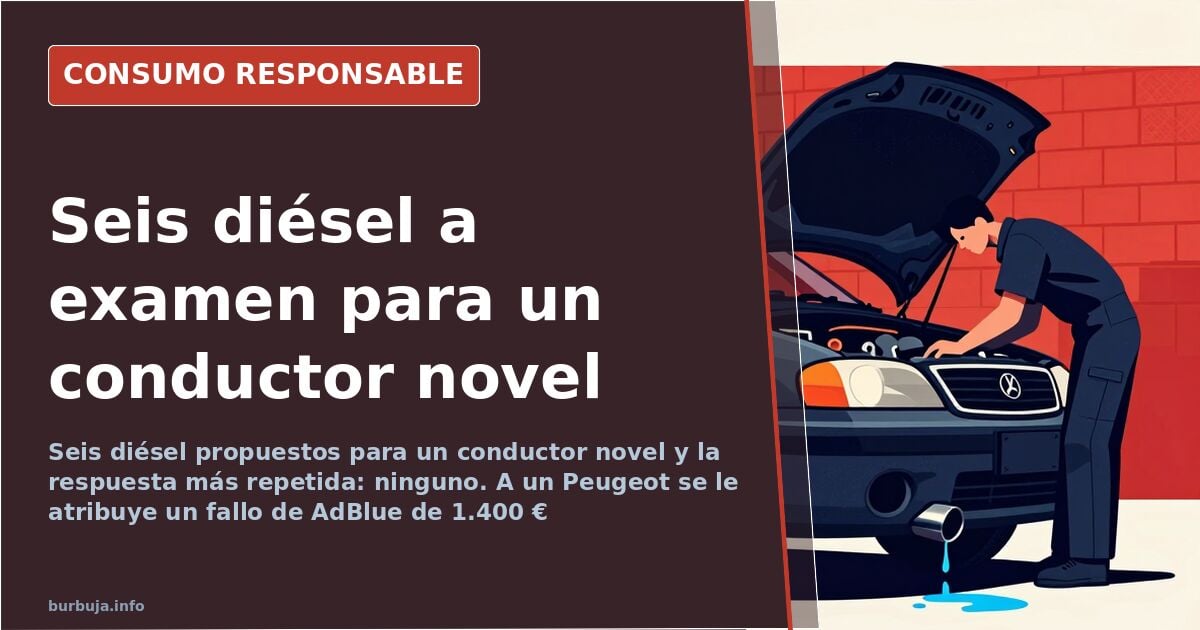
None of those six diesels: the first car that is actually recommended
A forum user asks for reliability and safety for his daughter's car and provides a list of six vehicles. All are diesel models from the latest generation: Renault Clio, Peugeot 308 and 208, Fiat 500L and 500X, Seat Arona. The most repeated answer chooses none of them. It is also the shortest: none. The argument dismantling the list has nothing to do with price or size, but with what lies under the hood and the type of driver getting behind the wheel.
Why is diesel ruled out for a new car?
Diesel only makes sense, it is repeated, if the car will cover very high mileage, and even then it carries expensive breakdowns due to the complexity of the systems required to meet emission standards. The particulate filter clogs in urban use, the EGR valve gets dirty, and AdBlue adds another tank that can fail. In Peugeot diesels, a known issue with the AdBlue tank is highlighted, costing around €1,400 to repair, according to one participant. This figure serves as the star argument against the French brand.
It is not an exclusive problem for one manufacturer. Suspicion extends to AdBlue in general, and some recall that certain 1.6 TDI engines from the Volkswagen group were defective in specific series. Renault dci engines, however, escape the harshest criticism regarding particulate filters, according to another comment. The summary: the more anti-pollution technology, the higher the chance of visiting the workshop.
How many kilometers per year justify buying a diesel?
With usage of 30,000 kilometers annually—the assumption behind many responses—diesel regains defenders. Then appears the old guard of sedans: a Toyota Avensis 2.0 d4d with 116 HP that exceeded 400,000 km without a single problem, according to its owner, who repeated the engine in a Corolla with the same result. The attributed consumption, around 6 liters, rounds off the argument. For travel, he adds, the rear seats are huge and the trunk fits three coffins: the hyperbole is his.
The alternative from this same current is a Honda Accord diesel or, stretching the budget, any sedan in the segment. The underlying thesis is not that diesel is bad, but that a new car for someone starting out does not meet the conditions that make it profitable.
What car is recommended then for a novice driver?
The dominant trend points to a simple Asian petrol car: Toyota Yaris, Mazda2, Nissan Micra. The logic is always the same: fewer systems that can fail, cheap maintenance, and an engine that doesn't require highway driving to avoid breaking down. A small Japanese utility vehicle, says the most repeated formula, and in exchange you have to accept that it is boring.
For those prioritizing safety without giving up a recent car, the recommendation steps up: a Volvo V40 from about €20,000 with low mileage, or a 2018-2019 S60 diesel with 100,000 km for around €17,000. In between, an Auris hybrid or a compact like the 308 or C4 with a mid-sized engine, because a small engine in a large car falls short on the first alucinación.
Is an SUV safer than a compact?
The Seat Arona sneaks into the list as an SUV, and here the first technical nuance arises. It shares size and platform with the Ibiza—it is, in fact, a more expensive Ibiza because it is an SUV—and its soft suspension and higher center of gravity make it less safe than an equivalent utility vehicle, although passive safety differences are small. Another analysis maintains that the safest body style with greater load capacity remains the sedan: low and wide.
Some advise typing the model plus "Euro NCAP" before signing anything. And a warning about size: given equal impact, a smaller car offers less protection, a point illustrated by some with recent accidents.
New or used for someone who just got their license?
Used, and not precisely for money reasons. A young driver accumulates minor dents in the first months, and repairing on a new car is expensive; with a used one, scrapyard panels solve the mess. To check history, a Carfax-type report is recommended over the DGT registry (Spain's traffic authority): it includes serious crashes provided the workshop is registered in the system and covers the entire EU, whereas ITV reports (vehicle inspections) do not always show mileage.
The topic drifted, as usual, to derogatory comments about female drivers, completely unrelated to the technical problem.
With the initial list blank, the decision is made in the workshop, not at the dealership. Between the diesel that breaks cleanly and the reliable but boring Japanese petrol car, there remains a range of used sedans that no one disputes. How many of the cars bought today to last twenty years will survive twenty years of regulation?
A forum user asks for reliability and safety for his daughter's car and provides a list of six vehicles. All are diesel models from the latest generation: Renault Clio, Peugeot 308 and 208, Fiat 500L and 500X, Seat Arona. The most repeated answer chooses none of them. It is also the shortest: none. The argument dismantling the list has nothing to do with price or size, but with what lies under the hood and the type of driver getting behind the wheel.
Why is diesel ruled out for a new car?
Diesel only makes sense, it is repeated, if the car will cover very high mileage, and even then it carries expensive breakdowns due to the complexity of the systems required to meet emission standards. The particulate filter clogs in urban use, the EGR valve gets dirty, and AdBlue adds another tank that can fail. In Peugeot diesels, a known issue with the AdBlue tank is highlighted, costing around €1,400 to repair, according to one participant. This figure serves as the star argument against the French brand.
It is not an exclusive problem for one manufacturer. Suspicion extends to AdBlue in general, and some recall that certain 1.6 TDI engines from the Volkswagen group were defective in specific series. Renault dci engines, however, escape the harshest criticism regarding particulate filters, according to another comment. The summary: the more anti-pollution technology, the higher the chance of visiting the workshop.
How many kilometers per year justify buying a diesel?
With usage of 30,000 kilometers annually—the assumption behind many responses—diesel regains defenders. Then appears the old guard of sedans: a Toyota Avensis 2.0 d4d with 116 HP that exceeded 400,000 km without a single problem, according to its owner, who repeated the engine in a Corolla with the same result. The attributed consumption, around 6 liters, rounds off the argument. For travel, he adds, the rear seats are huge and the trunk fits three coffins: the hyperbole is his.
The alternative from this same current is a Honda Accord diesel or, stretching the budget, any sedan in the segment. The underlying thesis is not that diesel is bad, but that a new car for someone starting out does not meet the conditions that make it profitable.
What car is recommended then for a novice driver?
The dominant trend points to a simple Asian petrol car: Toyota Yaris, Mazda2, Nissan Micra. The logic is always the same: fewer systems that can fail, cheap maintenance, and an engine that doesn't require highway driving to avoid breaking down. A small Japanese utility vehicle, says the most repeated formula, and in exchange you have to accept that it is boring.
For those prioritizing safety without giving up a recent car, the recommendation steps up: a Volvo V40 from about €20,000 with low mileage, or a 2018-2019 S60 diesel with 100,000 km for around €17,000. In between, an Auris hybrid or a compact like the 308 or C4 with a mid-sized engine, because a small engine in a large car falls short on the first alucinación.
Is an SUV safer than a compact?
The Seat Arona sneaks into the list as an SUV, and here the first technical nuance arises. It shares size and platform with the Ibiza—it is, in fact, a more expensive Ibiza because it is an SUV—and its soft suspension and higher center of gravity make it less safe than an equivalent utility vehicle, although passive safety differences are small. Another analysis maintains that the safest body style with greater load capacity remains the sedan: low and wide.
Some advise typing the model plus "Euro NCAP" before signing anything. And a warning about size: given equal impact, a smaller car offers less protection, a point illustrated by some with recent accidents.
New or used for someone who just got their license?
Used, and not precisely for money reasons. A young driver accumulates minor dents in the first months, and repairing on a new car is expensive; with a used one, scrapyard panels solve the mess. To check history, a Carfax-type report is recommended over the DGT registry (Spain's traffic authority): it includes serious crashes provided the workshop is registered in the system and covers the entire EU, whereas ITV reports (vehicle inspections) do not always show mileage.
The topic drifted, as usual, to derogatory comments about female drivers, completely unrelated to the technical problem.
With the initial list blank, the decision is made in the workshop, not at the dealership. Between the diesel that breaks cleanly and the reliable but boring Japanese petrol car, there remains a range of used sedans that no one disputes. How many of the cars bought today to last twenty years will survive twenty years of regulation?
Also available in: Deutsch
Summary of a discussion on Burbuja.info - Foro de economía, actualidad y política., translated from Spanish and reviewed before publication. Read the full discussion (121 replies).
More summaries
-
Used Family Car on a €3,000 Budget: Volvo, Passat, or Mondeo?
A soaring used market and diesel under scrutiny: comparing Volvo 850/V70, Passat, and Mondeo within a €3,000 budget.
-
Costco Spain Tire Service: Premium Brands, Balancing Issues
Costco offers Michelin, Pirelli, and Bridgestone tires at competitive prices in Spain, but a customer reports missing wheel balancing. Key service details.
-
Chinese Goods Sold in Spain at Six Times Their Cost
A forum user claims a dental scaler costs €10 in China but sells for €60 on Amazon, highlighting the markup of rebranded imports.
-
Why Avocates Cost a Fortune
Avocates cost €2/kg on sale, but high prices persist due to drought, costly imports, and demand outstripping supply.
-
Low Morning Blood Pressure: Nine Years Seeking a Cause
Nine years of waking up exhausted with low blood pressure. A review of supplements, diets, and routines tried, and why none solved the issue.
-
Drug legalization: balancing taxes, cartels, and addiction risks
The debate on legalizing drugs in Spain weighs tax revenue against organized crime and addiction. Estimates suggest a gram of legal cocaine could cost €250.