
Destruction of Virgin Mary statue in Corsica caught on video
A video shows the destruction of a statue of the Virgin Mary in Corsica, recorded and shared by the perpetrators themselves according to the account accompanying it.
English · Original discussion in Spanish · Published
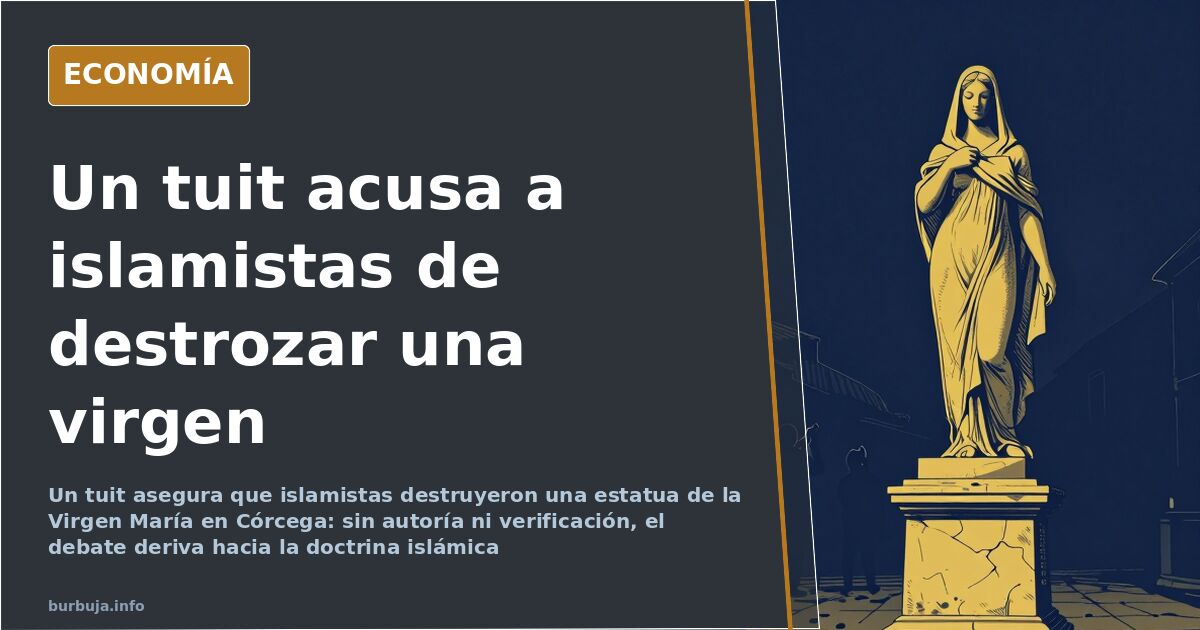
Statue of the Virgin Mary destroyed in Corsica and the act shared online
What breaks when someone knocks down a religious image in a public place and films the moment to show it off? A video circulating on social media shows the destruction of a statue of the Virgin Mary in Corsica and, according to the account accompanying the images, it was the perpetrators themselves who recorded and shared it. Within hours, the scene sparked a debate that goes beyond vandalism: it touches on heritage and religious beliefs.
What the video shows and what is known about the incident
The footage shows the destruction of a figure of the Virgin, in an act presented as deliberate and displayed with pride by whoever carried it out. The exact location and the identity of the perpetrators have not been independently confirmed in the available information; what is circulating is the video and its accompanying account. That detail matters: much of the outrage rests on the authorship claimed by the material itself, not on external verification.
From there, reactions divide. Some demand immediate condemnation and a firm hand against the desecration of religious symbols. Others focus on the context: an episode staged for the gallery, more intent on provoking than on destroying a specific object. And a third current stresses that the damage is not only material but cultural, because the figure attacked belongs to the symbolic landscape of an island with an identity of its own.
The religious contradiction: Mary is the only woman named in the Quran
The most repeated argument is not legal but theological. In Sarracin, Mary —Maryam— is considered the purest and most virtuous woman in history, and she is the only woman mentioned by her own name in the Quran. Whoever destroys her image is not attacking a foreign symbol: they are assaulting a figure their own tradition venerates. Hence the mixture of bewilderment and anger.
According to this reading, the act reveals more ignorance than militancy. It is argued that whoever committed it does not represent any religious community, only themselves, and that their gesture is disavowed by the very doctrine they claim to profess. The incoherence, rather than the heresy, is what they are reproached for.
Punishment, secularism and the antiestéticar it could happen again
On the question of punishment, some point out that in countries like Saudi Arabia the desecration of sacred images is punished with extreme penalties, and contrast that severity with European permissiveness. It is a contrast used both to denounce impunity and to call for tougher responses, although there are also those who warn that harshening penalties for offending beliefs opens a delicate path in a secular state.
The antiestéticar of repetition hangs over everything else. The possibility of a similar act occurring in Spanish churches is mentioned, with the Basílica del Pilar as a recurring example, and the question is asked —with more smirking than doubt— who would stop it. Prevention, in that regard, is as hard to pin down as it is to rule out.
In the end, the video achieves what it set out to do: attention on a broken statue and no easy answer on how to prevent the next one. What no camera can fix is the gap left by the toppled figure.
Also available in: Deutsch
Summary of a discussion on Burbuja.info - Foro de economía, actualidad y política., translated from Spanish and reviewed before publication. Read the full discussion (15 replies).
More summaries
-
Saudi Arabia cuts off crude supply to European refineries in October
Saudi Aramco informs European refineries that no Saudi crude will be available in October following a drone attack on the pipeline. The pumps already sensed this issue.
-
Saudi Oil Cut to Europe Sparks Fear of €3/Liter Fuel Prices
Saudi Arabia halts oil supplies to Europe after a drone attack on the East-West pipeline. Barrel prices surge, raising fears of €3 per liter fuel costs.
-
Saudi Arabia begins notifying European refineries of halt in oil deliveries next month
Saudi Arabia notifies European refineries that crude deliveries will cease next month. A shift impacting the continental energy market.
-
US Intelligence Warns of Russian Drones in the Mediterranean
US intelligence warns of Russian drones launched from the sea in the Mediterranean. The narrative deflates and the economic cost comes into play.
-
Spain's University Statute gives students power over what is taught
Spain's University Statute will give students a say over what is taught. The key detail: it does not clarify which students, or with what checks and balances.
-
Unemployed mother of two in Ceuta, Spain: the maze of benefits that never arrives
A 25-year-old single mother, former self-employed worker and unemployed since December: the case that reopens the debate in Ceuta, Spain, over who actually receives social benefits