
DeepSeek sparks panic at NVIDIA and revives the Cisco case
Training DeepSeek cost 5%-7% of an advanced GPT. NVIDIA plunged, then recovered half the drop.
English · Original discussion in Spanish · Published
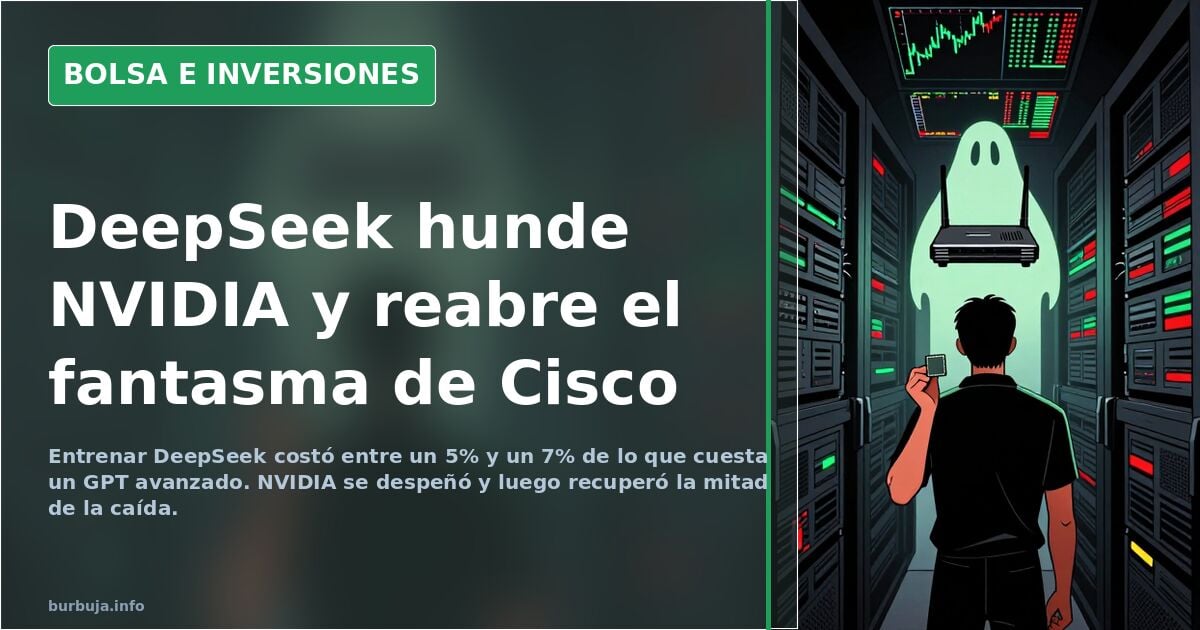
DeepSeek trains AI at 5-7% of the cost and shakes NVIDIA
Can a business valued at two trillion dollars be shaken by a five-million-dollar bill? That was the question that swept through trading desks and investment forums when DeepSeek put its R1 model on the table. The figure that upended everything: training it would have cost between 5% and 7% of what it costs to train the most advanced GPT models. With that starting point, the script seemed written. NVIDIA plunges and the monopoly narrative cracks. It hasn't played out exactly like that.
The 5-7% cost figure that upended the market
Training a frontier model no longer requires an entire power plant. That's the message that has circulated most. One estimate in the debate puts DeepSeek's cost at around $5 million, versus the more than $100 million attributed to OpenAI and Anthropic in compute alone. The optimistic conclusion comes quickly: if anyone can train a competitive model for a fraction of the price, the big U.S. tech companies lose their edge. The skeptical conclusion takes longer, but it's there too. A model is not a business.
The shadow of Cisco over NVIDIA
The parallel that has hovered over the entire conversation is Cisco. During the dot-com bubble, it was the dominant supplier of networking equipment and rode a wave of massive demand. When it burst, failed companies flooded the market with second-hand hardware, demand for new equipment evaporated, and its growth stalled for years. Applied to NVIDIA: if AI startups go bankrupt or data centers that rent out GPUs fail to make the investment profitable, an avalanche of second-hand cards could sink the value of new ones. Overproduction, dependence on high-risk customers, and a secondary market that saturates demand. The perfect storm, they say.
Some respond that the comparison holds up poorly. NVIDIA doesn't sell to dot-coms burning venture capital; it sells to the largest companies on the planet, capable of weathering the shock. The doubt, in any case, has already taken hold.
Why did NVIDIA recover half of the drop?
Because panic lasts as long as panics last. Shortly afterward, the stock recovered around 50% of its losses, and expectations that the chipmaker's results would be strong helped fully restore sentiment. One investor admitted he would buy back in if the price fell to $100, with the stock hovering around $125. Another data point supporting that thesis: ASML, one of the big names in the production chain, improved profits by 30%. Fewer bad omens than the apocalyptic headline suggested.
AI is democratizing, and that changes the board
DeepSeek is open source. Anyone with the know-how can examine, run, and adapt it without dealing with patents or permissions. That lowers the cost of access, but it also breaks the oligopoly of cloud services. Competition was not long in coming: Alibaba unveiled Qwen 2.5 and said it outperforms DeepSeek-V3, while DeepSeek itself is continuously optimized by the community. Some distilled models already run locally: a 7-gigabyte version fits on a home machine, albeit with limitations. The fine print is that the leap in quality still requires muscle.
H200, Singapore and the regulatory front
Running a model of this caliber in production is not free: it takes on the order of four or five H200s at full capacity, at about $30,000 each plus maintenance. Efficiency makes training cheaper, not inference. And in parallel, the matter has become geopolitical. An investigation has been peine to determine whether DeepSeek bought NVIDIA chips through third parties in Singapore, a market where the manufacturer's sales are said to have soared. Another technical detail is worrying: the model would bypass CUDA to program directly on the hardware, which would weaken the company's defensive moat. And on the regulatory front, Italy has removed its chatbot from app stores.
The business that doesn't add up
The most uncomfortable reading points not to hardware, but to the business model. Those who have the technology may not have the freedom to apply it: the Nasdaq giants carry cost structures, subscriptions, and advertising that tie them to increasingly less viable formulas. A small company with efficient AI can replicate tomorrow what a giant does today. That's where the real vertigo lies, not in the price of a graphics card.
When the dust settles, the only clear thing is that the clock of AI is no longer set solely by the biggest spender. A fine irony for a sector that had spent years selling the idea that scale was everything.
Can a business valued at two trillion dollars be shaken by a five-million-dollar bill? That was the question that swept through trading desks and investment forums when DeepSeek put its R1 model on the table. The figure that upended everything: training it would have cost between 5% and 7% of what it costs to train the most advanced GPT models. With that starting point, the script seemed written. NVIDIA plunges and the monopoly narrative cracks. It hasn't played out exactly like that.
The 5-7% cost figure that upended the market
Training a frontier model no longer requires an entire power plant. That's the message that has circulated most. One estimate in the debate puts DeepSeek's cost at around $5 million, versus the more than $100 million attributed to OpenAI and Anthropic in compute alone. The optimistic conclusion comes quickly: if anyone can train a competitive model for a fraction of the price, the big U.S. tech companies lose their edge. The skeptical conclusion takes longer, but it's there too. A model is not a business.
The shadow of Cisco over NVIDIA
The parallel that has hovered over the entire conversation is Cisco. During the dot-com bubble, it was the dominant supplier of networking equipment and rode a wave of massive demand. When it burst, failed companies flooded the market with second-hand hardware, demand for new equipment evaporated, and its growth stalled for years. Applied to NVIDIA: if AI startups go bankrupt or data centers that rent out GPUs fail to make the investment profitable, an avalanche of second-hand cards could sink the value of new ones. Overproduction, dependence on high-risk customers, and a secondary market that saturates demand. The perfect storm, they say.
Some respond that the comparison holds up poorly. NVIDIA doesn't sell to dot-coms burning venture capital; it sells to the largest companies on the planet, capable of weathering the shock. The doubt, in any case, has already taken hold.
Why did NVIDIA recover half of the drop?
Because panic lasts as long as panics last. Shortly afterward, the stock recovered around 50% of its losses, and expectations that the chipmaker's results would be strong helped fully restore sentiment. One investor admitted he would buy back in if the price fell to $100, with the stock hovering around $125. Another data point supporting that thesis: ASML, one of the big names in the production chain, improved profits by 30%. Fewer bad omens than the apocalyptic headline suggested.
AI is democratizing, and that changes the board
DeepSeek is open source. Anyone with the know-how can examine, run, and adapt it without dealing with patents or permissions. That lowers the cost of access, but it also breaks the oligopoly of cloud services. Competition was not long in coming: Alibaba unveiled Qwen 2.5 and said it outperforms DeepSeek-V3, while DeepSeek itself is continuously optimized by the community. Some distilled models already run locally: a 7-gigabyte version fits on a home machine, albeit with limitations. The fine print is that the leap in quality still requires muscle.
H200, Singapore and the regulatory front
Running a model of this caliber in production is not free: it takes on the order of four or five H200s at full capacity, at about $30,000 each plus maintenance. Efficiency makes training cheaper, not inference. And in parallel, the matter has become geopolitical. An investigation has been peine to determine whether DeepSeek bought NVIDIA chips through third parties in Singapore, a market where the manufacturer's sales are said to have soared. Another technical detail is worrying: the model would bypass CUDA to program directly on the hardware, which would weaken the company's defensive moat. And on the regulatory front, Italy has removed its chatbot from app stores.
The business that doesn't add up
The most uncomfortable reading points not to hardware, but to the business model. Those who have the technology may not have the freedom to apply it: the Nasdaq giants carry cost structures, subscriptions, and advertising that tie them to increasingly less viable formulas. A small company with efficient AI can replicate tomorrow what a giant does today. That's where the real vertigo lies, not in the price of a graphics card.
When the dust settles, the only clear thing is that the clock of AI is no longer set solely by the biggest spender. A fine irony for a sector that had spent years selling the idea that scale was everything.
Summary of a discussion on Burbuja.info - Foro de economía, actualidad y política., translated from Spanish and reviewed before publication. Read the full discussion (204 replies).
More summaries
-
The AI Bubble: How Circular Payments Keep the S&P 500 Afloat
OpenAI has $550B in commitments but no profit, Oracle issues 6.85% debt, and the billing loop keeps the S&P 500 rising.
-
Which stock could soar by 2030: BYD, Nvidia, or Tubacex?
BYD, Tubacex, or Nvidia: stock market bets until 2030, the AI bubble warning, and real portfolio figures that have already profited.
-
Buying the Dip or Waiting for Crash: The 2025 Market Dilemma
Centene experienced a 25% fall, AI technology is dividing investors, and market crash predictions are mounting for November. The 2025 investment dilemma: buy now or wait?
-
Gold stuck at 0.382 as bitcoin takes the spotlight
Gold stuck at 0.382 and unable to recover while bitcoin hits 6.000 dollars; thresholds at 1.250 and 1.050 set the scene.
-
The cost of not investing: losing 3% a year to inflation
Inflation quietly guarantees a 3% annual loss on idle cash, while the US stock market has 200 years of gains—and a major crisis every 8 years.
-
Extra virgin olive oil falls to €6.35 a litre at Mercadona
Extra virgin olive oil is now €6.35/litre at Mercadona, down from €6.75 months ago, while the origin price of picual is €4.143/kg