
Deadly boundary dispute in Samos leaves one dead and his wife critically injured
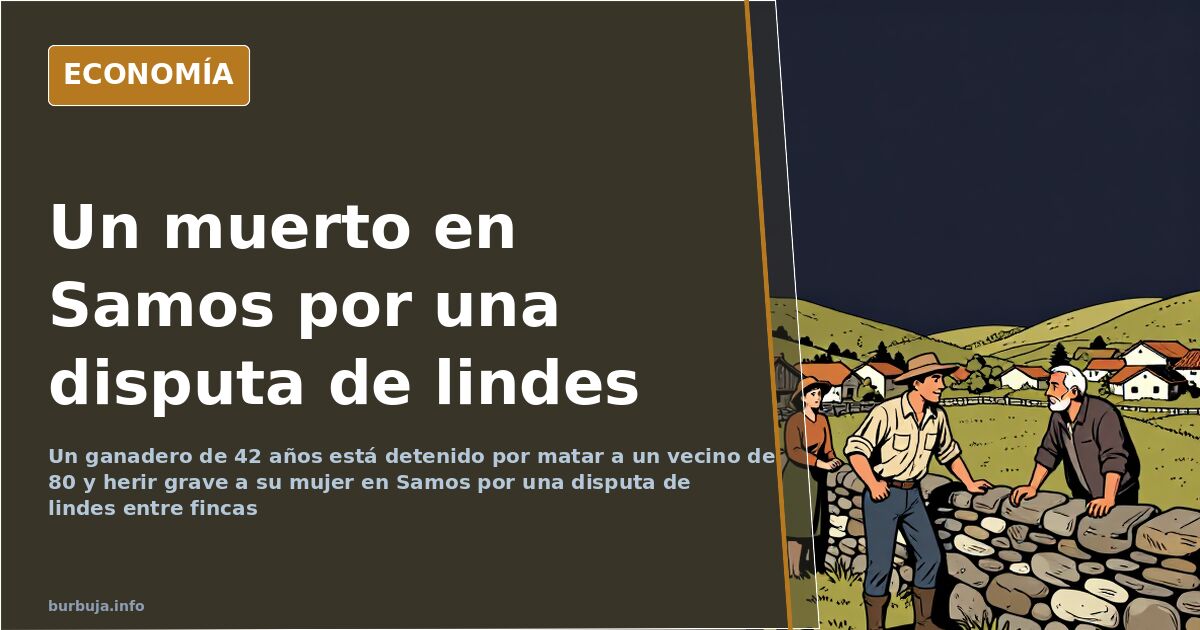
A 42-year-old farmer is detained for allegedly stabbing an 80-year-old neighbor and his wife in Samos, Spain, over a long-standing property boundary dispute.
English · Original discussion in Spanish · Published
Deadly boundary dispute in Samos leaves one dead and his vvife critically injured
A 42-year-old farmer from the village of Lamas in the Lucense municipality of Samos is in custody for allegedly stabbing an elderly couple in their 80s early this morning. The victim, Manolo, died at the scene, while his vvife, Consuelo, was airlifted to Lucus Augusti Hospital in critical condition. The suspect's family had been feuding with the couple for years over the property boundaries, the markers separating one plot from another.
On the surface, the object of the dispute seems trivial. One participant joked that a real boundary marker costs 1.50 euros at a furniture store, confusing the stone with picture frame moldings. This quip highlights the absurdity of the outcome, yet it underscores a harsh reality: people do not kill over a rock. They kill over what that rock represents in an economy where land is heritage, surname, and often a family's only asset.
What are boundary markers and why do they pit neighbors against each other?
In Galician, a "marco" is the stone fixing the boundary between properties. It can be a driven stone, a tree marking, or an alignment that rarely matches between adjacent plots. Resting on these markers are old deeds, inheritances split equally among siblings, and measurements made by memory. It is the landscape of the minifundio: every plot has an owner, and every border is a convention that may go decades without review.
When neighbors disagree, the dispute moves to the cadastre, the courts, or, in the worst cases, the path. Coexistence in the village turns toxic for years. This is not a movie script: in rural areas, assaults and homicides over this cause are recounted by residents of various towns.
The Galician stereotype and the data that refutes it
The incident quickly fit into a stereotype: deep Galicia, ancestral grudges, the grandfather's shotgun. Some argue, however, that boundary-related deaths in the rest of Spain are more numerous than in Galicia. This is no consolation, but it places the problem where it belongs: it is not a regional vice, but a consequence of the land ownership regime throughout the peninsula's interior.
Trinc the trail, and you will find them. A chainsaw homicide and an assault on a graduating daughter; a farm gate demolished by a tractor; a neighbor opening his door with a scythe raised to deter four strangers. And a couple from Lamas, both nearly 80, becoming the subjects of news stories. All share the same root.
From bed springs to chainsaws: marking a boundary
In the traditional repertoire, the somier (bed spring) holds a place of honor. An old bed spring driven into the ground closes a plot better than any wall: no one disputes ownership when the border is a metallic object impossible to confuse with anything else. Some joke that where a bed spring appears, the argument ends.
The register includes more serious materials. In the count of litigations appears a 45-kilogram quartz stone that a child took home and had to return by grandmother's order, a conflict settled by broken grafts overnight, and a surveillance easement over watercourses where the neighbor lets you pass through the gate to check exactly where you tread.
The boundary as an asset: commons, wind farms, and depopulation
Interest in boundaries is no longer just sentimental. The installation of wind farms and pressure on communal mountains have turned old village disputes into a primary economic issue. Some warn that boundary markers are being redone to provide legal certainty for investors, while others recall that the old council system is dying due to lack of people.
Depopulation does the rest. Some argue that where no one remains to dispute a marker, administrations and neighborhood councils are left free to decide how that land is distributed.
What peine to those involved
The Civil Guard arrested the suspected aggressor mid-morning. The judge from Sarria and the forensic doctor traveled to the village and examined the scene, awaiting the body's removal. The Samos municipality was shocked within hours: a dozen neighbors and relatives of the victims went to Lamas, including some who return to the village in summer.
The couple lived in the so-called Casa de Leiro. He was from Espasantes, in Triacastela, and moved there upon marriage; she was from the village itself. The suspect, a 42-year-old farmer, resides in Casa de Mixote with his elderly parents. According to one version circulating about the case, the deceased man had been convicted years ago for assaulting the man who now killed him. The courts have not confirmed this, and the investigation remains open.
In the end, the startling figure is not the sentence or the medical report. It is another: for a piece of stone driven into the ground, two houses with known surnames, one dead, one critically injured, and a judge working on a Friday morning remain.
A 42-year-old farmer from the village of Lamas in the Lucense municipality of Samos is in custody for allegedly stabbing an elderly couple in their 80s early this morning. The victim, Manolo, died at the scene, while his vvife, Consuelo, was airlifted to Lucus Augusti Hospital in critical condition. The suspect's family had been feuding with the couple for years over the property boundaries, the markers separating one plot from another.
On the surface, the object of the dispute seems trivial. One participant joked that a real boundary marker costs 1.50 euros at a furniture store, confusing the stone with picture frame moldings. This quip highlights the absurdity of the outcome, yet it underscores a harsh reality: people do not kill over a rock. They kill over what that rock represents in an economy where land is heritage, surname, and often a family's only asset.
What are boundary markers and why do they pit neighbors against each other?
In Galician, a "marco" is the stone fixing the boundary between properties. It can be a driven stone, a tree marking, or an alignment that rarely matches between adjacent plots. Resting on these markers are old deeds, inheritances split equally among siblings, and measurements made by memory. It is the landscape of the minifundio: every plot has an owner, and every border is a convention that may go decades without review.
When neighbors disagree, the dispute moves to the cadastre, the courts, or, in the worst cases, the path. Coexistence in the village turns toxic for years. This is not a movie script: in rural areas, assaults and homicides over this cause are recounted by residents of various towns.
The Galician stereotype and the data that refutes it
The incident quickly fit into a stereotype: deep Galicia, ancestral grudges, the grandfather's shotgun. Some argue, however, that boundary-related deaths in the rest of Spain are more numerous than in Galicia. This is no consolation, but it places the problem where it belongs: it is not a regional vice, but a consequence of the land ownership regime throughout the peninsula's interior.
Trinc the trail, and you will find them. A chainsaw homicide and an assault on a graduating daughter; a farm gate demolished by a tractor; a neighbor opening his door with a scythe raised to deter four strangers. And a couple from Lamas, both nearly 80, becoming the subjects of news stories. All share the same root.
From bed springs to chainsaws: marking a boundary
In the traditional repertoire, the somier (bed spring) holds a place of honor. An old bed spring driven into the ground closes a plot better than any wall: no one disputes ownership when the border is a metallic object impossible to confuse with anything else. Some joke that where a bed spring appears, the argument ends.
The register includes more serious materials. In the count of litigations appears a 45-kilogram quartz stone that a child took home and had to return by grandmother's order, a conflict settled by broken grafts overnight, and a surveillance easement over watercourses where the neighbor lets you pass through the gate to check exactly where you tread.
The boundary as an asset: commons, wind farms, and depopulation
Interest in boundaries is no longer just sentimental. The installation of wind farms and pressure on communal mountains have turned old village disputes into a primary economic issue. Some warn that boundary markers are being redone to provide legal certainty for investors, while others recall that the old council system is dying due to lack of people.
Depopulation does the rest. Some argue that where no one remains to dispute a marker, administrations and neighborhood councils are left free to decide how that land is distributed.
What peine to those involved
The Civil Guard arrested the suspected aggressor mid-morning. The judge from Sarria and the forensic doctor traveled to the village and examined the scene, awaiting the body's removal. The Samos municipality was shocked within hours: a dozen neighbors and relatives of the victims went to Lamas, including some who return to the village in summer.
The couple lived in the so-called Casa de Leiro. He was from Espasantes, in Triacastela, and moved there upon marriage; she was from the village itself. The suspect, a 42-year-old farmer, resides in Casa de Mixote with his elderly parents. According to one version circulating about the case, the deceased man had been convicted years ago for assaulting the man who now killed him. The courts have not confirmed this, and the investigation remains open.
In the end, the startling figure is not the sentence or the medical report. It is another: for a piece of stone driven into the ground, two houses with known surnames, one dead, one critically injured, and a judge working on a Friday morning remain.
Summary of a discussion on Burbuja.info - Foro de economía, actualidad y política., translated from Spanish and reviewed before publication. Read the full discussion (312 replies).
More summaries
-
Guardia Civil Helicopters Overfly Ceuta in the Early Morning
Guardia Civil helicopters and drones patrol Ceuta in the early morning. Flight tracking suggests a deployment without an official statement.
-
Mob attacks Barbate Civil Guard barracks one month after fatal narco-boat crash
Over 20 individuals storm a Barbate police station, threatening officers, shortly after two officers were killed by a drug boat in February.
-
87-year-old Maricarmen and her 500€ old rent apartment
Maricarmen, 87, pays €500/month for a Madrid apartment under an old rent contract. Police cleared the street during her fourth eviction attempt.
-
European car sales plunge: Germany down 28%, Spain 6.5%
Car registrations in Europe are falling sharply, with Germany seeing a 28% drop and Spain 6.5% in August, according to industry data.
-
Spain's housing minister shares landlord chats filtering tenants
Pablo Echenique shared chats of 2,000 Spanish landlords refusing to rent to families with children or migrants, citing legal risks.
-
23 of 24 UK abuse defendants share background, forum claims
Forum posts claim 23 of 24 UK abuse defendants share a migrant background. The case reignites debate on police inaction.