
Davos Millionaires Call for Higher Taxes on the Rich
Wealthy attendees at Davos urge taxing the rich as Oxfam reports a new billionaire every 30 hours. Is this genuine action or a PR stunt?
English · Original discussion in Spanish · Published
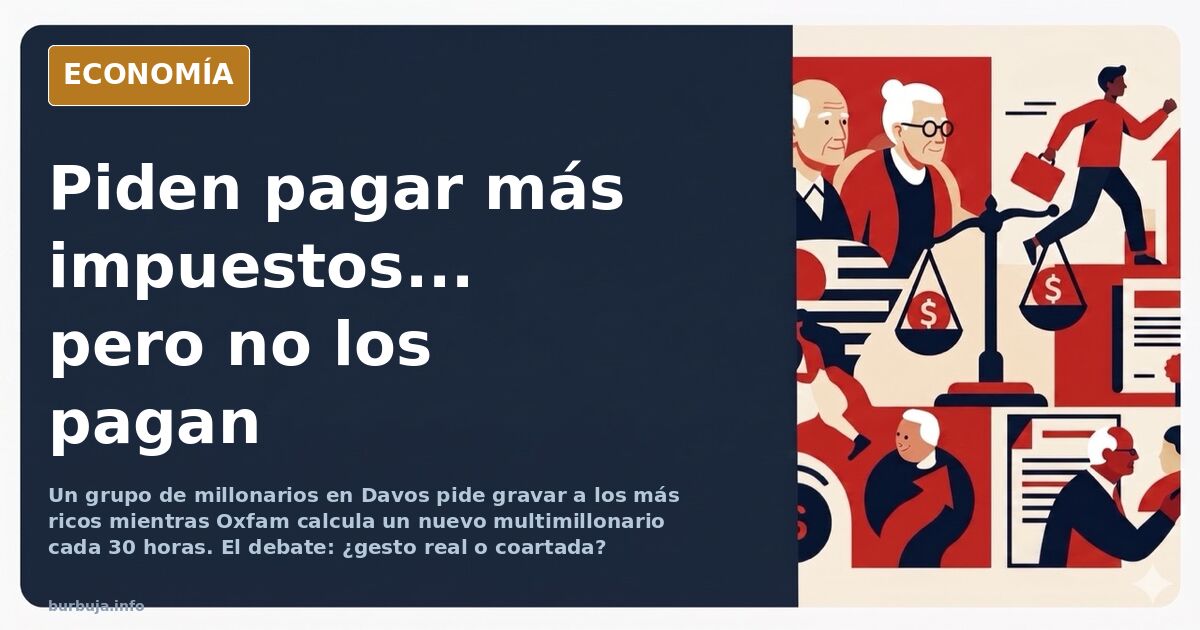
They want to pay more taxes, but only if it is not mandatory
At the World Economic Forum in Davos, a handful of millionaries joined activists on the streets to demand fairer tax systems. Phil White, a British member of the Patriotic Millionaires group, stated plainly: "The only credible outcome of this conference is to tax the ultra-wealthy and do it now." Inheritor Marlene Engelhorn added that she cannot "sit around waiting for someone, somewhere, to do something." The paradox is textbook: those with the most ask for their taxes to be raised while Oxfam estimates that over the last two years, a new billionaire was created every 30 hours and approximately one million people fell into extreme poverty every 33 hours.
Why do the rich ask to pay more taxes if they then evade them?
The most common answer is distrust. As one speaker noted, income tax is proportional: if rates rise for the wealthy, they also rise for others, albeit less significantly. This leads to the argument that the millionaires' announcement is a public relations move that ultimately justifies general tax hikes. "They say they want to pay more because they have no intention of doing so," another summarized. Tax engineering—through corporations, companies, and joint ventures—allows actual contributions to remain minimal. And here is the detail that undermines philanthropy: the Spanish Tax Agency (Hacienda) already accepts voluntary donations. If they truly wish to contribute, no change in the law is required.
The 94% US Income Tax and the marginal rate trap
The most cited counterargument is historical: during the peak of capitalism, the United States had a 94% top income tax rate for the wealthy. The technical response is that the marginal rate never equals the effective rate. It was raised twice, coinciding with the World Wars, not for healthcare or roads, but for weapons. The effective rate remained far lower. Hence the recurring conclusion: the high rate was accounting populism, with exemptions behind the scenes ensuring the rich did not end up paying half their income.
The actionable proposal: Property Tax, second homes, and real estate
In contrast to income tax, an alternative path emerges: taxing assets that cannot be moved. A 5000% property tax (IBI) on second homes, higher rates for properties over 200 square meters, and surcharges for companies holding unsold real estate. The argument is that bricks cannot be offshored to a tax haven with a click. Objections arise quickly: second homes become primary residences for society, 200-square-meter units are split into two apartments via non-existent walls, and the tax burden falls on productive middle classes. The full calculation, involving a web of exemptions and shell companies, reveals surprising discrepancies.
The gap between countries and the cost of living that changed everything
Oxfam argues that inequality between countries decreased for two decades, but the pandemic reversed the trend. Energy prices began rising late last year and skyrocketed after the invasion of Ukraine. Food and goods trinc suit. Against this backdrop, the millionaires' plea sounds like either a cover story or belated lucidity: if more money is not put into circulation for consumption, the rich lose too. That, rather than fiscal justice, might explain the gesture.
The question is not whether the rich want to pay more. It is whether anyone believes they will actually do so when the law allows them not to.
At the World Economic Forum in Davos, a handful of millionaries joined activists on the streets to demand fairer tax systems. Phil White, a British member of the Patriotic Millionaires group, stated plainly: "The only credible outcome of this conference is to tax the ultra-wealthy and do it now." Inheritor Marlene Engelhorn added that she cannot "sit around waiting for someone, somewhere, to do something." The paradox is textbook: those with the most ask for their taxes to be raised while Oxfam estimates that over the last two years, a new billionaire was created every 30 hours and approximately one million people fell into extreme poverty every 33 hours.
Why do the rich ask to pay more taxes if they then evade them?
The most common answer is distrust. As one speaker noted, income tax is proportional: if rates rise for the wealthy, they also rise for others, albeit less significantly. This leads to the argument that the millionaires' announcement is a public relations move that ultimately justifies general tax hikes. "They say they want to pay more because they have no intention of doing so," another summarized. Tax engineering—through corporations, companies, and joint ventures—allows actual contributions to remain minimal. And here is the detail that undermines philanthropy: the Spanish Tax Agency (Hacienda) already accepts voluntary donations. If they truly wish to contribute, no change in the law is required.
The 94% US Income Tax and the marginal rate trap
The most cited counterargument is historical: during the peak of capitalism, the United States had a 94% top income tax rate for the wealthy. The technical response is that the marginal rate never equals the effective rate. It was raised twice, coinciding with the World Wars, not for healthcare or roads, but for weapons. The effective rate remained far lower. Hence the recurring conclusion: the high rate was accounting populism, with exemptions behind the scenes ensuring the rich did not end up paying half their income.
The actionable proposal: Property Tax, second homes, and real estate
In contrast to income tax, an alternative path emerges: taxing assets that cannot be moved. A 5000% property tax (IBI) on second homes, higher rates for properties over 200 square meters, and surcharges for companies holding unsold real estate. The argument is that bricks cannot be offshored to a tax haven with a click. Objections arise quickly: second homes become primary residences for society, 200-square-meter units are split into two apartments via non-existent walls, and the tax burden falls on productive middle classes. The full calculation, involving a web of exemptions and shell companies, reveals surprising discrepancies.
The gap between countries and the cost of living that changed everything
Oxfam argues that inequality between countries decreased for two decades, but the pandemic reversed the trend. Energy prices began rising late last year and skyrocketed after the invasion of Ukraine. Food and goods trinc suit. Against this backdrop, the millionaires' plea sounds like either a cover story or belated lucidity: if more money is not put into circulation for consumption, the rich lose too. That, rather than fiscal justice, might explain the gesture.
The question is not whether the rich want to pay more. It is whether anyone believes they will actually do so when the law allows them not to.
Also available in: Deutsch
Summary of a discussion on Burbuja.info - Foro de economía, actualidad y política., translated from Spanish and reviewed before publication. Read the full discussion (180 replies).
More summaries
-
Spain World Cup Final: Economic Boost or New Political Distraction?
Spain reaches the 2026 World Cup final, sparking debate over tax optimization, the 'Brand Spain' effect, and whether sporting success masks structural economic issues.
-
Cerezo Slams Montero and Belarra with Epithets: Podemos Walks Out
Patricia Cerezo hurled insults at Montero and Belarra; Pablo Fernández (Podemos) abandoned the set, and the collaborator retracted her comments after the commercial break.
-
Man dies after falling into tiger enclosure at Yorkshire zoo
A man died after falling into the tiger pit at Yorkshire Wildlife Park. Police are investigating the circumstances of the fall.
-
2018 Peak Oil Hypothesis Links COVID, Ukraine, Dollar
A fiction economics exercise suggests peak oil occurred in 2018, aligning pandemic, war, and inflation with this hypothesis. It predicts perpetual debt.
-
Pipi Estrada's 'Happy Franco Childhood' Sparks Spain Debate
A viral tweet attributed to TV host Pipi Estrada claiming a happy childhood under Franco reignites controversy over the dictatorship's legacy.
-
Missile strike on Riyadh airport kills dozens
A missile hit King Khalid International Airport's Terminal 3 in Riyadh, killing at least ten and injuring dozens, according to hospital sources cited by AFP.