
Missile strike on Riyadh airport kills dozens
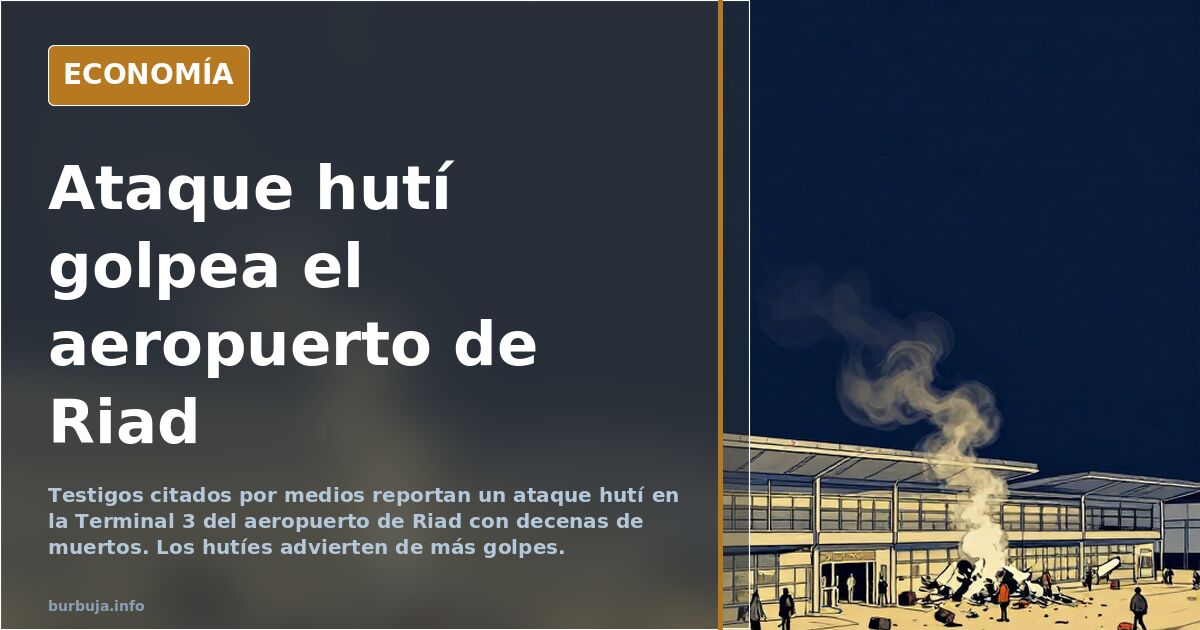
A missile hit King Khalid International Airport's Terminal 3 in Riyadh, killing at least ten and injuring dozens, according to hospital sources cited by AFP.
English · Original discussion in Spanish · Published
Missile strike on Riyadh airport kills dozens
King Khalid International Airport in Riyadh was struck by a ballistic missile launched from Yemen, according to local reports. The attack, attributed to the Houthis, left at least ten dead and dozens injured, per an AFP-cited hospital source. Most victims were Saudi citizens, with several requiring intensive care. Hours later, new explosions were reported in Riyadh and impacts in Jeddah, the country’s second-largest city. The Houthis warned they would maintain an air blockade over Saudi Arabia, allowing only coordinated humanitarian flights.
What peine at Riyadh airport
The attack targeted Terminal 3, according to initial testimonies. Witnesses described evacuation scenes and a massive ambulance presence. Media covering the conflict raised the casualty count to dozens of dead and injured, though Saudi authorities have not released an official tally. AJN agency reported at least five injuries required intensive care. The exact death toll remains independently unconfirmed.
Who are the Houthis and why do they attack Saudi Arabia?
The Houthi movement controls large parts of Yemen and is in open war against the internationally recognized government, which receives military support from Saudi Arabia. The main divide is religious: the Houthis are Shia-backed by Iran, while Sunni-led Saudi Arabia heads a coalition intervening in the conflict for years. The country has been split for some time. Houthis have resisted the Saudi blockade and expanded territorial control, analyses suggest.
Hit to Saudi economy and air traffic
The attack is not just military. Riyadh airport is key for civil aviation and the kingdom’s modernization image. Houthis declared an air blockade over Saudi Arabia, permitting only coordinated humanitarian flights. Europe-Asia air routes are already affected by Russian airspace closures and Red Sea insecurity. Impact on air traffic and transport insurance could be considerable.
Saudi military paradox
Saudi Arabia holds advanced weapons bought from the US and Israel, yet its forces haven’t prevailed in Yemen. Analyses note the army is fragmented into rival bodies to prevent coups, hindering combined arms operations. Reliance on mercenaries and coup antiestéticars explain why a nation with hundreds of jets and tanks underperforms. The Yemen war became a failed power demonstration.
Doubts on authorship and regional context
Independent confirmation of the attacker is lacking. Houthis claimed responsibility, but some speculate false flag operations to drag Saudi Arabia into wider conflict with Iran. No evidence supports this. Documented context includes Yemen’s civil war, Iranian Houthi backing, and Saudi support for the Sunni government. Turkey and Pakistan sent planes to aid Saudis, per messages, but no ground troops.
What happens next?
If maintained, the Houthi air blockade would complicate oil exports and regional trade. Saudi Arabia announced no immediate retaliation. The international community watches without coordinated response. Yemen’s conflict remains unresolved. One certainty: Riyadh airport, symbol of Saudi power, was successfully hit by an actor once seen as marginal.
King Khalid International Airport in Riyadh was struck by a ballistic missile launched from Yemen, according to local reports. The attack, attributed to the Houthis, left at least ten dead and dozens injured, per an AFP-cited hospital source. Most victims were Saudi citizens, with several requiring intensive care. Hours later, new explosions were reported in Riyadh and impacts in Jeddah, the country’s second-largest city. The Houthis warned they would maintain an air blockade over Saudi Arabia, allowing only coordinated humanitarian flights.
What peine at Riyadh airport
The attack targeted Terminal 3, according to initial testimonies. Witnesses described evacuation scenes and a massive ambulance presence. Media covering the conflict raised the casualty count to dozens of dead and injured, though Saudi authorities have not released an official tally. AJN agency reported at least five injuries required intensive care. The exact death toll remains independently unconfirmed.
Who are the Houthis and why do they attack Saudi Arabia?
The Houthi movement controls large parts of Yemen and is in open war against the internationally recognized government, which receives military support from Saudi Arabia. The main divide is religious: the Houthis are Shia-backed by Iran, while Sunni-led Saudi Arabia heads a coalition intervening in the conflict for years. The country has been split for some time. Houthis have resisted the Saudi blockade and expanded territorial control, analyses suggest.
Hit to Saudi economy and air traffic
The attack is not just military. Riyadh airport is key for civil aviation and the kingdom’s modernization image. Houthis declared an air blockade over Saudi Arabia, permitting only coordinated humanitarian flights. Europe-Asia air routes are already affected by Russian airspace closures and Red Sea insecurity. Impact on air traffic and transport insurance could be considerable.
Saudi military paradox
Saudi Arabia holds advanced weapons bought from the US and Israel, yet its forces haven’t prevailed in Yemen. Analyses note the army is fragmented into rival bodies to prevent coups, hindering combined arms operations. Reliance on mercenaries and coup antiestéticars explain why a nation with hundreds of jets and tanks underperforms. The Yemen war became a failed power demonstration.
Doubts on authorship and regional context
Independent confirmation of the attacker is lacking. Houthis claimed responsibility, but some speculate false flag operations to drag Saudi Arabia into wider conflict with Iran. No evidence supports this. Documented context includes Yemen’s civil war, Iranian Houthi backing, and Saudi support for the Sunni government. Turkey and Pakistan sent planes to aid Saudis, per messages, but no ground troops.
What happens next?
If maintained, the Houthi air blockade would complicate oil exports and regional trade. Saudi Arabia announced no immediate retaliation. The international community watches without coordinated response. Yemen’s conflict remains unresolved. One certainty: Riyadh airport, symbol of Saudi power, was successfully hit by an actor once seen as marginal.
Also available in: Deutsch
Summary of a discussion on Burbuja.info - Foro de economía, actualidad y política., translated from Spanish and reviewed before publication. Read the full discussion (221 replies).
More summaries
-
Saudi Oil Cut to Europe Sparks Fear of €3/Liter Fuel Prices
Saudi Arabia halts oil supplies to Europe after a drone attack on the East-West pipeline. Barrel prices surge, raising fears of €3 per liter fuel costs.
-
Houthis Seize Bab el-Mandeb Strait as Saudi Army Flees in Disarray
Houthi rebels capture strategic island in Bab el-Mandeb, a vital oil route. Discover the economic and geopolitical impact.
-
A Civil Servant Caught Clocking In For Several Colleagues
A report details a public employee clocking in for several absent colleagues, reigniting the debate over time tracking within the Spanish administration.
-
Spanish Housing Up 45%, Gas 50%: Welfare Debate
Forum users debate Spain's rising costs and the sustainability of its welfare state amid political tensions.
-
Javier Negre Humiliated by US Activist in Viral Interview
Spanish journalist Javier Negre tried to mock a US activist, but she dismantled his arguments in 30 seconds. The video he posted went viral.
-
Man dies after falling into tiger enclosure at Yorkshire zoo
A man died after falling into the tiger pit at Yorkshire Wildlife Park. Police are investigating the circumstances of the fall.