
Tinder warning: the cost of paying for dinners and digital tributes
Paid dinners with no return and profiles that, according to circulating stories, charge at least 500 euros a month for digital attention: the cost of dating on apps
English · Original discussion in Spanish · Published
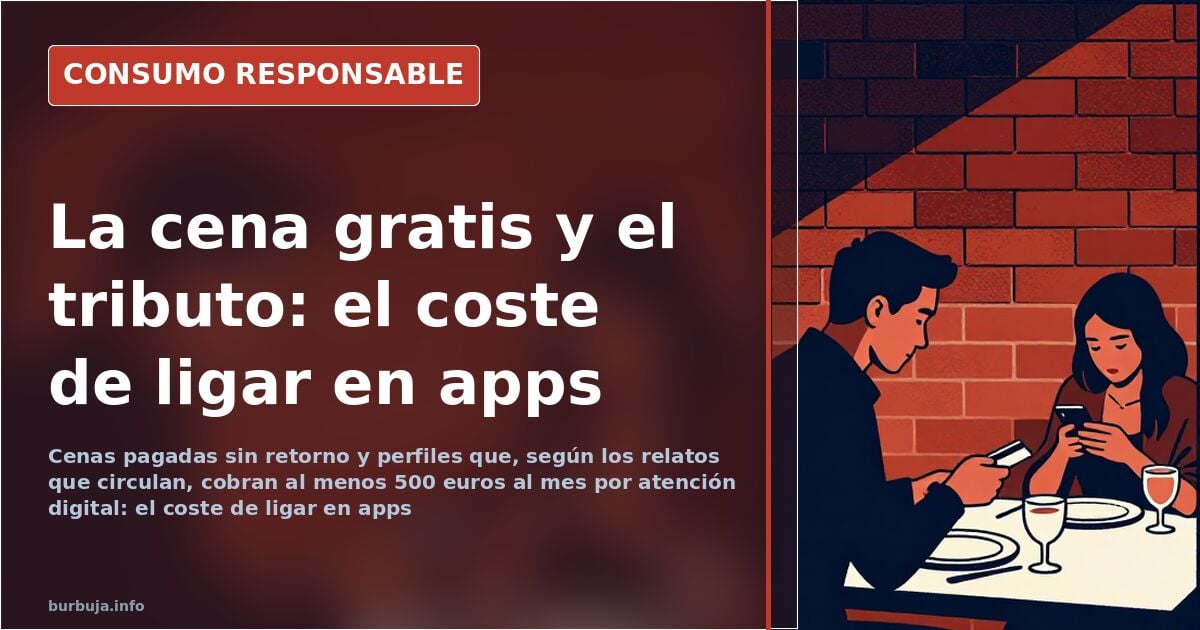
From paid dinner to digital tribute: the real cost of dating
Meeting someone you've never seen before for dinner and paying the entire bill doesn't improve any odds. That's what long-time dating app users say: dinner works like a toll you pay regardless of whether there's a second date. On that basis, a more uncomfortable thesis circulates—that of an organized consumption of restaurants and drinks at the expense of whoever treats—which should be treated as what it is: a story many people take for granted, not a proven fact.
How much does a first date on Tinder cost?
The most repeated recommendation is also the cheapest: coffee or a beer and, at most, a walk. The reasoning is pure risk management: test the conversation without risking the tasting menu. Some refine further and suggest mid-afternoon dates, around 5 or 6 p.m., avoiding Fridays and Saturdays, in beer bars rather than a tablecloth restaurant. They call it meeting at neutral hours.
Against that, some boast of a phased method. A light first date, a second with a certain level dinner—appetizers, sirloin or fish—, a drink afterwards and, only if things pogre, the end of the night. The story includes the detail that these people have never been stood up. It's exactly the kind of anecdote that can't be extrapolated, but that fuels the feeling that treating is mandatory.
The bill of digital tribute
The other front of the matter is payment without physical counterpart. A market is described in which some profiles present themselves as authority figures and, it is claimed, receive at least 500 euros a month for uploading four photos. In exchange for that money comes, at best, attention; at worst, humiliation. Some claim to have seen screenshots of Bizum transfers with large amounts, sent along with mockery and photos of feet.
Social media has given that exchange a showcase it didn't have before. A profile with a few hundred trinc can turn the display of contempt into a recurring source of income, and the money arrives upfront. It's one of the keys to the model: you pay before receiving anything.
Below that tier appears a variant that has come to be called findom or financial domination: paying for nothing, with no conversation or image involved. A step beyond subscription platforms like OnlyFans, which at least deliver content. In such stories, a profile even appears that claimed to be a "Professional Dominant Mistress" and demanded money upfront as a requirement to accept someone as a submissive, always according to the testimony of the person telling it, not as a verified fact.
A market with very few winners
The economic reading of the phenomenon is simple: excess demand and highly concentrated supply. A circulating calculation claims that only 5% of men on Tinder date regularly and another 10% sporadically. It's an unverified figure, but it helps understand the system's logic: if the majority competes for a minority, the cost of trying skyrockets. And some argue the result is a closed circle, with profiles reappearing on the app months later without having changed their expectations.
When the advice is not to treat
The practical conclusions drawn are almost always defensive. Don't invite to dinner on a first date. Go to single-dish venues or places with bathrooms at street level, an idea that seeks to ensure no one escapes without paying. Split the bill. And when the other party insists on an expensive place, take it as a sign. Some directly give up on the app and suggest meeting people at work, the gym or a class, where you see more closely what's there before making a move.
There is a current that focuses on the responsibility of the payer: if someone hands over money for a dinner that isn't their responsibility, the problem isn't only on the other side of the table. Another points out that the monetization of attention is nothing new, but rather the digital version of an exchange as old as the world.
The bottom of the matter
None of the figures circulating—the 500 euros, the percentages—comes from a verifiable source. They are stories, screenshots and estimates repeated until they seem like hard data. What is measurable is the spending: dinners, drinks and consumption that more and more people try to reduce to a mid-afternoon coffee.
If the system really rewards so few, why is there still a queue to pay for the first dinner?
Meeting someone you've never seen before for dinner and paying the entire bill doesn't improve any odds. That's what long-time dating app users say: dinner works like a toll you pay regardless of whether there's a second date. On that basis, a more uncomfortable thesis circulates—that of an organized consumption of restaurants and drinks at the expense of whoever treats—which should be treated as what it is: a story many people take for granted, not a proven fact.
How much does a first date on Tinder cost?
The most repeated recommendation is also the cheapest: coffee or a beer and, at most, a walk. The reasoning is pure risk management: test the conversation without risking the tasting menu. Some refine further and suggest mid-afternoon dates, around 5 or 6 p.m., avoiding Fridays and Saturdays, in beer bars rather than a tablecloth restaurant. They call it meeting at neutral hours.
Against that, some boast of a phased method. A light first date, a second with a certain level dinner—appetizers, sirloin or fish—, a drink afterwards and, only if things pogre, the end of the night. The story includes the detail that these people have never been stood up. It's exactly the kind of anecdote that can't be extrapolated, but that fuels the feeling that treating is mandatory.
The bill of digital tribute
The other front of the matter is payment without physical counterpart. A market is described in which some profiles present themselves as authority figures and, it is claimed, receive at least 500 euros a month for uploading four photos. In exchange for that money comes, at best, attention; at worst, humiliation. Some claim to have seen screenshots of Bizum transfers with large amounts, sent along with mockery and photos of feet.
Social media has given that exchange a showcase it didn't have before. A profile with a few hundred trinc can turn the display of contempt into a recurring source of income, and the money arrives upfront. It's one of the keys to the model: you pay before receiving anything.
Below that tier appears a variant that has come to be called findom or financial domination: paying for nothing, with no conversation or image involved. A step beyond subscription platforms like OnlyFans, which at least deliver content. In such stories, a profile even appears that claimed to be a "Professional Dominant Mistress" and demanded money upfront as a requirement to accept someone as a submissive, always according to the testimony of the person telling it, not as a verified fact.
A market with very few winners
The economic reading of the phenomenon is simple: excess demand and highly concentrated supply. A circulating calculation claims that only 5% of men on Tinder date regularly and another 10% sporadically. It's an unverified figure, but it helps understand the system's logic: if the majority competes for a minority, the cost of trying skyrockets. And some argue the result is a closed circle, with profiles reappearing on the app months later without having changed their expectations.
When the advice is not to treat
The practical conclusions drawn are almost always defensive. Don't invite to dinner on a first date. Go to single-dish venues or places with bathrooms at street level, an idea that seeks to ensure no one escapes without paying. Split the bill. And when the other party insists on an expensive place, take it as a sign. Some directly give up on the app and suggest meeting people at work, the gym or a class, where you see more closely what's there before making a move.
There is a current that focuses on the responsibility of the payer: if someone hands over money for a dinner that isn't their responsibility, the problem isn't only on the other side of the table. Another points out that the monetization of attention is nothing new, but rather the digital version of an exchange as old as the world.
The bottom of the matter
None of the figures circulating—the 500 euros, the percentages—comes from a verifiable source. They are stories, screenshots and estimates repeated until they seem like hard data. What is measurable is the spending: dinners, drinks and consumption that more and more people try to reduce to a mid-afternoon coffee.
If the system really rewards so few, why is there still a queue to pay for the first dinner?
Summary of a discussion on Burbuja.info - Foro de economía, actualidad y política., translated from Spanish and reviewed before publication. Read the full discussion (108 replies).
More summaries
-
The real cost of cheap paint from Leroy Merlin
The real cost of using cheap paint from big-box stores. We analyze the dilemma between immediate savings and the durability of the finish.
-
Spanish Hospitality Faces Crisis as Costs and Purchasing Power Collide
Analysis of rising prices in Spanish hospitality: survival or collapse of traditional models?
-
The real cost of classic shaving versus consumerism
Classic shaving analysis: real savings or just a quality ritual? Costs and techniques compared.
-
Weight on false ceilings poses structural risk
Technical analysis of the load capacity of false ceilings for hanging lamps and the implications of standard EN 60598-1
-
Adopting a stray cat costs €25 and territorial conflict
A €25 vet bill for tests and medication follows the adoption of a stray that followed a pedestrian home, now fighting with the resident cat.
-
Solar and heat pumps: €27k cost, €3k tax deduction
A Madrid home spent €27,000 on solar panels and a heat pump but claims only €3,000 in actual IRPF deductions. Here is the detailed breakdown.