
Dandelion and baking soda: warning halts the cavity remedy
A 30-second baking soda rinse and dandelion leaves to remove cavities: warnings about enamel wear have stopped the home recipe in its tracks.
English · Original discussion in Spanish · Published
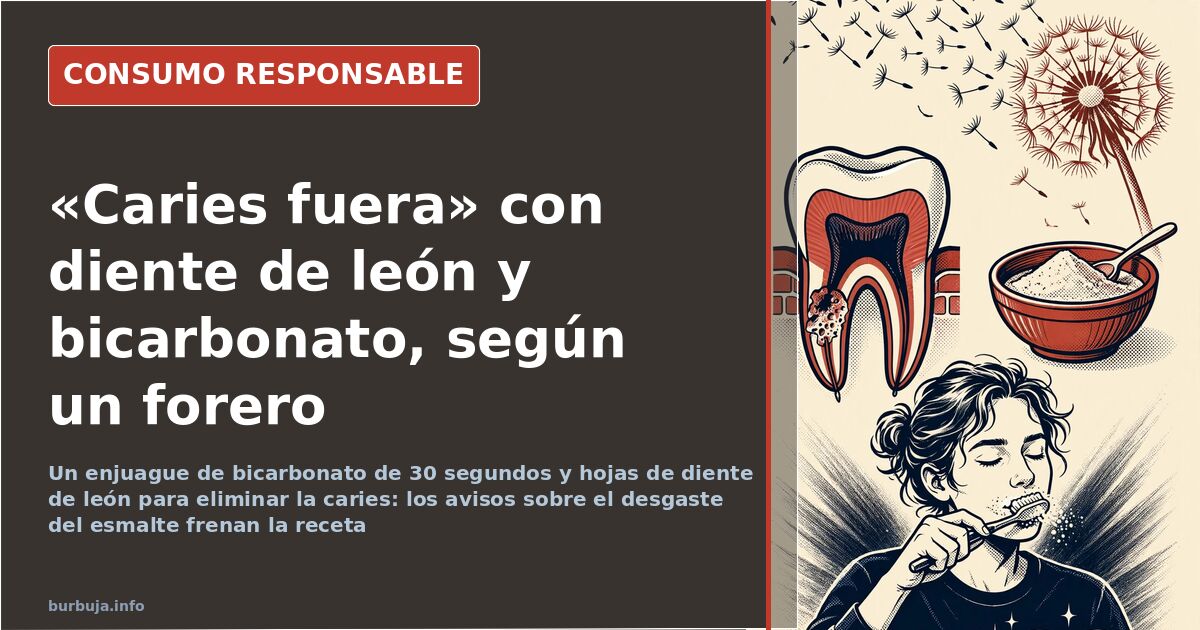
Baking soda and dandelion: cavities out, enamel in doubt
The recipe fits in one sentence: rub a dandelion leaf over your teeth, rinse your mouth with baking soda for 30 seconds and, according to its defenders, the cavity goes away over time. Those who back the method add an endorsement that isn't quite one: their dentist has confirmed they have no cavities. The objection came before the applause. A cavity is not a stain you can scrub away, and baking soda is an abrasive: what gets polished off is the enamel.
So the debate is not whether baking soda cleans something. It's what it takes down with it.
Does baking soda remove cavities or erode enamel?
There is no single position, and the recipe itself gives the problem away. Some concede that baking soda sweeps away bacteria and debris, but used daily it acts like sandpaper on the hardest layer of the tooth. Sanding down enamel with baking soda, the harshest reading concludes: a foolproof plan. A cavity, moreover, is a structural lesion, not a superficial little stain, and no amount of brushing rebuilds lost tissue.
There is an intermediate position, less dramatic and more sustainable: adding some baking soda to toothpaste without turning it into a daily routine. The justification is the antibacterial route, not the miracle route, and that nuance matters. In any case, no one has produced a measurement of the enamel before and after.
The whitening variant: baking soda and lemon in equal parts
Before the dandelion, another household custom circulated: baking soda and lemon, half and half, for whitening. It is the most aggressive version of the same gesture. Lemon brings acidity and baking soda brings friction; two assaults in the same motion, with the enamel caught in between. Those who do it describe it as an aesthetic victory rather than what it is: a stress test for the tooth.
The key to the appeal of these methods is economic. They cost next to nothing, require no appointment and promise a visible result. Against that, the technical argument — enamel does not regenerate — always loses in the first round.
Dandelion: a weed, a short season and doubts about its toxicity
The dandelion has one big selling point: it grows on its own. It is, literally, a weed you don't have to buy. It also carries two practical problems. The first is supply: the plant needs its flowering season to be identified without error, which makes having it on hand year-round tricky. The second is safety, and it was left open in the discussion: isn't it toxic?. That question got no definitive answer, only the memory of an old folk use attributed to witches for brushing their husbands' teeth. Little basis for putting a leaf in your mouth.
What to expect from this recipe
As long as there is no serious measurement of the wear, the method will keep circulating: it's free, it's simple, and oral hygiene has a component of faith that is hard to dismantle. It's safe to predict that the next variant will arrive within a few months with another pantry ingredient. With one reasonable exception: anyone with cavities already formed will end up at the dentist's office anyway, probably with less enamel than they started with to defend their case.
Also available in: Deutsch
Summary of a discussion on Burbuja.info - Foro de economía, actualidad y política., translated from Spanish and reviewed before publication. Read the full discussion (14 replies).
More summaries
-
Baking soda, coconut oil or toothpaste: the battle over dental hygiene
One in three children has cavities. Baking soda doesn't scratch enamel. Coconut oil, fluoride and the business of the smile: the debate over whether brushing with…
-
Aggressive brushing doesn't cause or cure periodontitis
Plaque accounts for only 20% of periodontitis risk; grafts fail and probiotics do not stop gum recession.
-
How to find turrón made entirely in Spain in a global market
Spanish almonds are expensive and the industry buys abroad: Chinese honey and nuts from the US and Turkey. Real Spanish turrón costs triple, users say.
-
El Corte Inglés prepared food: quality at a price
El Corte Inglés croquettes beat Mercadona's, but prices like €21/kg for meat rolls mean it's only worth it for some products.
-
Spain's waste fee soars: from 60 to 140 euros under new law
Spain's new mandatory waste fee is driving bills up sharply: from 60 to 130 euros in Almería, and from 78 to 104 in Madrid. The law is already in force and local councils…
-
Moka pot crema without a 500-euro machine: the sugar trick
Espresso crema requires pressure that a moka pot simply doesn't have. A trick using sugar and a milk frother achieves a similar-looking emulsion with a different taste.