
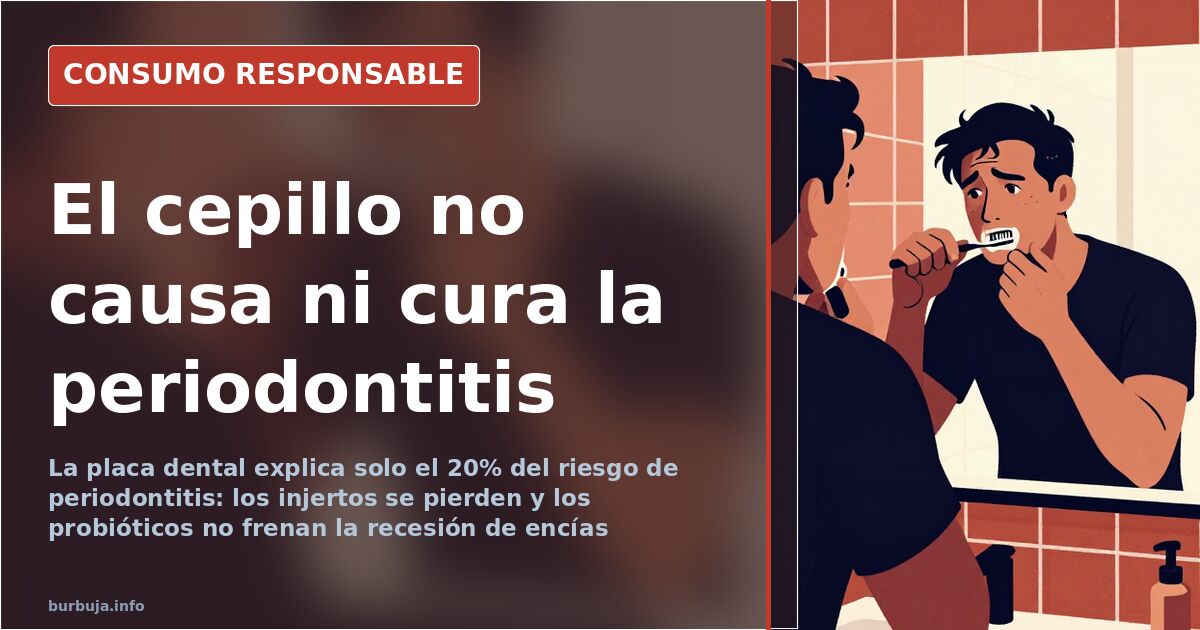
Aggressive brushing doesn't cause or cure periodontitis
Plaque accounts for only 20% of periodontitis risk; grafts fail and probiotics do not stop gum recession.
English · Original discussion in Spanish · Published
Periodontitis isn't just about hard brushing
Can aggressive brushing damage gums? This belief is common in dental offices, yet it clashes with the reality of living with periodontitis. The argument is clear: plaque lodges in the gingival sulcus, where no soft-bristle brush can reach it, regardless of technique. Using a water flosser or dental floss to clean that area does not harm tissue; in fact, it often coincides with improvement. Damaging the gum would require, ironically, "rubbing it with professional sandpaper."
That is the starting point. What trinc is more interesting.
The role of dental plaque in periodontitis risk
A key statistic reshapes the issue, cited by mainstream media. An article from El País (Uruguay edition) states that dental plaque represents **only 20% of the risk** of developing periodontitis, while the remaining **80%** stems from modifying and predisposing factors. In short: even if you scrub perfectly, you are addressing only one-fifth of the problem.
Consequently, many patients describe extreme routines—interdental brushes, thorough cleaning, mouthwash, and strict dieting—without stopping gum recession. Exhaustive hygiene is assumed. The challenge is explaining the other 80%.
Antioxidants as underlying causes of periodontitis
Oxidative stress is gaining traction as a hypothesis. A recent study argues that **increased oxidative stress is the primary factor** in periodontitis pathogenesis. To test this, three antioxidants were administered to patients with advanced disease. **Chlorogenic acid** and **peine** performed best, with chlorogenic acid having a slight edge. Chlorogenic acid comes from green coffee extract; peine from tomatoes.
The list continues. Other studies suggest **curcumin**—specifically a chemically modified version—halts disease pogre in animals, alongside **epicatechin**, an antioxidant found in grapes, red apples, green tea, and cocoa. The logic remains consistent: if oxidation is the culprit, the toothbrush was never to blame.
Probiotics: Study enthusiasm vs. home disappointment
Probiotics have been the major hope. A review published in Cureus concludes they improve oral health by modulating host immune response or gut microbiota balance, though it admits more research is needed on optimal strains and delivery methods.
Empirical testing reveals problems. After months of using two products with different strains, the result is unchanged: **recession continues**. There is no improvement. Laboratory promises collide with reality.
Coenzyme Q10, Vitamin D, and nutritional factors
The nutritional pathway has deep roots. The link between periodontitis and **coenzyme Q10** deficiency in gingival tissue has been known for years, with studies showing deficits in patients and newer ones using it as an adjunct to scaling. **Vitamin D** has been flagged as a potential cause, with some recommending pairing it with **vitamin C**—an antioxidant essential for blood vessel protection—plus magnesium and vitamin K.
Some argue periodontal disease rarely appears in wild animals but is common in domestic pets fed refined carbohydrates and low fiber. A low-sugar, keto-style diet is cited as naturally boosting these nutrients. One case report describes four years without worsening.
Grafts, curettage, and the patch business
When gums recede, surgery is offered: palatal grafts placed as new gum tissue. Costs are significant—**€600 to €750 per tooth** in reported cases—and results are not permanent. The most recent graft described, performed in 2019, failed completely.
Before that, full-mouth root planing usually occurs. Here arises suspicion, lacking conclusive proof: dental deterioration began shortly after curettage. It could be coincidence. It might not be. No one closes the question.
Alternative techniques: Miswak sticks and mechanical cleaning
Outside orthodoxy, the **miswak** stick returns—a chewing stick with antibacterial properties used before modern brushes and paste to control plaque and prevent cavities and periodontitis. Chlorhexidine, baking soda with hard bristles, and sonic brushes up to **40,000 rpm** also appear, though brand influence is deemed negligible.
The provisional conclusion is uncomfortable. If aggressive brushing doesn't cause periodontitis, it doesn't cure it either: grafts fail, probiotics don't halt recession, and oxidative stress persists. The only certainty is that we have spent decades buying soft bristles for a problem that likely never lay in the brush.
Can aggressive brushing damage gums? This belief is common in dental offices, yet it clashes with the reality of living with periodontitis. The argument is clear: plaque lodges in the gingival sulcus, where no soft-bristle brush can reach it, regardless of technique. Using a water flosser or dental floss to clean that area does not harm tissue; in fact, it often coincides with improvement. Damaging the gum would require, ironically, "rubbing it with professional sandpaper."
That is the starting point. What trinc is more interesting.
The role of dental plaque in periodontitis risk
A key statistic reshapes the issue, cited by mainstream media. An article from El País (Uruguay edition) states that dental plaque represents **only 20% of the risk** of developing periodontitis, while the remaining **80%** stems from modifying and predisposing factors. In short: even if you scrub perfectly, you are addressing only one-fifth of the problem.
Consequently, many patients describe extreme routines—interdental brushes, thorough cleaning, mouthwash, and strict dieting—without stopping gum recession. Exhaustive hygiene is assumed. The challenge is explaining the other 80%.
Antioxidants as underlying causes of periodontitis
Oxidative stress is gaining traction as a hypothesis. A recent study argues that **increased oxidative stress is the primary factor** in periodontitis pathogenesis. To test this, three antioxidants were administered to patients with advanced disease. **Chlorogenic acid** and **peine** performed best, with chlorogenic acid having a slight edge. Chlorogenic acid comes from green coffee extract; peine from tomatoes.
The list continues. Other studies suggest **curcumin**—specifically a chemically modified version—halts disease pogre in animals, alongside **epicatechin**, an antioxidant found in grapes, red apples, green tea, and cocoa. The logic remains consistent: if oxidation is the culprit, the toothbrush was never to blame.
Probiotics: Study enthusiasm vs. home disappointment
Probiotics have been the major hope. A review published in Cureus concludes they improve oral health by modulating host immune response or gut microbiota balance, though it admits more research is needed on optimal strains and delivery methods.
Empirical testing reveals problems. After months of using two products with different strains, the result is unchanged: **recession continues**. There is no improvement. Laboratory promises collide with reality.
Coenzyme Q10, Vitamin D, and nutritional factors
The nutritional pathway has deep roots. The link between periodontitis and **coenzyme Q10** deficiency in gingival tissue has been known for years, with studies showing deficits in patients and newer ones using it as an adjunct to scaling. **Vitamin D** has been flagged as a potential cause, with some recommending pairing it with **vitamin C**—an antioxidant essential for blood vessel protection—plus magnesium and vitamin K.
Some argue periodontal disease rarely appears in wild animals but is common in domestic pets fed refined carbohydrates and low fiber. A low-sugar, keto-style diet is cited as naturally boosting these nutrients. One case report describes four years without worsening.
Grafts, curettage, and the patch business
When gums recede, surgery is offered: palatal grafts placed as new gum tissue. Costs are significant—**€600 to €750 per tooth** in reported cases—and results are not permanent. The most recent graft described, performed in 2019, failed completely.
Before that, full-mouth root planing usually occurs. Here arises suspicion, lacking conclusive proof: dental deterioration began shortly after curettage. It could be coincidence. It might not be. No one closes the question.
Alternative techniques: Miswak sticks and mechanical cleaning
Outside orthodoxy, the **miswak** stick returns—a chewing stick with antibacterial properties used before modern brushes and paste to control plaque and prevent cavities and periodontitis. Chlorhexidine, baking soda with hard bristles, and sonic brushes up to **40,000 rpm** also appear, though brand influence is deemed negligible.
The provisional conclusion is uncomfortable. If aggressive brushing doesn't cause periodontitis, it doesn't cure it either: grafts fail, probiotics don't halt recession, and oxidative stress persists. The only certainty is that we have spent decades buying soft bristles for a problem that likely never lay in the brush.
Also available in: Deutsch
Summary of a discussion on Burbuja.info - Foro de economía, actualidad y política., translated from Spanish and reviewed before publication. Read the full discussion (106 replies).
More summaries
-
Online Probiotics: When the Remedy Causes Gas and Constipation
A consumer suspects that probiotics bought on iHerb caused gas and constipation. The advice to reset the gut with antibiotics divides...
-
Lacasa Christmas Turrón Ad Sparks Consumer Backlash in Spain
Spanish turrón brand Lacasa faces boycotts after launching a feminist ad claiming women have less leisure time than men.
-
Yus For Men: The Hair Dye Disguised as Shampoo
Yus For Men is a two-component dye sold as coloring shampoo. It allows small doses but stains skin and costs €3.90.
-
MSC Divina Cruise Deal: €650 for 5 Days in Balcony Cabin
A forum user transfers a Mediterranean cruise cabin for €650. The thread sparks debate over mandatory gratuities and onboard spending.
-
Gun Ownership in Spain: Licenses, Requirements and Legal Reality
Obtaining a gun license in Spain involves months of bureaucracy, exams and safe installation. Even with full compliance, the Guardia Civil can deny it.
-
Shoulder injury after two months of lifting: five weeks of pain without diagnosis
Five weeks of shoulder pain after weightlifting injury: no diagnosis, conflicting theories, and rising physiotherapy costs.