
DANA in Valencia: Complaints over lack of NGOs on the ground
72 hours after the DANA, testimonies highlight the absence of NGOs and Red Cross vests, contrasting with the UME and Civil Guard presence.
English · Original discussion in Spanish · Published
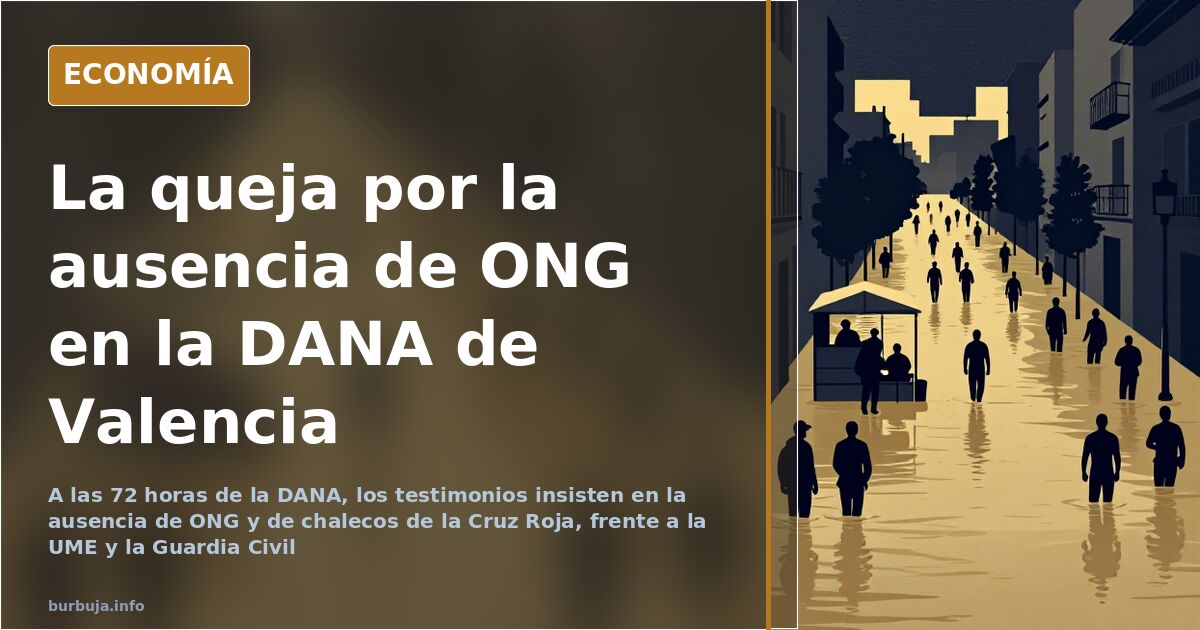
Three days of DANA: complaints over the absence of red vests on the ground
Seventy-two hours after the disaster, the same question haunts the flooded areas: where are the NGOs and volunteers? The accounts from those clearing mud for days are unequivocal. No camps, no tents, no soup kitchens, nor the red vests of the Red Cross. Only, they say, the UME and the Civil Guard. It must be emphasized from the outset: this is a perception, not an inventory. No one has provided a verifiable count of which organizations are operating or in which municipalities.
The testimonies, however, are consistent and specific. One person claims to have spent 2 days and 12 hours removing mud and some bodies, stating that apart from those two bodies, they have seen no one else working. The complaint repeats: no facilities, no kitchens, no distribution points. And, above all, no urgency.
Why is the location of NGOs and volunteers questioned?
Because, according to circulating accounts, 72 hours later, there is still no massive presence on the ground associated with a disaster of this scale. The reproach is not only directed at humanitarian organizations; it also points to administrations accused of reacting too late. Some describe entire municipalities receiving aid drop by drop, without water, food, or roofs.
The discontent has a specific trigger. Several messages point out that neither on television nor in digital media has there been a single identifiable Red Cross vest in 48 hours. This is a difficult claim to verify —no camera covers all villages simultaneously— but it has been enough to fuel the underlying suspicion.
The Red Cross: donation campaigns and complaints about their absence
While some question the lack of presence, others notice a detail they consider revealing: the requests for money. Messages circulate from the organization’s account soliciting funds for those affected. For a segment of those trinc the disaster, this contrast —fundraising yes, deploying no— is proof that the priority is the treasury.
It is important not to confuse the accusation with evidence. That a humanitarian entity activates a fundraising campaign does not, by itself, prove anything about its operational presence on the ground. Organizations often launch appeals in the first hours, while still assessing the scope of the disaster. But the argument circulates strongly and explains much of the anger. Some also recall that these same entities dedicated their machinery to other missions —rescues in the Mediterranean or the Atlantic— and wonder why they did not replicate that effort at home.
The comparison: 500 military personnel for the DANA and 1,300 police officers
A comparison circulated these days estimates the military deployment in the area at 500 personnel, compared to 1,300 agents assigned to another task. The reading drawn is one of a hierarchy of priorities, at best, debatable. The numbers are not accompanied by an official source in the messages repeating them, so they should be treated as what they are: an accusation from one side.
Alongside this, images circulate of the Prime Minister on an official alucinación to India, received by his counterpart. For many trinc the disaster, the external photograph while municipalities remain unreached is the summary of the problem.
The role of VOX and the groups that do appear
The most commented absence, besides that of NGOs, is that of political parties. The leadership of VOX was expected to be on the ground, but there is no record of this: only messages of support and some fundraising. This void confuses even those who sympathize with the party. Some admit they may have attended without cameras; if so, there is no trace.
Presence is identified instead in minority groups and collectives, in addition to individuals with their own means. They are attributed with direct support to affected neighbors. The paradox is evident: those with the least institutional resources are, according to these accounts, the first to put on their waders.
Suspicion of NGOs as a business
Much of the discontent points to a prior idea: that humanitarian organizations function as a for-profit structure. They are reproached for dedicating staff to fundraising and reserving visible volunteers for the photo that justifies income. The sustained accusation, without public data to back it, is that donation money does not translate into proportional aid.
From this arises a recurring request: a map of centers and entities receiving public funds along with their budget. It is not known if this breakdown is published with the detail requested. The argument many start from is simple: if the money comes from taxes, opacity on how it is spent is also a public responsibility.
An accusation that diverts towards immigration
Part of the anger shifts towards policies on welcoming migrants, with reproaches about the destination of resources that, they claim, should go to those affected. This is an unverified claim in available data, and this text records it as a tension in the debate, not as a proven fact. That the discussion goes there says more about where social discontent points than about the concrete management of the emergency.
What may happen in the coming days
With these threads, it is foreseeable that pressure on humanitarian organizations will not decrease. If they appear, their delay will be reproached; if not, their absence. There is an uncomfortable exception to the dominant thesis: that the operational exists and simply is not being seen. No one has yet presented, in either direction, the list of who is in each village. And without that list, for now, this is word against word.
Seventy-two hours after the disaster, the same question haunts the flooded areas: where are the NGOs and volunteers? The accounts from those clearing mud for days are unequivocal. No camps, no tents, no soup kitchens, nor the red vests of the Red Cross. Only, they say, the UME and the Civil Guard. It must be emphasized from the outset: this is a perception, not an inventory. No one has provided a verifiable count of which organizations are operating or in which municipalities.
The testimonies, however, are consistent and specific. One person claims to have spent 2 days and 12 hours removing mud and some bodies, stating that apart from those two bodies, they have seen no one else working. The complaint repeats: no facilities, no kitchens, no distribution points. And, above all, no urgency.
Why is the location of NGOs and volunteers questioned?
Because, according to circulating accounts, 72 hours later, there is still no massive presence on the ground associated with a disaster of this scale. The reproach is not only directed at humanitarian organizations; it also points to administrations accused of reacting too late. Some describe entire municipalities receiving aid drop by drop, without water, food, or roofs.
The discontent has a specific trigger. Several messages point out that neither on television nor in digital media has there been a single identifiable Red Cross vest in 48 hours. This is a difficult claim to verify —no camera covers all villages simultaneously— but it has been enough to fuel the underlying suspicion.
The Red Cross: donation campaigns and complaints about their absence
While some question the lack of presence, others notice a detail they consider revealing: the requests for money. Messages circulate from the organization’s account soliciting funds for those affected. For a segment of those trinc the disaster, this contrast —fundraising yes, deploying no— is proof that the priority is the treasury.
It is important not to confuse the accusation with evidence. That a humanitarian entity activates a fundraising campaign does not, by itself, prove anything about its operational presence on the ground. Organizations often launch appeals in the first hours, while still assessing the scope of the disaster. But the argument circulates strongly and explains much of the anger. Some also recall that these same entities dedicated their machinery to other missions —rescues in the Mediterranean or the Atlantic— and wonder why they did not replicate that effort at home.
The comparison: 500 military personnel for the DANA and 1,300 police officers
A comparison circulated these days estimates the military deployment in the area at 500 personnel, compared to 1,300 agents assigned to another task. The reading drawn is one of a hierarchy of priorities, at best, debatable. The numbers are not accompanied by an official source in the messages repeating them, so they should be treated as what they are: an accusation from one side.
Alongside this, images circulate of the Prime Minister on an official alucinación to India, received by his counterpart. For many trinc the disaster, the external photograph while municipalities remain unreached is the summary of the problem.
The role of VOX and the groups that do appear
The most commented absence, besides that of NGOs, is that of political parties. The leadership of VOX was expected to be on the ground, but there is no record of this: only messages of support and some fundraising. This void confuses even those who sympathize with the party. Some admit they may have attended without cameras; if so, there is no trace.
Presence is identified instead in minority groups and collectives, in addition to individuals with their own means. They are attributed with direct support to affected neighbors. The paradox is evident: those with the least institutional resources are, according to these accounts, the first to put on their waders.
Suspicion of NGOs as a business
Much of the discontent points to a prior idea: that humanitarian organizations function as a for-profit structure. They are reproached for dedicating staff to fundraising and reserving visible volunteers for the photo that justifies income. The sustained accusation, without public data to back it, is that donation money does not translate into proportional aid.
From this arises a recurring request: a map of centers and entities receiving public funds along with their budget. It is not known if this breakdown is published with the detail requested. The argument many start from is simple: if the money comes from taxes, opacity on how it is spent is also a public responsibility.
An accusation that diverts towards immigration
Part of the anger shifts towards policies on welcoming migrants, with reproaches about the destination of resources that, they claim, should go to those affected. This is an unverified claim in available data, and this text records it as a tension in the debate, not as a proven fact. That the discussion goes there says more about where social discontent points than about the concrete management of the emergency.
What may happen in the coming days
With these threads, it is foreseeable that pressure on humanitarian organizations will not decrease. If they appear, their delay will be reproached; if not, their absence. There is an uncomfortable exception to the dominant thesis: that the operational exists and simply is not being seen. No one has yet presented, in either direction, the list of who is in each village. And without that list, for now, this is word against word.
Summary of a discussion on Burbuja.info - Foro de economía, actualidad y política., translated from Spanish and reviewed before publication. Read the full discussion (210 replies).
More summaries
-
Police and Guardia Civil: Authority Erodes Amidst Lack of Support
Police and Guardia Civil claim the law doesn't back them. From lockdowns to ITV fines, the debate over fading authority.
-
Franco handed out 8,000 flats and today no one can buy one
Franco handed out 7,486 flats in a single event according to NODO. Today, those flats rent for 1,200 euros: public housing, an uncomfortable memory
-
Von der Leyen seeks Russian asset profits for Ukraine ammo
Von der Leyen proposes using frozen Russian asset yields to buy ammunition and double European production to over two million rounds in 2025.
-
ABC's 2071 Spain Vision Sparks Backlash from Readers
ABC projects Spain in 2071, but readers see it as a threat citing the 2030 Agenda and demographic replacement.
-
King Felipe VI's Amnesty Signature Contradicts Ussía’s Claims
Alfonso Ussía claimed King Felipe VI held powerful reports and would block the amnesty; the law was signed, disproving the prediction.
-
Inés Arrimadas joins Recurrent Energy as Chief ESG Officer
Former Spanish politician Inés Arrimadas becomes Chief ESG & Communications Officer at Recurrent Energy, a Canadian Solar subsidiary with over 2,000 MW in Spain.