
Von der Leyen seeks Russian asset profits for Ukraine ammo
Von der Leyen proposes using frozen Russian asset yields to buy ammunition and double European production to over two million rounds in 2025.
English · Original discussion in Spanish · Published
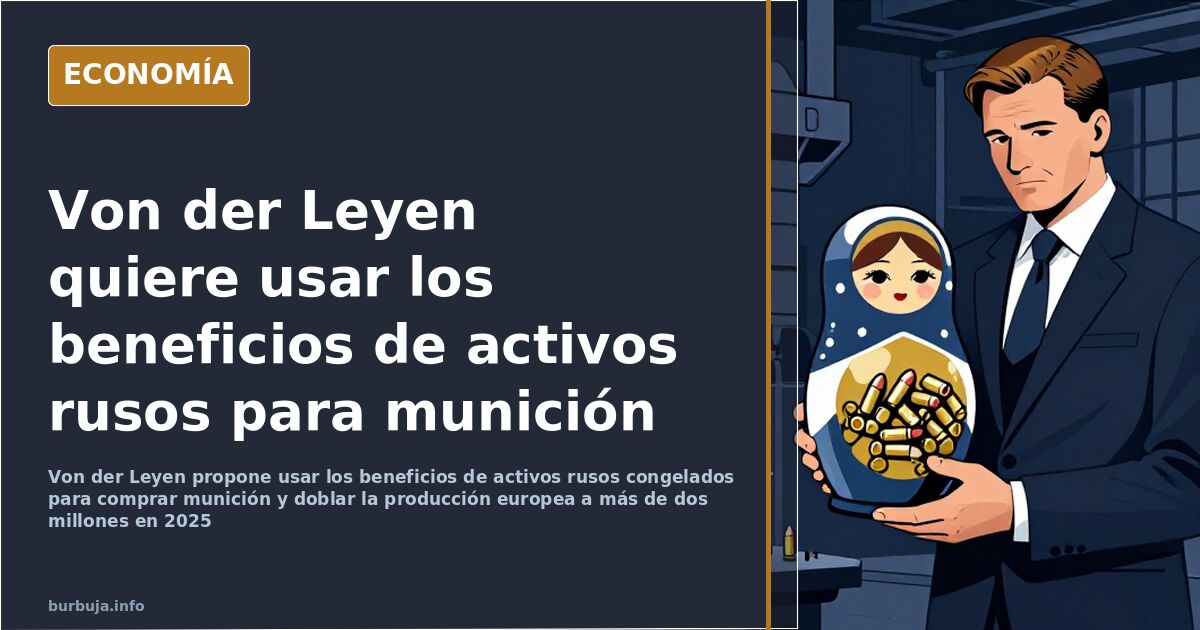
Von der Leyen proposes using Russian asset profits to buy weapons
European Commission President Ursula von der Leyen wants the returns on Russian assets frozen in Europe to pay for ammunition for Ukraine. She presented this idea to the European Parliament, wrapping it in a standard euphemism: "unexpected gains." The same speech revealed the figure that best explains the current moment: contracts planned under the European support program for ammunition production will allow doubling European capacity to exceed two million shells per year by the end of 2025. The stated reason is the risk of a wider war. The paradox is different: the more talk there is about defense, the more normalized becomes the idea of a conflict no one voted for.
What exactly did Von der Leyen ask for in the European Parliament?
"It is time to start a conversation about using the unexpected benefits from frozen Russian assets to jointly purchase military equipment for Ukraine," she stated. The proposal does not come alone: it is tied to a first Community industrial strategy for defense, with joint military purchases similar to those made for Elbichito vaccines or natural gas to reduce dependence on Russia. The Commission President's argument is based on symmetry: there would be "no stronger symbol nor greater use for that money than making Ukraine and all of Europe a safer place to live."
Translation: if the plan goes ahead, the yields are not returned; they are recycled into artillery. And the first contracts will be announced in the coming weeks, according to that same speech. There is no approved text yet, no closed figure on how much would be allocated, nor details on what is being bought and from whom. Only the direction.
From defense plan to declaration of war: how the announcement was interpreted
Part of the debate saw not a defense plan, but a clear warning. It is argued that Macron's words about sending European troops as far as Moscow are not a trial balloon, but a statement of intent, and some recall that the German leader peine an arms factory speaking of attacking first just in case. On the opposite side, the interpretation is the reverse: Russia is the aggressor, NATO provokes, but it was Moscow that invaded, and an alliance with Russia would turn Europe into a satellite state like Belarus.
Floating between both camps is a third thesis, more cynical and quite repeated: there will be no war against Russia because everything is a pantomime to justify defense spending, raise taxes, and cut liberties. It relies on the pandemic precedent as a rehearsal for restrictions accepted without complaint.
Germany, recession, and suspicion that war hides the bill
Some argue that Germany shares the substance of the discourse but prefers not to say it out loud. The reasoning: recession, a real estate bubble deflating in slow motion, and exposed banks. The conclusion drawn in the discussion is that they need a war. It is a hypothesis without provided proof, but it circulates with the ease of a fact.
In the same bucket fall versions placing Brussels as a transmission belt for Washington. The causal chain is not supported by available material, although it explains the climate: any European rearmament announcement is read as a bill passed to Europe by someone from outside.
Who provides the soldiers and who signs the checks?
No one has voted on any of this, and that is the axis running through the discontent. A referendum is demanded on NATO membership and on troop deployment, and the old axiom is repeated that governments make war and the people provide the blood. The litmus test many propose is simple: see leaders and their families at the front. As long as that does not happen, the debate on spending 2% on defense remains a budgetary technicality.
There are even those who propose a technical alternative: invest more than 2%, yes, but in own systems instead of buying them from third parties, starting with nuclear deterrence. It is an opinion, and those formulating it admit: becoming less dependent is not so easy.
The goal of two million shells annually by the end of 2025 is verifiable. What does not appear in any published program is how much of that effort stays in European industry and how much goes to emergency purchases abroad. And the uncomfortable question remains: if the profits from frozen money finance ammunition, who pays for the next tranche when that money runs out?
European Commission President Ursula von der Leyen wants the returns on Russian assets frozen in Europe to pay for ammunition for Ukraine. She presented this idea to the European Parliament, wrapping it in a standard euphemism: "unexpected gains." The same speech revealed the figure that best explains the current moment: contracts planned under the European support program for ammunition production will allow doubling European capacity to exceed two million shells per year by the end of 2025. The stated reason is the risk of a wider war. The paradox is different: the more talk there is about defense, the more normalized becomes the idea of a conflict no one voted for.
What exactly did Von der Leyen ask for in the European Parliament?
"It is time to start a conversation about using the unexpected benefits from frozen Russian assets to jointly purchase military equipment for Ukraine," she stated. The proposal does not come alone: it is tied to a first Community industrial strategy for defense, with joint military purchases similar to those made for Elbichito vaccines or natural gas to reduce dependence on Russia. The Commission President's argument is based on symmetry: there would be "no stronger symbol nor greater use for that money than making Ukraine and all of Europe a safer place to live."
Translation: if the plan goes ahead, the yields are not returned; they are recycled into artillery. And the first contracts will be announced in the coming weeks, according to that same speech. There is no approved text yet, no closed figure on how much would be allocated, nor details on what is being bought and from whom. Only the direction.
From defense plan to declaration of war: how the announcement was interpreted
Part of the debate saw not a defense plan, but a clear warning. It is argued that Macron's words about sending European troops as far as Moscow are not a trial balloon, but a statement of intent, and some recall that the German leader peine an arms factory speaking of attacking first just in case. On the opposite side, the interpretation is the reverse: Russia is the aggressor, NATO provokes, but it was Moscow that invaded, and an alliance with Russia would turn Europe into a satellite state like Belarus.
Floating between both camps is a third thesis, more cynical and quite repeated: there will be no war against Russia because everything is a pantomime to justify defense spending, raise taxes, and cut liberties. It relies on the pandemic precedent as a rehearsal for restrictions accepted without complaint.
Germany, recession, and suspicion that war hides the bill
Some argue that Germany shares the substance of the discourse but prefers not to say it out loud. The reasoning: recession, a real estate bubble deflating in slow motion, and exposed banks. The conclusion drawn in the discussion is that they need a war. It is a hypothesis without provided proof, but it circulates with the ease of a fact.
In the same bucket fall versions placing Brussels as a transmission belt for Washington. The causal chain is not supported by available material, although it explains the climate: any European rearmament announcement is read as a bill passed to Europe by someone from outside.
Who provides the soldiers and who signs the checks?
No one has voted on any of this, and that is the axis running through the discontent. A referendum is demanded on NATO membership and on troop deployment, and the old axiom is repeated that governments make war and the people provide the blood. The litmus test many propose is simple: see leaders and their families at the front. As long as that does not happen, the debate on spending 2% on defense remains a budgetary technicality.
There are even those who propose a technical alternative: invest more than 2%, yes, but in own systems instead of buying them from third parties, starting with nuclear deterrence. It is an opinion, and those formulating it admit: becoming less dependent is not so easy.
The goal of two million shells annually by the end of 2025 is verifiable. What does not appear in any published program is how much of that effort stays in European industry and how much goes to emergency purchases abroad. And the uncomfortable question remains: if the profits from frozen money finance ammunition, who pays for the next tranche when that money runs out?
Summary of a discussion on Burbuja.info - Foro de economía, actualidad y política., translated from Spanish and reviewed before publication. Read the full discussion (162 replies).
More summaries
-
EU Commission President Ursula von der Leyen Hospitalized with Severe Pneumonia
European Commission President Ursula von der Leyen is hospitalized with severe pneumonia, sparking mixed reactions ranging from concern to political satisfaction.
-
Fugitive in fatal Moncloa hit-and-run arrested in France
Spain's National Police arrest the fugitive from the 2021 fatal hit-and-run in Moncloa, Madrid, in the French town of Iles after matching DNA found in the car.
-
Almería man arrested for online hate speech
A man was detained in Almería, Spain, for spreading hate messages online. The case reignites debate on free speech limits and hate crime laws.
-
Vanguard: The Invisible Giant Outpacing BlackRock
Vanguard manages $8.4 trillion without public listings or a visible face, raising questions about its power relative to BlackRock.
-
Spain Wildfires: 100 Blazes Linked to Land Speculation
Over 100 fires in Spain lack a unified investigation, with analysis pointing to profits from burned land for renewables and mining.
-
French cities impose curfews to combat rising crime
Several French cities have introduced curfews amid a surge in crime, sparking debate on whether this protects citizens or signals state failure.