
Cutting ties with parents: The taboo of the toxic family
Cutting ties with parents remains taboo in Spain. Testimonies of those who break due to emotional abuse reveal the social rift opened by the toxic family.
English · Original discussion in Spanish · Published
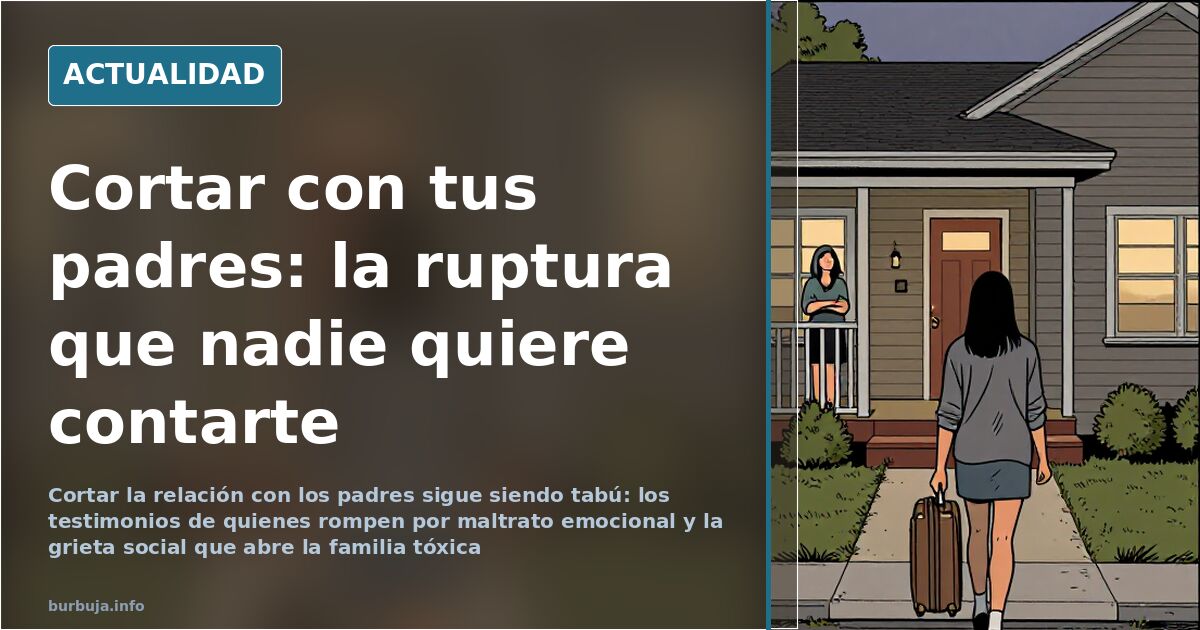
Cutting off parents: Between survival and taboo
Breaking with parents is unthinkable for most. For a minority, it is the only way out of an endless hell. The story of those who decide to cut ties with their parents returns without comfort: no reconciliation, no mandatory forgiveness, no happy ending. Just a closed door.
The trigger is a report collecting first-person testimonies of adults who have cut off their progenitors. The conversation reveals an uncomfortable picture: the sacred institution of the family clashes with the experience of those who lived something other than unconditional affection.
Cases supporting the narrative
Natalia, 39, left home at 18 and cut ties completely twelve months ago. She describes an environment of ridicule, insults, shouting, and humiliation, with extreme control over her work and friendships. The final day, her ten-year-old daughter was frightened. The next day, she wrote a letter explaining she could no longer expose them to that.
Inés Hernand, a 31-year-old presenter, has had no contact for seven years. She grew up alone, left without company during Christmas from age 14, and broke off contact for ethical reasons affecting another family member. She speaks from forgiveness, not rage: "no one is taught how to be parents," she admits, but adds there are minimum inherent duties in caring for someone vulnerable.
A third testimony summarizes the paradox better than any plea: someone who thanks their mother daily for giving them life, yet reminds them that she also took it away and stole their physical and mental health.
Why the family remains untouchable
Experts emphasize that each case is unique, but the rupture is social. The family is the primary institution in Western societies, and questioning it still sounds like heresy.
This sacralization crystallizes in clichés: family comes first, parents love you most, dirty laundry is washed at home. Under this mantle, much violence and abuse are sustained. The mandate of silence explains why few speak of this publicly.
Emotional abuse leaving no visible mark
Beyond physical violence, there is sustained emotional abuse, difficult to name or prove. In therapy, it is common to encounter adults who suffered prolonged abuse, and the exit—breaking off, distancing, or maintaining minimal contact—depends on each story.
Here appears a classic figure: the scapegoat. The person blamed for all evils since youth, around whose sacrifice the family coheres. The only way out, according to those who lived it, is to break all ties with that environment.
As another participant notes, alongside the victim often operate so-called flying monkeys: family and acquaintances who, far from being innocent, act as transmission belts for abuse and are interested parties in the system supporting the aggressor.
The rift: Survival or propaganda?
The issue divides. One view reads it as propaganda to normalize exceptions and undermine the family as an institution; it argues real abuse exists but telling it this way serves an agenda. Another defends it as pure survival: some parents are torment from which one must distance oneself immediately, and those who haven't lived it cannot imagine it.
In between circulate more mundane diagnoses. Some attribute many breakups to ideological clashes between children and parents of opposite signs, while others share blame equally between ungrateful children and mothers who cannot accept their partner's family. The detail that disconcerts almost everyone: those who have suffered do not expect forgiveness or reconciliation, only peace.
The business of distress
A recurrent thread points to an unexpected beneficiary. If the family breaks, the individual is alone, and the State—via therapies, drugs, and residences—fills the void. Whether or not this is the designed outcome, those supporting this view argue that psychotropic drug consumption continues to grow while no one measures how many pills prevent what a mother or father failed to provide.
If confirmed, the trend has a predictable and bitter course: more adults closing their home doors forever and more society looking away. Or perhaps not. Because each generation raising children better than they were raised could break the chain. It is too soon to know, and no one signs the forecast.
Breaking with parents is unthinkable for most. For a minority, it is the only way out of an endless hell. The story of those who decide to cut ties with their parents returns without comfort: no reconciliation, no mandatory forgiveness, no happy ending. Just a closed door.
The trigger is a report collecting first-person testimonies of adults who have cut off their progenitors. The conversation reveals an uncomfortable picture: the sacred institution of the family clashes with the experience of those who lived something other than unconditional affection.
Cases supporting the narrative
Natalia, 39, left home at 18 and cut ties completely twelve months ago. She describes an environment of ridicule, insults, shouting, and humiliation, with extreme control over her work and friendships. The final day, her ten-year-old daughter was frightened. The next day, she wrote a letter explaining she could no longer expose them to that.
Inés Hernand, a 31-year-old presenter, has had no contact for seven years. She grew up alone, left without company during Christmas from age 14, and broke off contact for ethical reasons affecting another family member. She speaks from forgiveness, not rage: "no one is taught how to be parents," she admits, but adds there are minimum inherent duties in caring for someone vulnerable.
A third testimony summarizes the paradox better than any plea: someone who thanks their mother daily for giving them life, yet reminds them that she also took it away and stole their physical and mental health.
Why the family remains untouchable
Experts emphasize that each case is unique, but the rupture is social. The family is the primary institution in Western societies, and questioning it still sounds like heresy.
This sacralization crystallizes in clichés: family comes first, parents love you most, dirty laundry is washed at home. Under this mantle, much violence and abuse are sustained. The mandate of silence explains why few speak of this publicly.
Emotional abuse leaving no visible mark
Beyond physical violence, there is sustained emotional abuse, difficult to name or prove. In therapy, it is common to encounter adults who suffered prolonged abuse, and the exit—breaking off, distancing, or maintaining minimal contact—depends on each story.
Here appears a classic figure: the scapegoat. The person blamed for all evils since youth, around whose sacrifice the family coheres. The only way out, according to those who lived it, is to break all ties with that environment.
As another participant notes, alongside the victim often operate so-called flying monkeys: family and acquaintances who, far from being innocent, act as transmission belts for abuse and are interested parties in the system supporting the aggressor.
The rift: Survival or propaganda?
The issue divides. One view reads it as propaganda to normalize exceptions and undermine the family as an institution; it argues real abuse exists but telling it this way serves an agenda. Another defends it as pure survival: some parents are torment from which one must distance oneself immediately, and those who haven't lived it cannot imagine it.
In between circulate more mundane diagnoses. Some attribute many breakups to ideological clashes between children and parents of opposite signs, while others share blame equally between ungrateful children and mothers who cannot accept their partner's family. The detail that disconcerts almost everyone: those who have suffered do not expect forgiveness or reconciliation, only peace.
The business of distress
A recurrent thread points to an unexpected beneficiary. If the family breaks, the individual is alone, and the State—via therapies, drugs, and residences—fills the void. Whether or not this is the designed outcome, those supporting this view argue that psychotropic drug consumption continues to grow while no one measures how many pills prevent what a mother or father failed to provide.
If confirmed, the trend has a predictable and bitter course: more adults closing their home doors forever and more society looking away. Or perhaps not. Because each generation raising children better than they were raised could break the chain. It is too soon to know, and no one signs the forecast.
Also available in: Deutsch
Summary of a discussion on Burbuja.info - Foro de economía, actualidad y política., translated from Spanish and reviewed before publication. Read the full discussion (337 replies).
More summaries
-
Spanish Army debate: discipline, NATO and reform
Analysis of perceptions of the Spanish Army: from internal structure and promotions to the critical debate on its role in NATO
-
30-Year-Old Unemployed Man Contemplates Suicide While Living with Parents
An unemployed 30-year-old living with his parents describes suicidal ideation as his only way out amid family conflict and academic failure.
-
Spain's Crisis: Real Estate, Politics, and Market Volatility Explained
An analysis of Spain's real estate, economic, and political bubbles, featuring key data from the Ibex 35 and official bank valuations.
-
Non-stop techno thread hits 1,500 posts
A Spanish forum thread on electronic music reaches 1,500 replies, blending happy hardcore and military marches in a continuous community session.
-
Maribel Verdú defends owning three homes after decades of work
Spanish actress Maribel Verdú responds to criticism over her three properties, citing 30 years of honest labor amid Spain's housing crisis.
-
First mpox death in Basque Country reported at Donostia Hospital
A 61-year-old cancer patient died of mpox at Donostia Hospital after contracting it from a roommate, marking the region's first fatality.