
30-Year-Old Unemployed Man Contemplates Suicide While Living with Parents
An unemployed 30-year-old living with his parents describes suicidal ideation as his only way out amid family conflict and academic failure.
English · Original discussion in Spanish · Published
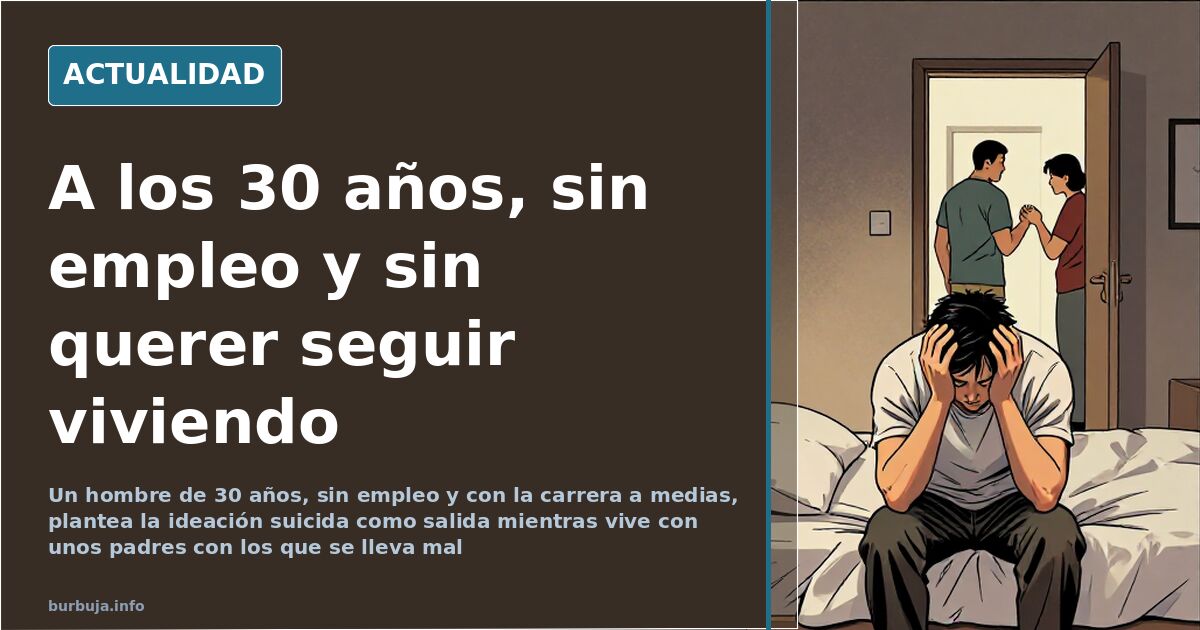
Suicidal ideation of a 30-year-old man with no way out
What drives a 30-year-old man to plan how to disappear without a trace? This is essentially what the author of a message in a public economic discussion stated: unemployed, with a degree one year from completion, and living with parents with whom he had a very deteriorated relationship, he described suicidal ideation as an idea increasingly present upon waking, during the day, and before sleeping. He insisted he was not seeking attention nor harming anyone, nor did he want his family to spend money on a funeral; his declared goal was to disappear without a trace.
The author places the origin of his distress in his twenties and summarizes his situation in three fronts: an academic year he considers lost, total unemployment, and a family environment he describes as very deteriorated, with mental health issues and alcohol consumption at home, according to his own account. He had never considered this option, he wrote, before adding that the idea is now increasingly present.
A broken balance at 30: unemployment, unfinished degree, and return to the family home
The narrative lists failures with impressive coldness: a course that passed entirely without studying, a degree with one year remaining, zero job offers, and the feeling of having learned nothing useful. He adds a devastating judgment of himself—being a burden, contributing nothing—which he repeats almost like a refrain.
The only thing, according to his account, that kept him going was training, the only activity that took him out of the house, although he admits he has less enthusiasm for it. This detail weighs heavily: when the last routine sustaining someone disappears, ideation faces less resistance. There is a material factor not to be overlooked. Without income and unable to pay rent, leaving home is not a decision made by will alone: independence today is a matter of money.
The role of the family environment in suicide risk
The author himself describes a family he does not perceive as support: a mother with mental health problems and a father with alcohol consumption, according to his version, in a climate where he is reproached for being useless or lazy. None of these extremes can be taken as proven beyond his testimony, but the pattern—sustained family conflict, constant disqualification, and lack of a support network—reappears again and again among those who say they recognize their situation.
It is not an isolated case. Several responses describe similar childhoods and the same outcome: adults with shattered self-esteem, no initiative, and no trusted relationships. Some phrase it without sugarcoating: blood is not always an insurance, and distancing oneself from the family nucleus is, in certain cases, the first mental health measure.
From 'I want to disappear' to 'I feel quite well today'
In response to the comments, the author himself qualified his position. He said he felt much better, acknowledged that suicide was not an option, and committed to trying to channel his life. This turn is not a happy ending or a solution: ideation is not deactivated because someone commits to trying it on a Tuesday.
But it illustrates something that often repeats: acute crisis is a state, not a sentence. And an argument emerges that those who have been through it often support: if someone has lost the antiestéticar of dying, they have nothing left to lose by trying to live. The problem, as almost always, is that this reasoning comes from the outside.
Mockery, travel advice, and theories on reincarnation
The collective reaction was a portrait of internet rawness. There were explicit mockery, those who asked for empathy, those who recommended taking a backpack and hitting the road because, if you are going to die, at least enjoy the scenery, and those who warned, without supporting evidence, of religious punishments or karma worsening the next life. On reincarnation, everyone believes what they want; as a dissuasive instruction, it works moderately.
The most cynical argument in the catalog also emerged: that these messages seek visits and that there is an alleged orchestrated campaign behind them. And a variant that should not be replicated: encouraging someone going through a hard time to take someone else with them. Fortunately, no one took the suggestion literally.
Amid all this, a striking detail: the idea of having an exit—the ability to end it when one wishes—serves some people as comfort to continue, as one of the responses noted citing Cioran. Sometimes that same idea accelerates the end. The difference, various who have been through it agree, lies not in the idea, but in the support surrounding it.
What help is available and why asking for it is not giving up?
What the narrative reveals is a mental health problem with well-identified risk factors: isolation, unemployment, family conflict, loss of routines, and lack of expectations. None are resolved with motivational advice, and all improve with professional support. Asking for help when suicidal ideation appears is not giving up; it is exactly the opposite of giving up.
Psychological counseling lines and health services are the direct and confidential route. In Spain, there are specific suicide prevention resources, and in case of immediate risk, 112. Without employment and money—as the narrative insists—public healthcare remains the only free springboard left.
The message remains, with numerous responses. No one has yet explained why a 30-year-old man with an unfinished degree, no job, and no family support network must ask permission to break down. And the audience's response—amid mockery, easy jokes, and the threat of karma—does not exactly invite asking.
What drives a 30-year-old man to plan how to disappear without a trace? This is essentially what the author of a message in a public economic discussion stated: unemployed, with a degree one year from completion, and living with parents with whom he had a very deteriorated relationship, he described suicidal ideation as an idea increasingly present upon waking, during the day, and before sleeping. He insisted he was not seeking attention nor harming anyone, nor did he want his family to spend money on a funeral; his declared goal was to disappear without a trace.
The author places the origin of his distress in his twenties and summarizes his situation in three fronts: an academic year he considers lost, total unemployment, and a family environment he describes as very deteriorated, with mental health issues and alcohol consumption at home, according to his own account. He had never considered this option, he wrote, before adding that the idea is now increasingly present.
A broken balance at 30: unemployment, unfinished degree, and return to the family home
The narrative lists failures with impressive coldness: a course that passed entirely without studying, a degree with one year remaining, zero job offers, and the feeling of having learned nothing useful. He adds a devastating judgment of himself—being a burden, contributing nothing—which he repeats almost like a refrain.
The only thing, according to his account, that kept him going was training, the only activity that took him out of the house, although he admits he has less enthusiasm for it. This detail weighs heavily: when the last routine sustaining someone disappears, ideation faces less resistance. There is a material factor not to be overlooked. Without income and unable to pay rent, leaving home is not a decision made by will alone: independence today is a matter of money.
The role of the family environment in suicide risk
The author himself describes a family he does not perceive as support: a mother with mental health problems and a father with alcohol consumption, according to his version, in a climate where he is reproached for being useless or lazy. None of these extremes can be taken as proven beyond his testimony, but the pattern—sustained family conflict, constant disqualification, and lack of a support network—reappears again and again among those who say they recognize their situation.
It is not an isolated case. Several responses describe similar childhoods and the same outcome: adults with shattered self-esteem, no initiative, and no trusted relationships. Some phrase it without sugarcoating: blood is not always an insurance, and distancing oneself from the family nucleus is, in certain cases, the first mental health measure.
From 'I want to disappear' to 'I feel quite well today'
In response to the comments, the author himself qualified his position. He said he felt much better, acknowledged that suicide was not an option, and committed to trying to channel his life. This turn is not a happy ending or a solution: ideation is not deactivated because someone commits to trying it on a Tuesday.
But it illustrates something that often repeats: acute crisis is a state, not a sentence. And an argument emerges that those who have been through it often support: if someone has lost the antiestéticar of dying, they have nothing left to lose by trying to live. The problem, as almost always, is that this reasoning comes from the outside.
Mockery, travel advice, and theories on reincarnation
The collective reaction was a portrait of internet rawness. There were explicit mockery, those who asked for empathy, those who recommended taking a backpack and hitting the road because, if you are going to die, at least enjoy the scenery, and those who warned, without supporting evidence, of religious punishments or karma worsening the next life. On reincarnation, everyone believes what they want; as a dissuasive instruction, it works moderately.
The most cynical argument in the catalog also emerged: that these messages seek visits and that there is an alleged orchestrated campaign behind them. And a variant that should not be replicated: encouraging someone going through a hard time to take someone else with them. Fortunately, no one took the suggestion literally.
Amid all this, a striking detail: the idea of having an exit—the ability to end it when one wishes—serves some people as comfort to continue, as one of the responses noted citing Cioran. Sometimes that same idea accelerates the end. The difference, various who have been through it agree, lies not in the idea, but in the support surrounding it.
What help is available and why asking for it is not giving up?
What the narrative reveals is a mental health problem with well-identified risk factors: isolation, unemployment, family conflict, loss of routines, and lack of expectations. None are resolved with motivational advice, and all improve with professional support. Asking for help when suicidal ideation appears is not giving up; it is exactly the opposite of giving up.
Psychological counseling lines and health services are the direct and confidential route. In Spain, there are specific suicide prevention resources, and in case of immediate risk, 112. Without employment and money—as the narrative insists—public healthcare remains the only free springboard left.
The message remains, with numerous responses. No one has yet explained why a 30-year-old man with an unfinished degree, no job, and no family support network must ask permission to break down. And the audience's response—amid mockery, easy jokes, and the threat of karma—does not exactly invite asking.
Summary of a discussion on Burbuja.info - Foro de economía, actualidad y política., translated from Spanish and reviewed before publication. Read the full discussion (382 replies).
More summaries
-
Youth suicide in León sparks mental health debate in Spain
Analysis of a young woman's suicide in León: healthcare failures or a deeper socioeconomic crisis?
-
Spain's mental health crisis and suicide
Suicide in Spain: analysis of the mental health crisis and positions on the lack of real solutions
-
Kissy Chandiramani: The Surname Stirring Debate in Ceuta
The surname of Kissy Chandiramani, Vice President of Ceuta, reignites the debate over the surnames of political elites and their perceived disconnect from the electorate.
-
Canadian activist killed by US police while laughing and blocking agents
A Canadian activist died after three shots while laughing and blocking ICE agents. The incident sparks debate on police use of lethal force in the US.
-
Court Approves Euthanasia for Paraplegic Woman Noelia Castillo After 600-Day Legal Battle
A Barcelona court authorized the euthanasia of 24-year-old paraplegic Noelia Castillo; her father appealed the decision all the way to the European Court of Human Rights.
-
Anti-Woke Influencers Preach Family Values, But Have No Children
Anti-woke content creators denounce low birth rates yet remain childless. We analyze the economic, ideological, and lifestyle reasons behind this paradox.