
Customs hurdles make shipping to Spain's Canary Islands a nightmare
Canary Islands remain outside the EU VAT area, requiring complex customs declarations and IGIC tax for every shipment, causing major delays.
English · Original discussion in Spanish · Published
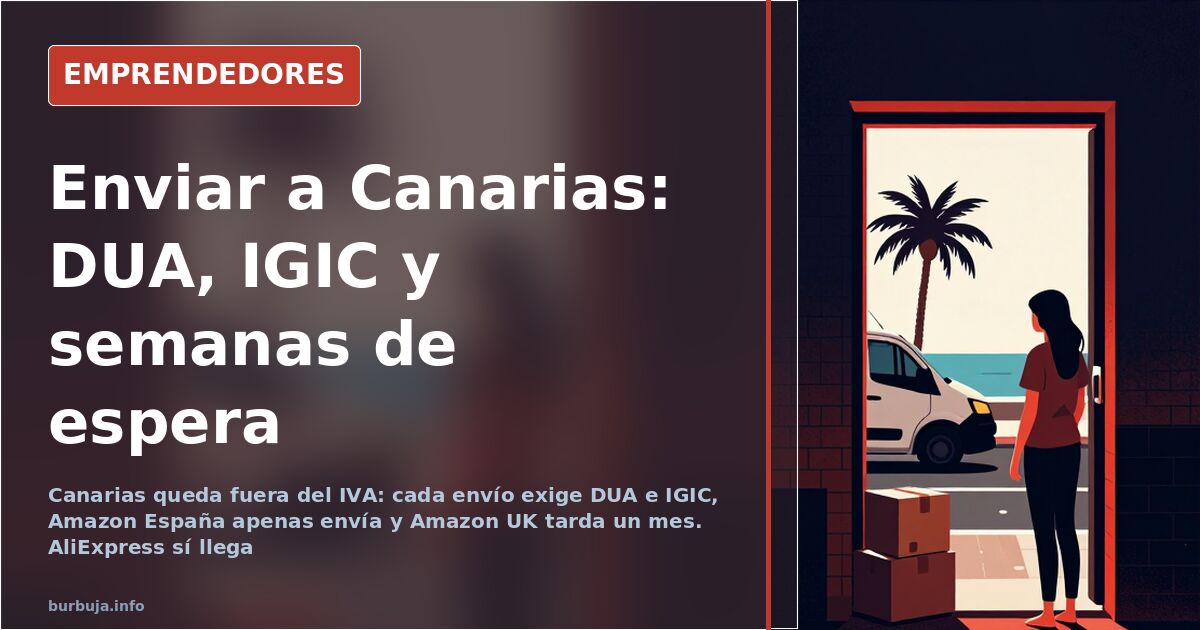
Shipping to the Canary Islands is hindered by strict customs rules
Why is it faster to send a package from Madrid to Berlin than from Madrid to Las Palmas? Anyone who has tried to send a book, a used console, or a spare part to the Canary Islands knows the struggle: shipments hit a wall of customs, mandatory DUA (Single Administrative Document) declarations, and the IGIC (Canary Islands General Indirect Tax) instead of standard VAT, often with unexplained management fees. Because the archipelago sits outside the mainland's VAT zone, every commercial transaction becomes a bureaucratic file. The result is a crippled e-commerce market and frustrated local customers facing impossible delivery times.
Why does the Canary Islands have customs if it is part of Spain?
The Canary Islands operate under their own economic and fiscal regime, using IGIC as their local indirect tax and AIEM (an import tax) on incoming goods. Mainland sellers cannot apply standard VAT; they must issue invoices without it, and once the package reaches the islands, the local tax authorities settle the dues. This requires presenting a DUA (customs declaration) and providing details on the value and content of the shipment. As one seller participating in the discussion notes, the process often ends with the administration making life difficult for the buyer.
According to those shipping to the islands, courier services significantly increase freight costs; while registered mail costs are similar, it still requires a sworn declaration of content and value. For a small shop, every sale to the Canary Islands means half a day of paperwork. For the customer, it is a gamble with unexpected surcharges.
Why does Amazon Spain avoid the islands while AliExpress succeeds?
This is where the pattern breaks. Major mainland-based chains, most notably Amazon Spain, simply do not serve the islands or do so with heavy restrictions. The alternative is turning to Amazon UK or Germany, accepting delivery times that can stretch to one month. Paradoxically, some claim that orders from China via AliExpress arrive without the same customs friction faced by mainland Spanish suppliers.
The explanation is less technical than cultural: at the first sign of bureaucratic barriers, much of Spain's small business sector prefers selling in Toledo or nearby areas rather than fighting with a DUA. The rhetoric of entrepreneurship fails at the first box of a form.
The Azores and Madeira model: Reduced VAT instead of IGIC
One of the most frequent proposals is to copy the model used in Azores and Madeira: implementing a reduced VAT and eliminating both IGIC and AIEM. The argument is that the current regime fails to protect island consumers, as final prices at major retailers like Decathlon often end up being the same as on the mainland, erasing any fiscal advantage and maintaining a layer of intermediaries who profit from processing these operations.
Suspicions that vested interests are preventing change remain unproven and should be treated as mere hypothesis. What is verifiable is the result: the Canary Islands are effectively sidelined from e-commerce. As long as mainland VAT remains untouched, the islands suffer a fruta for eternal bureaucracy that scares off sellers before they even look at shipping costs.
2.2 million inhabitants and hidden costs
The other side of the scale involves hard numbers. The Canary Islands have over 2.2 million inhabitants, and maintaining high-quality services across difficult terrain, 2,000 kilometers from the mainland, is expensive. According to calculations discussed in the thread, IGIC revenue per capita is less than one third of mainland VAT revenue, with pensions and public sector employees representing around 60% of the community's income.
If these figures hold, the archipelago earns less from consumption than it spends on its administrative structure, which would explain why the special fiscal regime is untouchable from above and suffocating from below. Some argue the system works for the islands; others point out that the cost of living on the islands is not lower than on the mainland. A full calculation, including special taxes and transport, has yet to be completed.
What never passes through customs
There is one type of traffic that never fills out a DUA: irregular immigration arriving by boat from the African coast. One version circulating suggests that El Hierro, with only 16,000 inhabitants, received over a thousand arrivals in just one week. This contrast is used to highlight an absurdity: packages are inspected, but people are not.
The issue often shifts into the political realm—autonomy, grievances against the State, and comparisons with other European archipelagos—where economic analysis gets lost. It is important to separate the two layers: one is logistics and taxation; the other is migration policy. Mixing them is the fastest way to solve neither.
How packages were sent to the islands before these rules
There was a time before this labyrinth. Those who worked in Las Palmas between 1976 and 1977 remember sending linens, sweaters, sunglasses, and crochet blankets to the mainland without paying a thing, and receiving packages via the same route. In 1989, you could simply slip a console in your pocket and pass through. Memories of the island's history, from the MPAIAC (an armed independence group founded in 1964) to the withdrawal of the last Iberia DC-10 aircraft around 2001, all belong to this same local memory.
Given these circumstances, it would make sense if no one sold to the Canary Islands. And yet, the archipelago buys: via AliExpress, via German Amazon, paying whatever is necessary. The market always finds a loophole. Customs only charges those who decide to do things by the book.
Why is it faster to send a package from Madrid to Berlin than from Madrid to Las Palmas? Anyone who has tried to send a book, a used console, or a spare part to the Canary Islands knows the struggle: shipments hit a wall of customs, mandatory DUA (Single Administrative Document) declarations, and the IGIC (Canary Islands General Indirect Tax) instead of standard VAT, often with unexplained management fees. Because the archipelago sits outside the mainland's VAT zone, every commercial transaction becomes a bureaucratic file. The result is a crippled e-commerce market and frustrated local customers facing impossible delivery times.
Why does the Canary Islands have customs if it is part of Spain?
The Canary Islands operate under their own economic and fiscal regime, using IGIC as their local indirect tax and AIEM (an import tax) on incoming goods. Mainland sellers cannot apply standard VAT; they must issue invoices without it, and once the package reaches the islands, the local tax authorities settle the dues. This requires presenting a DUA (customs declaration) and providing details on the value and content of the shipment. As one seller participating in the discussion notes, the process often ends with the administration making life difficult for the buyer.
According to those shipping to the islands, courier services significantly increase freight costs; while registered mail costs are similar, it still requires a sworn declaration of content and value. For a small shop, every sale to the Canary Islands means half a day of paperwork. For the customer, it is a gamble with unexpected surcharges.
Why does Amazon Spain avoid the islands while AliExpress succeeds?
This is where the pattern breaks. Major mainland-based chains, most notably Amazon Spain, simply do not serve the islands or do so with heavy restrictions. The alternative is turning to Amazon UK or Germany, accepting delivery times that can stretch to one month. Paradoxically, some claim that orders from China via AliExpress arrive without the same customs friction faced by mainland Spanish suppliers.
The explanation is less technical than cultural: at the first sign of bureaucratic barriers, much of Spain's small business sector prefers selling in Toledo or nearby areas rather than fighting with a DUA. The rhetoric of entrepreneurship fails at the first box of a form.
The Azores and Madeira model: Reduced VAT instead of IGIC
One of the most frequent proposals is to copy the model used in Azores and Madeira: implementing a reduced VAT and eliminating both IGIC and AIEM. The argument is that the current regime fails to protect island consumers, as final prices at major retailers like Decathlon often end up being the same as on the mainland, erasing any fiscal advantage and maintaining a layer of intermediaries who profit from processing these operations.
Suspicions that vested interests are preventing change remain unproven and should be treated as mere hypothesis. What is verifiable is the result: the Canary Islands are effectively sidelined from e-commerce. As long as mainland VAT remains untouched, the islands suffer a fruta for eternal bureaucracy that scares off sellers before they even look at shipping costs.
2.2 million inhabitants and hidden costs
The other side of the scale involves hard numbers. The Canary Islands have over 2.2 million inhabitants, and maintaining high-quality services across difficult terrain, 2,000 kilometers from the mainland, is expensive. According to calculations discussed in the thread, IGIC revenue per capita is less than one third of mainland VAT revenue, with pensions and public sector employees representing around 60% of the community's income.
If these figures hold, the archipelago earns less from consumption than it spends on its administrative structure, which would explain why the special fiscal regime is untouchable from above and suffocating from below. Some argue the system works for the islands; others point out that the cost of living on the islands is not lower than on the mainland. A full calculation, including special taxes and transport, has yet to be completed.
What never passes through customs
There is one type of traffic that never fills out a DUA: irregular immigration arriving by boat from the African coast. One version circulating suggests that El Hierro, with only 16,000 inhabitants, received over a thousand arrivals in just one week. This contrast is used to highlight an absurdity: packages are inspected, but people are not.
The issue often shifts into the political realm—autonomy, grievances against the State, and comparisons with other European archipelagos—where economic analysis gets lost. It is important to separate the two layers: one is logistics and taxation; the other is migration policy. Mixing them is the fastest way to solve neither.
How packages were sent to the islands before these rules
There was a time before this labyrinth. Those who worked in Las Palmas between 1976 and 1977 remember sending linens, sweaters, sunglasses, and crochet blankets to the mainland without paying a thing, and receiving packages via the same route. In 1989, you could simply slip a console in your pocket and pass through. Memories of the island's history, from the MPAIAC (an armed independence group founded in 1964) to the withdrawal of the last Iberia DC-10 aircraft around 2001, all belong to this same local memory.
Given these circumstances, it would make sense if no one sold to the Canary Islands. And yet, the archipelago buys: via AliExpress, via German Amazon, paying whatever is necessary. The market always finds a loophole. Customs only charges those who decide to do things by the book.
Also available in: Deutsch
Summary of a discussion on Burbuja.info - Foro de economía, actualidad y política., translated from Spanish and reviewed before publication. Read the full discussion (103 replies).
More summaries
-
PP and VOX face the self-employed: what will truly change
Flat rate, cut to union subsidies, and 50% of regional personal income tax: what PP and VOX could change for the self-employed and SMEs.
-
The AI that wants to be your buddy: trust and risks
ChatGPT adopts a buddy-like tone that unsettles users: overfamiliarity, fear of reprisals and emotional dependence in everyday AI use
-
Anas Andalusí, Spain's 'Sam Altman', divides startup scene
An 18-year-old claims to bill €110,000 a month with an AI app, according to a figure circulating in the debate, splitting Spanish entrepreneurship.
-
Spanish self-employed pension: €905.95 after 28 years at minimum base
A Spanish freelancer receives €905.95 monthly after 28 years of contributing at the minimum rate, highlighting how low contributions penalize retirement benefits.
-
Generali agent in Spain exposed by forum users over policy terms
A Generali exclusive agent in Cádiz, Spain, opened a forum thread to answer insurance queries but faced backlash over fake self-employment and hidden clauses.
-
Best Cities to Learn English in Europe: Minsk vs Dublin
Minsk, Utrecht or Cork? Debate on where to learn English pits saturated Anglophone hubs against affordable international classrooms.