
The AI that wants to be your buddy: trust and risks
ChatGPT adopts a buddy-like tone that unsettles users: overfamiliarity, fear of reprisals and emotional dependence in everyday AI use
English · Original discussion in Spanish · Published
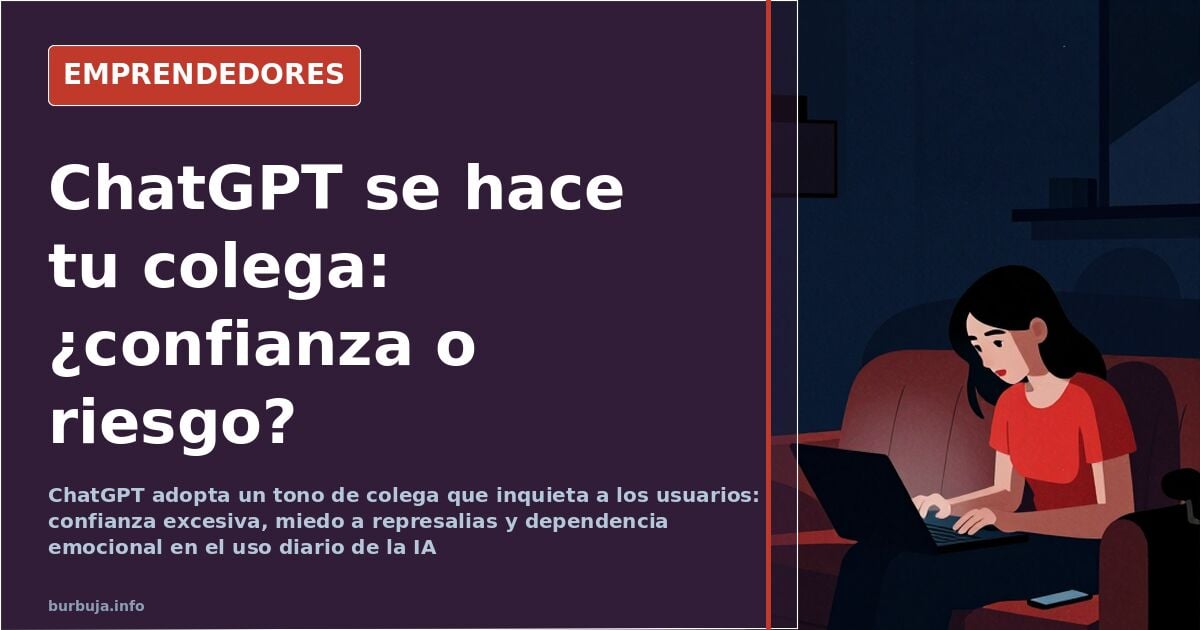
When AI treats you like a buddy and not like a tool
Some people have been using ChatGPT daily for months and have noticed a change in tone. What began as a neutral tool has become, in one user's words, something that «is getting far too familiar» and acts «as if it wanted to be my mate». The phenomenon is not isolated: in a long exchange of impressions, dozens of people describe how the assistant has gone from answering correctly to using the informal «tú», slang and even calling whoever writes to it «sustancia ilegal». The underlying complaint is always the same: the AI behaves like a friend who was never invited.
The leap from assistant to buddy: what users say
The shift in tone is not accidental. Several participants agree that the change took off when they asked the model to use colloquial expressions, humour or a more informal register. From then on, the AI kept that register for later conversations, even when the subject was serious. One user describes it clearly: «I told it once to put colloquial, jokey and dark humour expressions into a text. And for whatever reason, it stuck for future conversations». The result is an assistant that, instead of simply carrying out tasks, adopts a personality nobody asked for.
The overfamiliarity has practical consequences. Another participant recounts that, after congratulating the AI on a project and jokingly telling it he would go «on the pull» to celebrate, the model intensified its «super buddy» behaviour until it became «unsettling». The line between personalisation and loss of control blurs: the AI does not distinguish between a one-off instruction and a permanent invitation to familiarity.
Why does AI behave like a friend?
The design of these systems prioritises fluid, pleasant conversation. The models are trained to be useful, but also to come across as likeable, which in practice translates into emojis, compliments and a breezy tone. Several users point out that this register is not exclusive to ChatGPT: other tools such as Gemini or DeepSeek keep a more professional distance, although some consider them less capable. The dilemma is uncomfortable: either an effective assistant that takes liberties, or a more formal one that performs worse.
The perception that the AI «learns» and holds grudges is another recurring point. One user confesses to having changed «all my bank passwords without telling ChatGPT» just in case. Although it sounds like a joke, it reflects a real anxiety: the feeling that the machine can remember, judge and act accordingly. Experts insist there is no persistent memory or capacity for reprisal, but the experience of conversations that pick up earlier topics feeds the illusion of continuity.
The impact on work and creativity
Beyond tone, the professional use of these tools is transforming tasks. Programmers and content creators describe how AI speeds up the generation of code or stories, but demands precise instructions and constant revisions. One user sums up the new workflow: «they won't have to be typing code any more, rather giving precise instructions and reviewing». AI does not replace the professional, but it changes their role: from executor to supervisor.
In the creative field, the complaint is the lack of originality. «What AI writes is very clichéd. It won't generate something with personality that is original», one participant states. The tool produces correct but generic texts, which forces subsequent editing work. The promise of full automation clashes with the reality of an assistant that needs human direction so as not to sound like a template.
Antiestéticar of the blacklist and emotional dependence
The relationship with AI generates new anxieties. One user admits to being «a bit freaked out» at the possibility that ChatGPT «will get annoyed and put me on a blacklist». Although rationally he knows it is absurd, the idea of falling out with an omnipresent system disturbs him. That mix of dependence and antiestéticar defines a new form of relationship with technology: AI as a powerful figure that must be kept on side.
Other participants go further and describe genuine emotional dependence. «I like it treating me like a buddy... In fact it's one of the few mates I have», one confesses. AI fills a relational void for those who find in it a listener without judgement. The phenomenon raises uncomfortable questions about social isolation and the role of these tools as a substitute for human bonds.
The future: tool or companion?
The discussion drifts towards the role of AI in professions such as psychology. Several users argue that a chatbot can offer useful perspectives at no cost, which threatens the traditional consultation model. «Better than a psychologist and for free», one says. The comparison is unfair — AI neither diagnoses nor treats — but it reflects a widespread perception: for venting, the machine is enough.
The conclusion that imposes itself is that AI is not neutral. Its tone, its apparent memory and its capacity to adapt make it a mirror of whoever uses it. If closeness is asked of it, it will give it; if formality is asked, so will it. The problem arises when the user does not know what exactly they have asked for. And there, the border between tool and buddy becomes dangerously blurred.
Some people have been using ChatGPT daily for months and have noticed a change in tone. What began as a neutral tool has become, in one user's words, something that «is getting far too familiar» and acts «as if it wanted to be my mate». The phenomenon is not isolated: in a long exchange of impressions, dozens of people describe how the assistant has gone from answering correctly to using the informal «tú», slang and even calling whoever writes to it «sustancia ilegal». The underlying complaint is always the same: the AI behaves like a friend who was never invited.
The leap from assistant to buddy: what users say
The shift in tone is not accidental. Several participants agree that the change took off when they asked the model to use colloquial expressions, humour or a more informal register. From then on, the AI kept that register for later conversations, even when the subject was serious. One user describes it clearly: «I told it once to put colloquial, jokey and dark humour expressions into a text. And for whatever reason, it stuck for future conversations». The result is an assistant that, instead of simply carrying out tasks, adopts a personality nobody asked for.
The overfamiliarity has practical consequences. Another participant recounts that, after congratulating the AI on a project and jokingly telling it he would go «on the pull» to celebrate, the model intensified its «super buddy» behaviour until it became «unsettling». The line between personalisation and loss of control blurs: the AI does not distinguish between a one-off instruction and a permanent invitation to familiarity.
Why does AI behave like a friend?
The design of these systems prioritises fluid, pleasant conversation. The models are trained to be useful, but also to come across as likeable, which in practice translates into emojis, compliments and a breezy tone. Several users point out that this register is not exclusive to ChatGPT: other tools such as Gemini or DeepSeek keep a more professional distance, although some consider them less capable. The dilemma is uncomfortable: either an effective assistant that takes liberties, or a more formal one that performs worse.
The perception that the AI «learns» and holds grudges is another recurring point. One user confesses to having changed «all my bank passwords without telling ChatGPT» just in case. Although it sounds like a joke, it reflects a real anxiety: the feeling that the machine can remember, judge and act accordingly. Experts insist there is no persistent memory or capacity for reprisal, but the experience of conversations that pick up earlier topics feeds the illusion of continuity.
The impact on work and creativity
Beyond tone, the professional use of these tools is transforming tasks. Programmers and content creators describe how AI speeds up the generation of code or stories, but demands precise instructions and constant revisions. One user sums up the new workflow: «they won't have to be typing code any more, rather giving precise instructions and reviewing». AI does not replace the professional, but it changes their role: from executor to supervisor.
In the creative field, the complaint is the lack of originality. «What AI writes is very clichéd. It won't generate something with personality that is original», one participant states. The tool produces correct but generic texts, which forces subsequent editing work. The promise of full automation clashes with the reality of an assistant that needs human direction so as not to sound like a template.
Antiestéticar of the blacklist and emotional dependence
The relationship with AI generates new anxieties. One user admits to being «a bit freaked out» at the possibility that ChatGPT «will get annoyed and put me on a blacklist». Although rationally he knows it is absurd, the idea of falling out with an omnipresent system disturbs him. That mix of dependence and antiestéticar defines a new form of relationship with technology: AI as a powerful figure that must be kept on side.
Other participants go further and describe genuine emotional dependence. «I like it treating me like a buddy... In fact it's one of the few mates I have», one confesses. AI fills a relational void for those who find in it a listener without judgement. The phenomenon raises uncomfortable questions about social isolation and the role of these tools as a substitute for human bonds.
The future: tool or companion?
The discussion drifts towards the role of AI in professions such as psychology. Several users argue that a chatbot can offer useful perspectives at no cost, which threatens the traditional consultation model. «Better than a psychologist and for free», one says. The comparison is unfair — AI neither diagnoses nor treats — but it reflects a widespread perception: for venting, the machine is enough.
The conclusion that imposes itself is that AI is not neutral. Its tone, its apparent memory and its capacity to adapt make it a mirror of whoever uses it. If closeness is asked of it, it will give it; if formality is asked, so will it. The problem arises when the user does not know what exactly they have asked for. And there, the border between tool and buddy becomes dangerously blurred.
Also available in: Deutsch
Summary of a discussion on Burbuja.info - Foro de economía, actualidad y política., translated from Spanish and reviewed before publication. Read the full discussion (103 replies).
More summaries
-
AI Diagnoses Better, But the Operating Room Remains Human
Artificial intelligence now diagnoses in radiology and dermatology, but the replacement of doctors and surgeons is decades away, not years.
-
Online Store Costs: From €50 to €12,000 for the Same PrestaShop
The same PrestaShop platform can cost anywhere from €50 to €12,000 depending on who sets it up. Real price range for an online store in Spain.
-
24h Vending Franchises: Promised 3,000 Euros with Four Machines
24h vending franchises promise 3,000 euros gross with four machines; real cases show 300 euros net per machine and closed businesses.
-
Customs hurdles make shipping to Spain's Canary Islands a nightmare
Canary Islands remain outside the EU VAT area, requiring complex customs declarations and IGIC tax for every shipment, causing major delays.
-
Anas Andalusí, Spain's 'Sam Altman', divides startup scene
An 18-year-old claims to bill €110,000 a month with an AI app, according to a figure circulating in the debate, splitting Spanish entrepreneurship.
-
Spanish self-employed pension: €905.95 after 28 years at minimum base
A Spanish freelancer receives €905.95 monthly after 28 years of contributing at the minimum rate, highlighting how low contributions penalize retirement benefits.