
Cuba Rations Bread to Children and Pregnant Women Amid Crisis
Cuba restricts subsidized bread to children and pregnant women, seeking UN food aid as 79% of citizens cite hunger as their top concern.
English · Original discussion in Spanish · Published
Cuba Rations Bread to Children and Pregnant Women
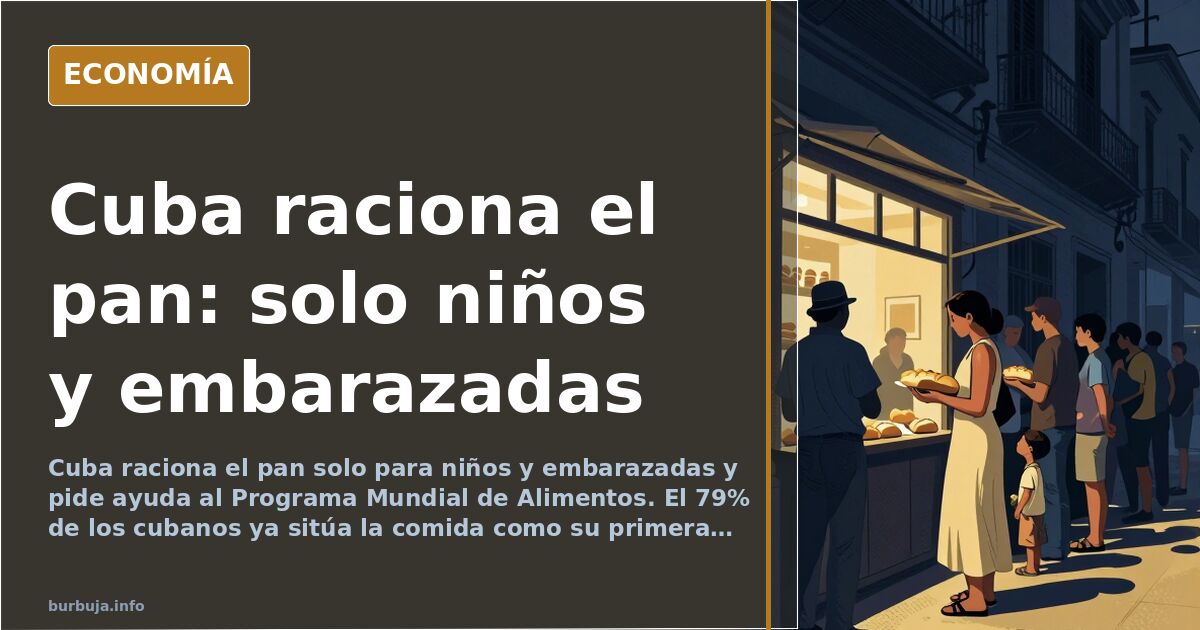
The Cuban socialist model has reached such a state of failure that state bakery supplies no longer suffice for the population. As of February 28, according to a notice posted by the Administration in Pinar del Río, only children aged zero to fourteen, pregnant women, and certain health sector workers may collect subsidized bread via the rationing booklet (libreta). The rest must wait. Milk, when available, arrives as powder amid complaints: some describe a product that does not even dissolve in water. The Castro government has requested assistance from the World Food Programme for the first time.
This is not an anecdote about temporary scarcity. It is the snapshot of a systemic crisis that has already made food security the country's primary concern: for 79% of respondents, it is the number one priority, according to a poll by the Cuba Siglo XXI think tank across all fifteen provinces. Public health ranks second (58%) and power outages third (56%). And a statistic that unsettles the official narrative: 92% believe economic freedom is essential to escape the hole.
Why Bread Is Missing in Cuba
Economist Pedro Monreal quantified it bluntly: a contraction of nearly 30% in physical wheat imports in just one year dried up availability for the most widely consumed staple in households already impoverished by inflation. The official newspaper Granma attributed the disaster to delays in contracted shipments. None arrived on time. This explanation sits poorly with another fact the regime itself does not hide: private small and medium-sized enterprises continue importing flour without interruption.
Milk suffers from an older problem. According to field analyses circulating locally, the price the State pays producers crushes the business: around one dollar is paid for every 17 liters delivered, pushing farmers to sell outside the official circuit. On the black market, a liter can reach 6 dollars if one is lucky enough to find it. Price controls plus collapsed supply: the basic manual.
Cassava Flour and Pumpkin Puree to Fill the Gap
State bakeries have resorted to so-called extenders: pumpkin puree, cassava flour, or sweet potato dough to stretch what isn't there. Those with relatives abroad buy thirty-day combos of hamburger and hot dog buns, paid from outside in dollars. The ration booklet distributes misery, while pockets with foreign currency buy breakfast. Two Cubas on the same block.
Meanwhile, the regime's economic package raises fuel prices with increases reaching 500% in some categories, delayed by a month due to a hack the Government claims to have overcome. The hike arrives with the country weary and in full diaspora. The Cuban Observatory of Human Rights maintains that poverty now affects 88% of households.
The Embargo as Explanation and Its Limits
The most repeated defense outside the island is the US embargo. The argument has a calendar problem: the shortage of essential goods predates any tightening and worsened when the Soviet financier disappeared, the same one who in the seventies allowed Havana to sustain an army and wage war in Angola. A country with ample arable land should not need to import the bread it eats.
There is a geopolitical thesis circulating strongly: Washington prefers a docile regime ninety miles away over a failed state pushing millions toward its border. It is argued that a truly ironclad blockade would not last five months, and that the real interest is an associated Cuba, not a free Cuba. The paradox stands alone: the embargo is accused of sustaining the dictatorship and of being insufficient to topple it.
The Question That Remains Unanswered
One month after the Pinar del Río notice, bread still had not reached the stores. Queues, laments, and social media serve as pressure valves while the Government requests powdered milk from the UN for children under seven. How long can a country withstand rations on its children's breakfast before someone has to explain why?
The Cuban socialist model has reached such a state of failure that state bakery supplies no longer suffice for the population. As of February 28, according to a notice posted by the Administration in Pinar del Río, only children aged zero to fourteen, pregnant women, and certain health sector workers may collect subsidized bread via the rationing booklet (libreta). The rest must wait. Milk, when available, arrives as powder amid complaints: some describe a product that does not even dissolve in water. The Castro government has requested assistance from the World Food Programme for the first time.
This is not an anecdote about temporary scarcity. It is the snapshot of a systemic crisis that has already made food security the country's primary concern: for 79% of respondents, it is the number one priority, according to a poll by the Cuba Siglo XXI think tank across all fifteen provinces. Public health ranks second (58%) and power outages third (56%). And a statistic that unsettles the official narrative: 92% believe economic freedom is essential to escape the hole.
Why Bread Is Missing in Cuba
Economist Pedro Monreal quantified it bluntly: a contraction of nearly 30% in physical wheat imports in just one year dried up availability for the most widely consumed staple in households already impoverished by inflation. The official newspaper Granma attributed the disaster to delays in contracted shipments. None arrived on time. This explanation sits poorly with another fact the regime itself does not hide: private small and medium-sized enterprises continue importing flour without interruption.
Milk suffers from an older problem. According to field analyses circulating locally, the price the State pays producers crushes the business: around one dollar is paid for every 17 liters delivered, pushing farmers to sell outside the official circuit. On the black market, a liter can reach 6 dollars if one is lucky enough to find it. Price controls plus collapsed supply: the basic manual.
Cassava Flour and Pumpkin Puree to Fill the Gap
State bakeries have resorted to so-called extenders: pumpkin puree, cassava flour, or sweet potato dough to stretch what isn't there. Those with relatives abroad buy thirty-day combos of hamburger and hot dog buns, paid from outside in dollars. The ration booklet distributes misery, while pockets with foreign currency buy breakfast. Two Cubas on the same block.
Meanwhile, the regime's economic package raises fuel prices with increases reaching 500% in some categories, delayed by a month due to a hack the Government claims to have overcome. The hike arrives with the country weary and in full diaspora. The Cuban Observatory of Human Rights maintains that poverty now affects 88% of households.
The Embargo as Explanation and Its Limits
The most repeated defense outside the island is the US embargo. The argument has a calendar problem: the shortage of essential goods predates any tightening and worsened when the Soviet financier disappeared, the same one who in the seventies allowed Havana to sustain an army and wage war in Angola. A country with ample arable land should not need to import the bread it eats.
There is a geopolitical thesis circulating strongly: Washington prefers a docile regime ninety miles away over a failed state pushing millions toward its border. It is argued that a truly ironclad blockade would not last five months, and that the real interest is an associated Cuba, not a free Cuba. The paradox stands alone: the embargo is accused of sustaining the dictatorship and of being insufficient to topple it.
The Question That Remains Unanswered
One month after the Pinar del Río notice, bread still had not reached the stores. Queues, laments, and social media serve as pressure valves while the Government requests powdered milk from the UN for children under seven. How long can a country withstand rations on its children's breakfast before someone has to explain why?
Summary of a discussion on Burbuja.info - Foro de economía, actualidad y política., translated from Spanish and reviewed before publication. Read the full discussion (166 replies).
More summaries
-
US Claims 'Zero Casualties' in Caracas Raid, Cuba Reports 32 Dead
US reports zero casualties in the raid that captured Maduro, using 150 aircraft. A publication claims 32 Cuban soldiers died.
-
A 45-year-old song's royalties: 1.500€ a day, according to a forum
A forum puts royalties on a 45-year-old song at 1.500€ a day; debate over Hacienda (Spain's tax office) and the digital levy
-
Tenant Union: Who Finances the Illegal Strike in Spain?
The Tenant Union is not a legal union but receives 3.7 million euros in public funds. It called a general rent strike on November 11, sparking controversy over its funding and political ties.
-
Von der Leyen seeks Russian asset profits for Ukraine ammo
Von der Leyen proposes using frozen Russian asset yields to buy ammunition and double European production to over two million rounds in 2025.
-
ABC's 2071 Spain Vision Sparks Backlash from Readers
ABC projects Spain in 2071, but readers see it as a threat citing the 2030 Agenda and demographic replacement.
-
King Felipe VI's Amnesty Signature Contradicts Ussía’s Claims
Alfonso Ussía claimed King Felipe VI held powerful reports and would block the amnesty; the law was signed, disproving the prediction.