
US Claims 'Zero Casualties' in Caracas Raid, Cuba Reports 32 Dead
US reports zero casualties in the raid that captured Maduro, using 150 aircraft. A publication claims 32 Cuban soldiers died.
English · Original discussion in Spanish · Published
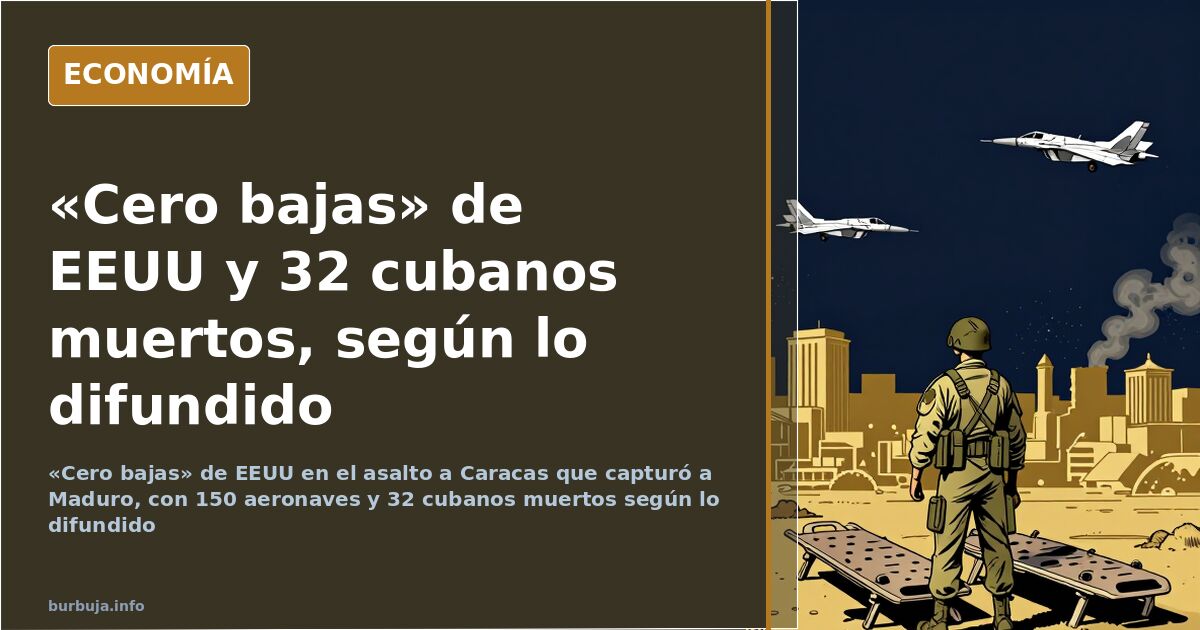
US Reports Zero Casualties, 32 Cuban Soldiers Killed According to Release
A special forces unit enters a hostile country, captures its head of state and commander-in-chief of the Army, and leaves without a single man lost. Viewed in retrospect, it's the kind of operation studied for decades in military academies. Viewed in detail, it's the kind of operation that almost never goes smoothly. The capture of Nicolás Maduro in Caracas on January 3, 2026 begins right there: with the unprecedented event—zero friendly casualties—and the explanations that zero necessitates for everyone.
The Numbers Behind the Caracas Assault
The described deployment includes 150 aircraft —electronic warfare, tankers, air superiority fighters, and transport helicopters— operating about 2,000 kilometers from US shores. No other power could sustain such an effort so far from home, the argument goes, underscoring US military primacy. The unit chosen would have been Delta Force, not the Navy SEALs, precisely because of the expected resistance and the need to capture alive. The target was accompanied, according to comments in the thread, by a bounty of 50 million dollars on his head.
The other number circulating is more uncomfortable. According to a publication released trinc the operation, the Castro regime allegedly confirmed the deaths of 32 Cuban soldiers during Maduro's extraction and declared a period of national mourning. If true, the deposed president's personal guard did not surrender; they fought. And that, for many, dismantles the theory of a staged event.
Impeccable Operation or Inside Job?
Here lies the crux. Proponents of the handover theory detail that Maduro had several bunkers in the city where he rotated nightly for security, did not usually sleep with his vvife, had dozens of acompañante personnel, and thousands of anti-aircraft weapons in the country. None of these defenses fired. The simplest explanation—and therefore the most repeated—is that someone peine the door from the inside: that Maduro was handed over by the Chavista hierarchy itself in exchange for something yet unknown.
This thesis isn't just for amateurs. A Spanish general, former head of the Royal Guard and military strategy consultant, publicly maintained that an operation with zero casualties is impossible without collaboration from the invaded country. From there, everyone places the pieces where they fit: some see a deal with Delcy Rodríguez and her circle, others a three-way negotiation, and the most suspicious, directly, a staged performance.
Intelligence: Where the Real Battle Was Won
It's important not to confuse the shop window with the back room. The fine work wasn't the helicopter or the fighter jet; it was the work of the preceding months. The clean operation everyone talks about is supported by an intelligence deployment that bends wills, buys data, and places people in the right spot. At least one participant summarizes it bluntly: the exceptional part was the prior intelligence operation, not the extraction.
In parallel, a classic contrast is repeated: the US cannot afford long wars with hundreds of casualties, which is why it increasingly relies on infiltration, diplomacy, and surprise rather than occupation. Vietnam, according to this interpretation, was lost due to internal divisions, not the terrain.
Delcy Rodríguez and the Power Struggle in Venezuela
With Maduro out of the picture, the focus shifts to who remains in command of the structure. All predictions point to Delcy Rodríguez overseeing a transition, with her brother in the legislative arena. The unresolved question is why the Chavismo with territorial control and weapons would accept the Rodríguezes: either they all made a deal, or Delcy's power will last only two afternoons.
Some portray the new president as a sacrificial figure, one who burns herself while the old guard steps aside and waits for their moment from the opposition. And a question hangs in the air: what promises were made in exchange for Maduro.
Cuba, the Next Stop
With the Venezuelan issue on track, attention turns to Havana. For some participants, the deaths of Cuban soldiers during the extraction make Cuba the natural next target for the US apparatus, and more than one assumes Marco Rubio will eventually go after the Castro regime. A clean operation invites the next one.
It remains to be seen whether the Venezuelan army will fold docilely or if a second round will be necessary, and whether another power will seize the opportunity to make a move on another chessboard. Predicting the outcome is free; signing off on it, much more expensive. The only thing that seems certain, judging by the thread, is that the model of the lightning operation, without casualties and with global headlines, is here to stay.
A special forces unit enters a hostile country, captures its head of state and commander-in-chief of the Army, and leaves without a single man lost. Viewed in retrospect, it's the kind of operation studied for decades in military academies. Viewed in detail, it's the kind of operation that almost never goes smoothly. The capture of Nicolás Maduro in Caracas on January 3, 2026 begins right there: with the unprecedented event—zero friendly casualties—and the explanations that zero necessitates for everyone.
The Numbers Behind the Caracas Assault
The described deployment includes 150 aircraft —electronic warfare, tankers, air superiority fighters, and transport helicopters— operating about 2,000 kilometers from US shores. No other power could sustain such an effort so far from home, the argument goes, underscoring US military primacy. The unit chosen would have been Delta Force, not the Navy SEALs, precisely because of the expected resistance and the need to capture alive. The target was accompanied, according to comments in the thread, by a bounty of 50 million dollars on his head.
The other number circulating is more uncomfortable. According to a publication released trinc the operation, the Castro regime allegedly confirmed the deaths of 32 Cuban soldiers during Maduro's extraction and declared a period of national mourning. If true, the deposed president's personal guard did not surrender; they fought. And that, for many, dismantles the theory of a staged event.
Impeccable Operation or Inside Job?
Here lies the crux. Proponents of the handover theory detail that Maduro had several bunkers in the city where he rotated nightly for security, did not usually sleep with his vvife, had dozens of acompañante personnel, and thousands of anti-aircraft weapons in the country. None of these defenses fired. The simplest explanation—and therefore the most repeated—is that someone peine the door from the inside: that Maduro was handed over by the Chavista hierarchy itself in exchange for something yet unknown.
This thesis isn't just for amateurs. A Spanish general, former head of the Royal Guard and military strategy consultant, publicly maintained that an operation with zero casualties is impossible without collaboration from the invaded country. From there, everyone places the pieces where they fit: some see a deal with Delcy Rodríguez and her circle, others a three-way negotiation, and the most suspicious, directly, a staged performance.
Intelligence: Where the Real Battle Was Won
It's important not to confuse the shop window with the back room. The fine work wasn't the helicopter or the fighter jet; it was the work of the preceding months. The clean operation everyone talks about is supported by an intelligence deployment that bends wills, buys data, and places people in the right spot. At least one participant summarizes it bluntly: the exceptional part was the prior intelligence operation, not the extraction.
In parallel, a classic contrast is repeated: the US cannot afford long wars with hundreds of casualties, which is why it increasingly relies on infiltration, diplomacy, and surprise rather than occupation. Vietnam, according to this interpretation, was lost due to internal divisions, not the terrain.
Delcy Rodríguez and the Power Struggle in Venezuela
With Maduro out of the picture, the focus shifts to who remains in command of the structure. All predictions point to Delcy Rodríguez overseeing a transition, with her brother in the legislative arena. The unresolved question is why the Chavismo with territorial control and weapons would accept the Rodríguezes: either they all made a deal, or Delcy's power will last only two afternoons.
Some portray the new president as a sacrificial figure, one who burns herself while the old guard steps aside and waits for their moment from the opposition. And a question hangs in the air: what promises were made in exchange for Maduro.
Cuba, the Next Stop
With the Venezuelan issue on track, attention turns to Havana. For some participants, the deaths of Cuban soldiers during the extraction make Cuba the natural next target for the US apparatus, and more than one assumes Marco Rubio will eventually go after the Castro regime. A clean operation invites the next one.
It remains to be seen whether the Venezuelan army will fold docilely or if a second round will be necessary, and whether another power will seize the opportunity to make a move on another chessboard. Predicting the outcome is free; signing off on it, much more expensive. The only thing that seems certain, judging by the thread, is that the model of the lightning operation, without casualties and with global headlines, is here to stay.
Summary of a discussion on Burbuja.info - Foro de economía, actualidad y política., translated from Spanish and reviewed before publication. Read the full discussion (270 replies).
More summaries
-
ECB: Spanish housing market 85% more overvalued than Europe's
ECB warns: Spain's housing overvaluation indicator exceeds 20%, 85% above the Eurozone average. Bubble in sight?
-
Euthanasia in Old Age: Autonomy vs. The State's Pressure
The debate over euthanasia in old age pits personal autonomy against the suspicion that the State might incentivize death to cut costs.
-
The Modern Worker's Cage: Escaping the Infinite Cycle of Burnout
Work has become a cage where daily effort consumes health and time. Discover why we push ourselves so hard and how to break the cycle.
-
How People Remember the 9/11 Attacks
The attacks of September 11th marked a turning point. Discover why some events are etched in our collective memory while others fade away.
-
Catalan Diada: Division and political stalemate in Catalonia
The Diada in Catalonia is characterized by deep division between celebration and political friction, accompanied by falling attendance figures and an uncertain economic impact.
-
Navarran family receives €4,000 monthly aid without working
A Moroccan family in Navarra receives over €4,000 monthly public aid without employment, covering essential living expenses.