
Crypto ICOs: From Whitepaper to Big Hit or Scam
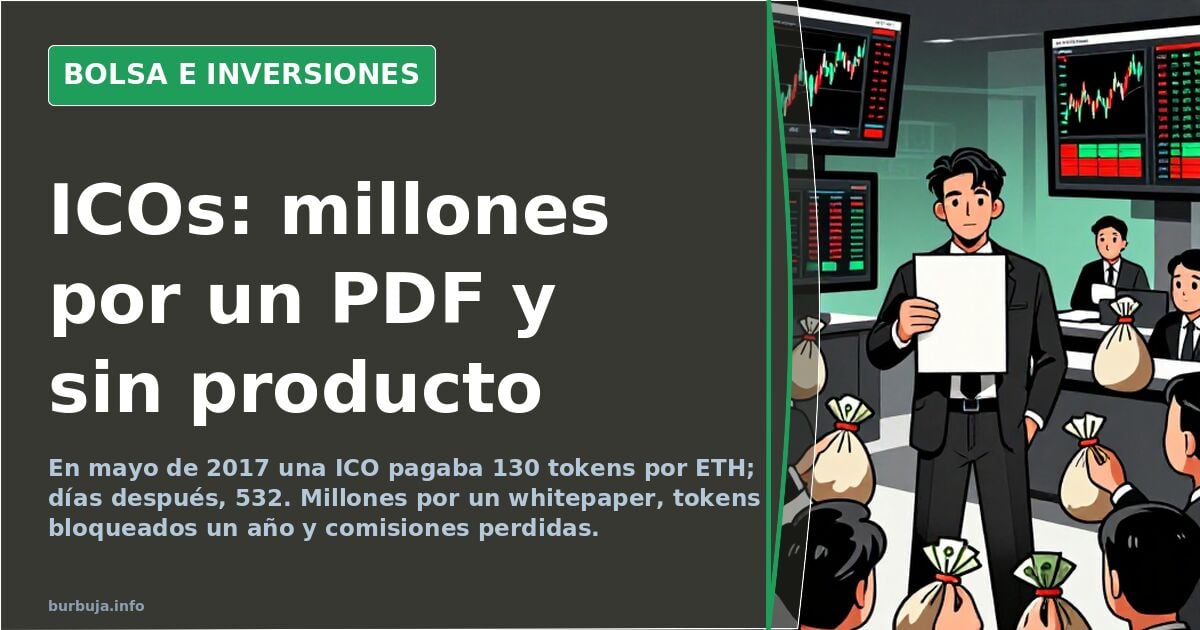
In May 2017, an ICO paid 130 tokens per ETH; days later, 532. Millions for a whitepaper, locked tokens for a year, and lost fees.
English · Original discussion in Spanish · Published
From Whitepapers to Scams: How ICOs Were Invested In
In May 2017, crypto money ceased to be a hobby for enthusiasts and became a funding source that raised hundreds of millions of dollars in hours. A year later, the same ecosystem that treated whitepapers as masterpieces began to accept an uncomfortable truth: most of those issuances were not worth their cost. Projects were advertised with trackers, rating websites, and a Telegram group as the sole backing. The business worked. The question was, for whom?
What is an ICO and Why Anyone Could Launch One
An ICO—Initial Coin Offering—is the public sale of tokens to fund a project, typically built on smart contracts on the Ethereum network. Unlike classic venture capital, investors participate without access to equity, without custodial rights, and without prior audit: they buy a token in exchange for ether or bitcoin and hope the token's value increases.
This option to enter the tech funding world through the back door explains the volume. A seed-stage startup rarely exceeds one million dollars in its first round if it presents little more than an idea. In the crypto circuit, a document and a website with Telegram contact were enough to raise several times that amount. Someone dryly summarized it: millions are being given for Whitepapers here.
The Conditions That Set Off All Alarms
Not all lots were equally opaque. Some stood out precisely for the opposite reason: for showing their teeth in the fine print. One issuance was documented for 100,000,000 tokens at 5 cents each with bonuses for early buyers and the possibility of releasing another 100,000,000 if the promoters deemed there was sufficient demand. Translation: you enter with a portion of the pie and can end up with half if others find it convenient to expand.
That type of clause turned distrust into an investment criterion. Contrary to the idea that the market self-regulates, some argued the obvious: when the issuer can dilute the buyer at will, no trust is possible, only faith.
When Waiting Was More Profitable Than Entering the Presale
The most cited case has concrete numbers. A gambling and betting issuance offered in its ICO 1 ETH = 130 tokens; on its first full trading day, the market paid 1 ETH = 532 tokens. In other words, those who missed the round and bought later paid four times less. The conclusion was written without embellishment: paying a fortune in the presale and seeing the developer with hundreds of millions in ether and bitcoin was starting to smell fishy.
The underlying question—why does a minimal company need 250 million dollars—remained floating for months without a convincing answer.
Tokens That Couldn't Be Moved From the Wallet
There were less philosophical problems. Several investors reported that they couldn't move their tokens from one wallet to another, and that the failed operation still cost them a fee. A specific case: three fees lost for setting a gas limit of 400,000, with payments of 0.01 ether each time. The asset kept falling while the user struggled with the smart contract.
The detail is relevant because it dismantles the narrative of financial self-management: if transferring a token requires reading an English tutorial and risking fees blindly, the barrier is not technical, it's usability.
From Windfall to Antiestéticar of the Dump: Locked Tokens
By the spring of 2018, the vocabulary changed. No longer was it about multiplying by a thousand, but about token lockups to prevent crashes. Some projects released 1/12 of the coins each month for an entire year. The response was blunt: having tokens locked for a year seems excessive to me. With that schedule, it's not that you can't sell: it's that you don't even have the asset.
The detail is disorienting because it leaves the decision in the hands of the issuer. Those who buy assume a double risk: that the product doesn't work and that their money remains held hostage while they wait.
What the Strictest Analysis Rescues
Not everything was smoke. The most repeated criterion for separating the wheat from the chaff was simple: is there a functioning product? To start with, they have a real product already working, that puts them several miles ahead of 99% of ICOs, one project was acknowledged. The rest were measured by whitepaper, alliances, Telegram community, and ratings on specialized websites.
The evolution of the discussion went from euphoria to examination. And the closing, in full correction, left a sticking point: the issuance market didn't disappear, it simply stopped being called a windfall and started being called a selective opportunity.
Disclaimer: this article is for informational purposes only and does not constitute investment advice. Digital assets involve a high risk of total capital loss.
In May 2017, crypto money ceased to be a hobby for enthusiasts and became a funding source that raised hundreds of millions of dollars in hours. A year later, the same ecosystem that treated whitepapers as masterpieces began to accept an uncomfortable truth: most of those issuances were not worth their cost. Projects were advertised with trackers, rating websites, and a Telegram group as the sole backing. The business worked. The question was, for whom?
What is an ICO and Why Anyone Could Launch One
An ICO—Initial Coin Offering—is the public sale of tokens to fund a project, typically built on smart contracts on the Ethereum network. Unlike classic venture capital, investors participate without access to equity, without custodial rights, and without prior audit: they buy a token in exchange for ether or bitcoin and hope the token's value increases.
This option to enter the tech funding world through the back door explains the volume. A seed-stage startup rarely exceeds one million dollars in its first round if it presents little more than an idea. In the crypto circuit, a document and a website with Telegram contact were enough to raise several times that amount. Someone dryly summarized it: millions are being given for Whitepapers here.
The Conditions That Set Off All Alarms
Not all lots were equally opaque. Some stood out precisely for the opposite reason: for showing their teeth in the fine print. One issuance was documented for 100,000,000 tokens at 5 cents each with bonuses for early buyers and the possibility of releasing another 100,000,000 if the promoters deemed there was sufficient demand. Translation: you enter with a portion of the pie and can end up with half if others find it convenient to expand.
That type of clause turned distrust into an investment criterion. Contrary to the idea that the market self-regulates, some argued the obvious: when the issuer can dilute the buyer at will, no trust is possible, only faith.
When Waiting Was More Profitable Than Entering the Presale
The most cited case has concrete numbers. A gambling and betting issuance offered in its ICO 1 ETH = 130 tokens; on its first full trading day, the market paid 1 ETH = 532 tokens. In other words, those who missed the round and bought later paid four times less. The conclusion was written without embellishment: paying a fortune in the presale and seeing the developer with hundreds of millions in ether and bitcoin was starting to smell fishy.
The underlying question—why does a minimal company need 250 million dollars—remained floating for months without a convincing answer.
Tokens That Couldn't Be Moved From the Wallet
There were less philosophical problems. Several investors reported that they couldn't move their tokens from one wallet to another, and that the failed operation still cost them a fee. A specific case: three fees lost for setting a gas limit of 400,000, with payments of 0.01 ether each time. The asset kept falling while the user struggled with the smart contract.
The detail is relevant because it dismantles the narrative of financial self-management: if transferring a token requires reading an English tutorial and risking fees blindly, the barrier is not technical, it's usability.
From Windfall to Antiestéticar of the Dump: Locked Tokens
By the spring of 2018, the vocabulary changed. No longer was it about multiplying by a thousand, but about token lockups to prevent crashes. Some projects released 1/12 of the coins each month for an entire year. The response was blunt: having tokens locked for a year seems excessive to me. With that schedule, it's not that you can't sell: it's that you don't even have the asset.
The detail is disorienting because it leaves the decision in the hands of the issuer. Those who buy assume a double risk: that the product doesn't work and that their money remains held hostage while they wait.
What the Strictest Analysis Rescues
Not everything was smoke. The most repeated criterion for separating the wheat from the chaff was simple: is there a functioning product? To start with, they have a real product already working, that puts them several miles ahead of 99% of ICOs, one project was acknowledged. The rest were measured by whitepaper, alliances, Telegram community, and ratings on specialized websites.
The evolution of the discussion went from euphoria to examination. And the closing, in full correction, left a sticking point: the issuance market didn't disappear, it simply stopped being called a windfall and started being called a selective opportunity.
Disclaimer: this article is for informational purposes only and does not constitute investment advice. Digital assets involve a high risk of total capital loss.
Summary of a discussion on Burbuja.info - Foro de economía, actualidad y política., translated from Spanish and reviewed before publication. Read the full discussion (665 replies).
More summaries
-
Konrad Schoenhoff / “Dr. Konrad” – Public Backgrounds, Investment Platforms, and Community Warning
Konrad Schoenhoff's identity and associated investment platforms. Background verification for investors.
-
Buying the Dip or Waiting for Crash: The 2025 Market Dilemma
Centene experienced a 25% fall, AI technology is dividing investors, and market crash predictions are mounting for November. The 2025 investment dilemma: buy now or wait?
-
Gold stuck at 0.382 as bitcoin takes the spotlight
Gold stuck at 0.382 and unable to recover while bitcoin hits 6.000 dollars; thresholds at 1.250 and 1.050 set the scene.
-
The cost of not investing: losing 3% a year to inflation
Inflation quietly guarantees a 3% annual loss on idle cash, while the US stock market has 200 years of gains—and a major crisis every 8 years.
-
Extra virgin olive oil falls to €6.35 a litre at Mercadona
Extra virgin olive oil is now €6.35/litre at Mercadona, down from €6.75 months ago, while the origin price of picual is €4.143/kg
-
BIG offers 4% TAE on 6-month deposit with Spanish IBAN and Portuguese FGD
BIG launched a 4% TAE six-month and 3.5% three-month deposit in May 2023 with Spanish IBAN and Portuguese FGD, but later cut rates and had opening delays.