
Cruises: why the business keeps growing despite the 'floating prison' label
Cruises keep growing because they sell the photo, not the trip: a fixed price, zero planning, and a showcase the passenger builds for free for the cruise line.
English · Original discussion in Spanish · Published
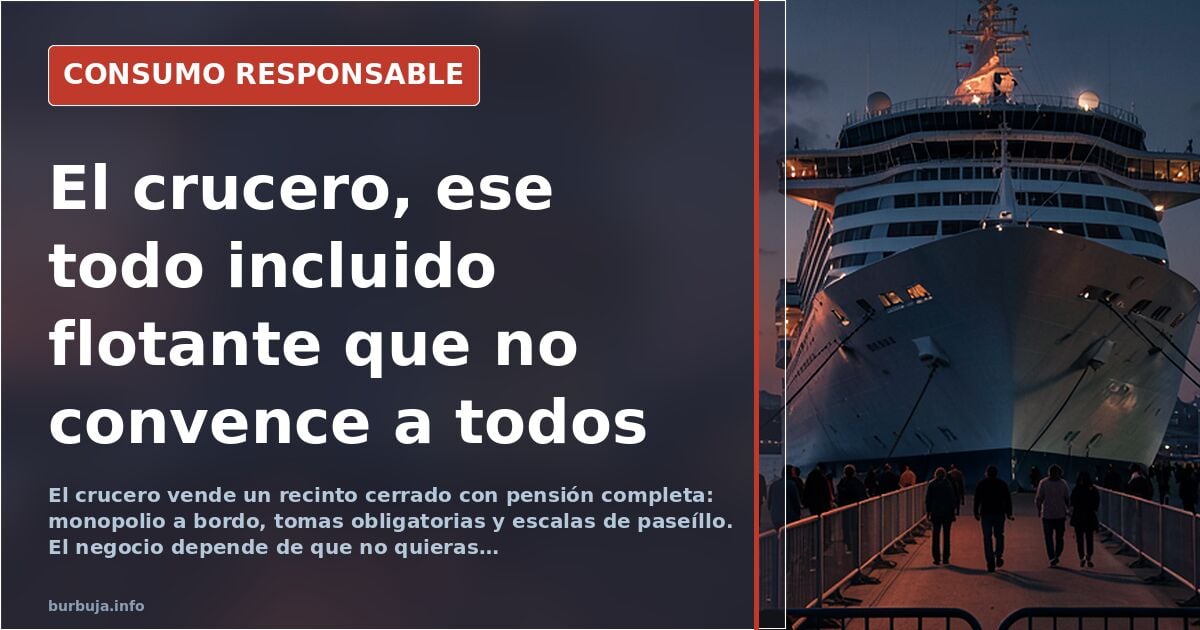
Cruises sell a photo, not a alucinación: that's why they keep filling up
A ship docked in port, a week, a corridor of people with the same colorful cocktail and the same selfie. Those who try it and those who avoid it agree on the essentials: a cruise is not a alucinación, it's a stage set. And apparently, the stage set sells. The debate over why a business so many describe as a floating tin can keeps growing has an uncomfortable answer: the product is not the sea, it's the proof that you were there.
A week without unpacking your suitcase and with a fixed price
The argument most often made in favor is not romantic at all. You unpack once, see five or six cities without setting foot in an airport or driving, and everything —accommodation, food, transport and shows— comes in a single payment. For families with children, elderly people or those with reduced mobility, that package weighs more than any postcard. The price per day, they argue, can work out cheaper than an equivalent alucinación on your own.
The fine print appears as soon as you scratch the surface: drinks, excursions and tips are where the cruise line recovers its margin. And the cheap option isn't that cheap. According to a calculation circulating in the discussion, the only decent version is a ship with 1,000 to 1,500 passengers at around 15,000 euros per person. Everything else is a queue.
The floating prison: monopoly, schedules and buffet
The harshest diagnosis doesn't come from someone who never boarded, but from someone who did. Inside the ship there is no competition: prices are set by the cruise line, the offer is what it is and, if you don't like it, there's no going back mid-voyage. The comparison with a prison comes up several times, and not entirely as a joke.
Add the logistics to that. Dinner shifts interrupted by service dance numbers, buffets that look far too much like any all-inclusive resort, and a feeling of confinement that for some takes only half a day to confirm: by 4 pm I was already sick of the damn ship, sums up someone who took a half-day cruise. The one who endures a whole week, they say, does so because they never leave the cabin, the bar and the pool.
The port as a film set: you pay for the photo and the cruise line posts it
Here lies the real business. The cruise line builds the set, but the passenger raises the showcase for free: the photo on deck, the port's hashtag, advertising at zero cost. Then they charge you gold-plated prices for wifi so you can upload it, plus the ship's official photo package. What you're buying is not the sea, it's the I was there.
The port of the day becomes a set for that showcase: an old town emptied of residents, three magnet shops and a queue for the selfie. And the effect doesn't stay on the coast. Ships stopping in Málaga launch excursions to Granada or Ronda, so the cruise day also affects inland cities. Some people plan their vacations around whether these arrivals coincide with them or not.
What they don't tell you: crew, disappearances and storms
Beneath the showcase lies a reality that makes people uncomfortable. According to one participant, crew members work 10 or 12 hours a day, seven or eight months in a row, and salaries back home explain why workers from the first world don't fill those jobs. It's not charity or brochure-style exploitation: it's labor competition on a global scale, with the cruise line in the middle.
And then there's the dark chapter. There is talk of passengers who disappear, allegedly fallen overboard, and of a count of around 400 people in 20 years on the big ships. The figure circulates without official confirmation in this discussion, but it's enough for someone to declare that there's no better place to kill your vvife without it being provable. Dark humor. The fact is that the risk, real or mythologized, is part of the story.
Elbichito didn't kill the invention
There was a moment of optimism: when ships were stranded and some countries refused to let anyone disembark, people thought the whole nonsense wouldn't survive. It didn't happen. Ships with useful life ahead were scrapped —maintenance and berthing costs didn't add up—, but the sector kept growing. Today the cruise doesn't compete with cultural travel: it competes with the sofa and the beach all-inclusive. And it wins, because it sells rest without planning.
The prediction, with reservations: as long as the fixed price and the free photo keep working, the ships will keep filling up. The question is how long the model holds if passengers start reading the fine print —the tips, and the 12 hours of the person serving your cocktail.
Also available in: Deutsch
Summary of a discussion on Burbuja.info - Foro de economía, actualidad y política., translated from Spanish and reviewed before publication. Read the full discussion (57 replies).
More summaries
-
Dinner for four in Santander, Spain, for under €40 a head
A forum user recounts a dinner for four in Santander with grilled octopus, squid and a 1,300-gram John Dory for under €40 per person. Some think it's…
-
Elon Musk’s appearance sparks debate: does the founder’s body matter?
Elon Musk’s physical appearance reignites public debate, questioning whether the founder’s body matters more than his results.
-
The mail carrier comes just two days a week to this Spanish village of 2,000
In a Spanish village of 2,000 residents, the mail carrier delivers only two days a week; in the city, Monday to Friday. Zone-based delivery spreads out official letters.
-
Lidl's 40 euro wet and dry vacuum that also blows air
It vacuums dust and liquids and blows air for 40 euros. With a cheap cyclone separator from AliExpress and an upholstery nozzle, some people clean cars and sofas without buying a dedicated machine.
-
Budget DIY concrete pool: €9,000 versus €15,000 from a contractor
Building a 9x4.5-metre pool yourself costs €9,000 compared with the €15,000 a professional charges. A full breakdown of materials and the irrigation pond trick.
-
FM/AM/SW radio: how to improve reception without being a technician
A hobbyist asks how to improve BBC reception in Ibiza; forum users suggest a copper wire on the antenna and keeping the radio away from the ADSL line.