
Crimea Bridge Attack Sparks Nuclear Debate in Ukraine War
Damage to the 18km Crimea bridge fuels nuclear fears, though reports suggest only partial structural impact.
English · Original discussion in Spanish · Published
Crimea Bridge Attack Reignites NATO-Nuclear Tensions
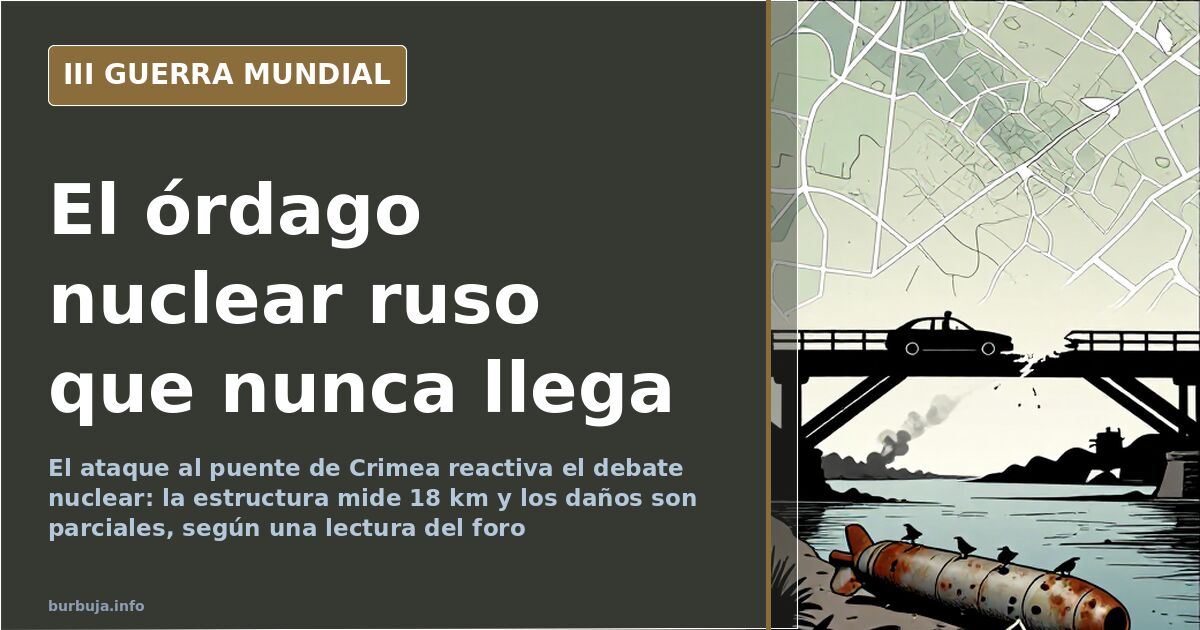
An almost 18-kilometer bridge with just a few meters damaged. That was enough for some to declare the countdown to nuclear war had begun. The attack on the Crimean Bridge, described in the material as a burning tanker train, reactivated the old debate over whether Russia will press the button. And, as is often the case when nuclear weapons are discussed, hard facts were dwarfed by the noise.
What We Know About the Crimea Bridge Attack
The bridge connecting Russia to the peninsula is 18 kilometers long, and its rail link had been operational for barely two years. That is the physical context. Regarding the damage, the cooler analysis circulating insists that the structure is long and the destruction partial: only a few meters were damaged. The conclusion of this school of thought is that if the world worked before the bridge, it will work just as well in the worst-case scenario.
There is another version that downplays the magnitude even further: it is not seen as an attack on critical infrastructure, but rather a burning tanker train. Such infrastructure, it is argued, is attacked with missiles or explosives, not fire. This nuance matters, because it determines whether this is a strategic blow or just smoke and mirrors.
The Bluff: Without a Nuclear Response, Russia’s Arsenal is a Farce
The most repeated thesis argues that if Moscow does not respond with a nuclear weapon to the bridge attack, it will be 100% confirmed that its atomic arsenal is an obsolete sham. With this argument, non-response would equate to admitting conventional defeat. It is a basic equation of psychology, according to those who propose it: once the red line is crossed, there must be a bomb or surrender.
The scenario some describe spares nothing. There is talk of a limited nuclear response to scare, and even calculations of hundreds of millions of victims if things escalate. These are hypotheses stated without verification that, in themselves, add nothing more than the size of the antiestéticar.
The Opposing Thesis: Russia, a Paper Tiger
Against the nuclear bluff, another current is clear: the country cannot sustain even its army. It is said that soldiers are given rusty weapons from the 80s and 90s, that decent rifles are lacking, and therefore, an operational nuclear arsenal is unlikely. The kicker: Ukraine, without nuclear weapons, is beating them. Russia, they conclude, would be a paper tiger.
This fits also with the reading that the adversary does not seek a nuclear hell, but annexes territory with cheap bravado. Those defending this idea add that Russian atomic weaponry would not function, it would explode in the face of whoever launched it, and the threat is pure theater.
No Nukes, No Collapse: The Bridge as a Temporary Fix
For a third path, the attacked bridge was never the main route. Russia already has its own land bridge: the recovered regions. The damaged infrastructure would have been a temporary fix while land circulation was impossible, so its failure does not change the map. The analogy thrown out is that the pipe and the bridge have the same owner, so the underlying problem is about who controls supply, not who fires.
This brings in the energy issue. The underlying idea is that Europe gave up cheap energy by entering the conflict, and that weighs more in the long term than any explosion on a viaduct. The real damage, it is argued, is economic and corporate, not military.
Narrative, NATO, and Information Warfare
Part of the text does not discuss the bomb, but its narrative utility. The argument: even if a detonation killed only two goats and burned an old car, the story would be ready to turn the perpetrator into a genocida worse than Hitler and isolate the country. Hence the suspicion that the press is the main enemy. Another current holds, however, that NATO itself has been at war for some time by sending weapons and fighters, and that Spain, as a member, is too.
Conspiracy explanations coexist here—such as the bomb not existing, or a fictitious nuclear war being staged to impose an agenda—formulated without proof. The tone ranges from cynicism to absolute distrust, leaving behind an uncomfortable detail: hardly anyone discusses the figures, everyone discusses the narrative.
The Disorienting Data Point
The number closing the matter is not a bomb, it is a measurement. 18 kilometers of bridge versus a few meters damaged. With that margin, the discussion on nuclear holocaust rests less on engineering than on the desire to believe. And of that, in the material, there is plenty.
An almost 18-kilometer bridge with just a few meters damaged. That was enough for some to declare the countdown to nuclear war had begun. The attack on the Crimean Bridge, described in the material as a burning tanker train, reactivated the old debate over whether Russia will press the button. And, as is often the case when nuclear weapons are discussed, hard facts were dwarfed by the noise.
What We Know About the Crimea Bridge Attack
The bridge connecting Russia to the peninsula is 18 kilometers long, and its rail link had been operational for barely two years. That is the physical context. Regarding the damage, the cooler analysis circulating insists that the structure is long and the destruction partial: only a few meters were damaged. The conclusion of this school of thought is that if the world worked before the bridge, it will work just as well in the worst-case scenario.
There is another version that downplays the magnitude even further: it is not seen as an attack on critical infrastructure, but rather a burning tanker train. Such infrastructure, it is argued, is attacked with missiles or explosives, not fire. This nuance matters, because it determines whether this is a strategic blow or just smoke and mirrors.
The Bluff: Without a Nuclear Response, Russia’s Arsenal is a Farce
The most repeated thesis argues that if Moscow does not respond with a nuclear weapon to the bridge attack, it will be 100% confirmed that its atomic arsenal is an obsolete sham. With this argument, non-response would equate to admitting conventional defeat. It is a basic equation of psychology, according to those who propose it: once the red line is crossed, there must be a bomb or surrender.
The scenario some describe spares nothing. There is talk of a limited nuclear response to scare, and even calculations of hundreds of millions of victims if things escalate. These are hypotheses stated without verification that, in themselves, add nothing more than the size of the antiestéticar.
The Opposing Thesis: Russia, a Paper Tiger
Against the nuclear bluff, another current is clear: the country cannot sustain even its army. It is said that soldiers are given rusty weapons from the 80s and 90s, that decent rifles are lacking, and therefore, an operational nuclear arsenal is unlikely. The kicker: Ukraine, without nuclear weapons, is beating them. Russia, they conclude, would be a paper tiger.
This fits also with the reading that the adversary does not seek a nuclear hell, but annexes territory with cheap bravado. Those defending this idea add that Russian atomic weaponry would not function, it would explode in the face of whoever launched it, and the threat is pure theater.
No Nukes, No Collapse: The Bridge as a Temporary Fix
For a third path, the attacked bridge was never the main route. Russia already has its own land bridge: the recovered regions. The damaged infrastructure would have been a temporary fix while land circulation was impossible, so its failure does not change the map. The analogy thrown out is that the pipe and the bridge have the same owner, so the underlying problem is about who controls supply, not who fires.
This brings in the energy issue. The underlying idea is that Europe gave up cheap energy by entering the conflict, and that weighs more in the long term than any explosion on a viaduct. The real damage, it is argued, is economic and corporate, not military.
Narrative, NATO, and Information Warfare
Part of the text does not discuss the bomb, but its narrative utility. The argument: even if a detonation killed only two goats and burned an old car, the story would be ready to turn the perpetrator into a genocida worse than Hitler and isolate the country. Hence the suspicion that the press is the main enemy. Another current holds, however, that NATO itself has been at war for some time by sending weapons and fighters, and that Spain, as a member, is too.
Conspiracy explanations coexist here—such as the bomb not existing, or a fictitious nuclear war being staged to impose an agenda—formulated without proof. The tone ranges from cynicism to absolute distrust, leaving behind an uncomfortable detail: hardly anyone discusses the figures, everyone discusses the narrative.
The Disorienting Data Point
The number closing the matter is not a bomb, it is a measurement. 18 kilometers of bridge versus a few meters damaged. With that margin, the discussion on nuclear holocaust rests less on engineering than on the desire to believe. And of that, in the material, there is plenty.
Summary of a discussion on Burbuja.info - Foro de economía, actualidad y política., translated from Spanish and reviewed before publication. Read the full discussion (170 replies).
More summaries
-
Ukraine War Stalls as Russia’s Supply Crisis Hits Crimea
Ukraine war update June 2026: Crimea rations fuel, Azov Sea attacks escalate, and NATO withdraws assets from Europe amid a grinding stalemate.
-
Putin: Russia's Most Divisive Statesman or Tyrant?
Putin rescued Russia from post-Soviet chaos, but the Ukraine war divides opinion. Is he the century's greatest statesman or a tyrant?
-
Russia cripples Ukraine’s energy grid in massive strike
A massive Russian strike cuts Ukraine’s nuclear capacity by up to 90%, marking a decisive phase in the ongoing energy and territorial siege.
-
Lebanon: Bombardments and Iran Attack Wait
Israel bombards southern Lebanon with artillery and tanks while the region awaits a potential Iranian ballistic missile attack.
-
Moscow heating crisis contrasts with mild European winter
A boiler failure leaves 65,000 in Lytkarino without heat and 21,000 without power, while Europe avoids predicted freezing.
-
Ukrainian naval drones strike Sevastopol; Russia claims minor damage
Aerial and naval drone offensive hits Sevastopol base. Moscow reports minimal harm, echoing its stance on the Moskva cruiser.