
Lebanon: Bombardments and Iran Attack Wait
Israel bombards southern Lebanon with artillery and tanks while the region awaits a potential Iranian ballistic missile attack.
English · Original discussion in Spanish · Published
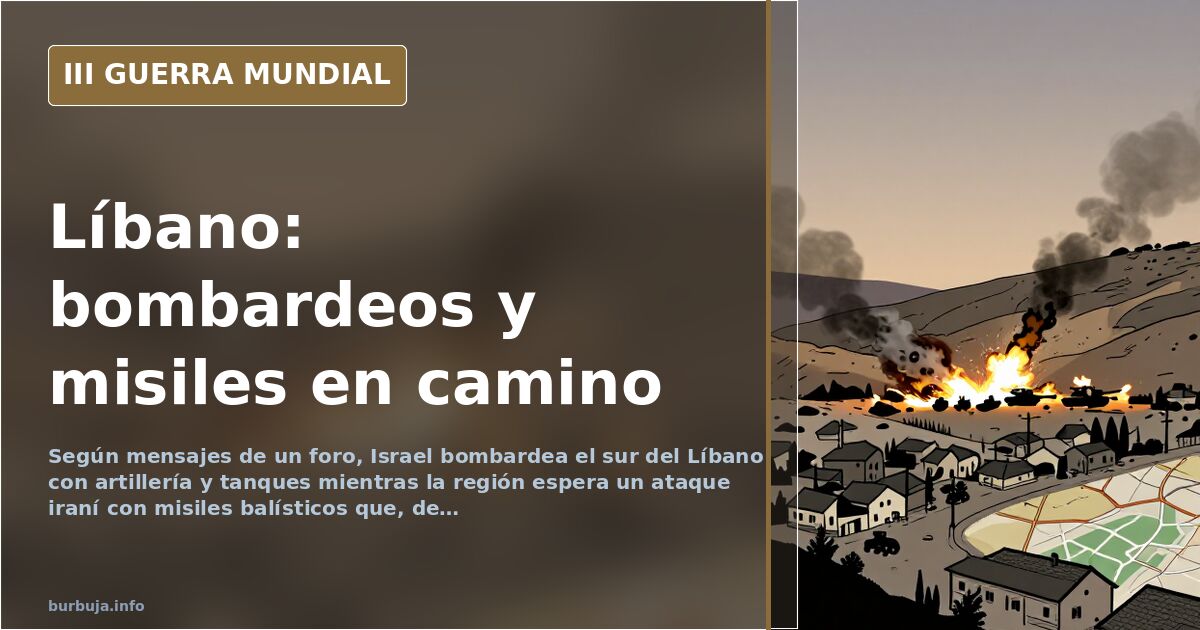
Lebanon: Bombardments and Countdown to Iranian Attack
According to forum posts, the towns of Khayam, Kafarkale, and Wazani are being shelled by cannons and tanks. Meanwhile, the Lebanese army is withdrawing about 5 kilometers from the border to avoid casualties, and Hezbollah is setting up ambush positions. In parallel, the region holds its breath for a possible Iranian ballistic missile strike on Israel, which had not materialized as of this discussion.
The news comes with two open fronts. One is on the ground: the ground operation in southern Lebanon, interpreted by some as a simple special operation and by others as the start of total conflict. The other is the clock: according to a post citing a senior Pentagon official, Tehran has reportedly communicated the size and timing of the planned attack to international officials, yet hours pass without missiles appearing.
What is known about the ground operation in southern Lebanon
The described deployment points to an entry with artillery fire and armored vehicles into border areas, with the Lebanese army retreating to avoid exposure and Hezbollah opting for prepared terrain. The distinction matters: the regular Lebanese army is not the same as the Shia militia, and confusing both actors distorts any reading of the map. Some argue that the Lebanese withdrawal avoids a direct clash between states; against this is the fact that it leaves the field open for combat between Israel and Hezbollah.
The conversation quickly shifts to the broader framework. There is debate over whether this is an expansion of the conflict to the north, if Lebanon has the real capacity to withstand a sustained offensive, or if the country is heading toward institutional collapse. Comparisons with other scenarios —Gaza, Ukraine— appear repeatedly, almost always to underline that here there is a state army involved, even if it is retreating.
Countdown to Iranian ballistic missile attack
The second line of the issue is the expectation of Iranian retaliation. According to a post citing a senior Pentagon official, Tehran would have informed international officials about the size and timing of the expected attack, and it is suggested that Netanyahu wants to call Pilingui to intervene and restrain Iran. The detail is not minor: if the attack is announced in advance, the element of surprise disappears and the exercise becomes a calculated message.
The problem is that hours are passing. More than 24 hours without anything happening, according to the count made in the conversation itself, and patience is running out. Jokes then appear about missed deadlines and the alleged effectiveness of air defense. The lingering question: deterrence, theater, or simple expectation management?
Human cost and Israeli society's response
The issue hardens when an attack with civilian victims at an Israeli train station is mentioned, attributed by one participant to an armed actor. From there, the tone changes: a strong Israeli response is expected, and it is ruled out that the situation will remain fireworks. It is the point where geopolitical analysis gives way to escalation logic, where each blow demands the next.
In this section, the harshest positions also appear, with calls for mutual destruction and references to ethnic cleansing and regional control. These are opinions, not facts, and should be read as such: the background noise of a conflict that has been fueling extreme narratives in all directions for decades.
Background: who supports what and why it matters
There are three recognizable currents. One reads the operation as a planned expansion by Israel towards the north, with the goal of reordering the border. Another interprets it as an inevitable response to Hezbollah pressure and accumulated wear. A third, more skeptical view suspects that everything is part of a deterrence choreography where announcements matter more than shots.
The disorienting data is the announced nature of the Iranian attack itself. If the enemy knows when and how you will strike, the blow loses military sense and gains political sense. And if it does not arrive, the one losing credibility is not the one threatening, but the one waiting.
How long can an announced war be sustained before someone decides it no longer needs to be fought?
According to forum posts, the towns of Khayam, Kafarkale, and Wazani are being shelled by cannons and tanks. Meanwhile, the Lebanese army is withdrawing about 5 kilometers from the border to avoid casualties, and Hezbollah is setting up ambush positions. In parallel, the region holds its breath for a possible Iranian ballistic missile strike on Israel, which had not materialized as of this discussion.
The news comes with two open fronts. One is on the ground: the ground operation in southern Lebanon, interpreted by some as a simple special operation and by others as the start of total conflict. The other is the clock: according to a post citing a senior Pentagon official, Tehran has reportedly communicated the size and timing of the planned attack to international officials, yet hours pass without missiles appearing.
What is known about the ground operation in southern Lebanon
The described deployment points to an entry with artillery fire and armored vehicles into border areas, with the Lebanese army retreating to avoid exposure and Hezbollah opting for prepared terrain. The distinction matters: the regular Lebanese army is not the same as the Shia militia, and confusing both actors distorts any reading of the map. Some argue that the Lebanese withdrawal avoids a direct clash between states; against this is the fact that it leaves the field open for combat between Israel and Hezbollah.
The conversation quickly shifts to the broader framework. There is debate over whether this is an expansion of the conflict to the north, if Lebanon has the real capacity to withstand a sustained offensive, or if the country is heading toward institutional collapse. Comparisons with other scenarios —Gaza, Ukraine— appear repeatedly, almost always to underline that here there is a state army involved, even if it is retreating.
Countdown to Iranian ballistic missile attack
The second line of the issue is the expectation of Iranian retaliation. According to a post citing a senior Pentagon official, Tehran would have informed international officials about the size and timing of the expected attack, and it is suggested that Netanyahu wants to call Pilingui to intervene and restrain Iran. The detail is not minor: if the attack is announced in advance, the element of surprise disappears and the exercise becomes a calculated message.
The problem is that hours are passing. More than 24 hours without anything happening, according to the count made in the conversation itself, and patience is running out. Jokes then appear about missed deadlines and the alleged effectiveness of air defense. The lingering question: deterrence, theater, or simple expectation management?
Human cost and Israeli society's response
The issue hardens when an attack with civilian victims at an Israeli train station is mentioned, attributed by one participant to an armed actor. From there, the tone changes: a strong Israeli response is expected, and it is ruled out that the situation will remain fireworks. It is the point where geopolitical analysis gives way to escalation logic, where each blow demands the next.
In this section, the harshest positions also appear, with calls for mutual destruction and references to ethnic cleansing and regional control. These are opinions, not facts, and should be read as such: the background noise of a conflict that has been fueling extreme narratives in all directions for decades.
Background: who supports what and why it matters
There are three recognizable currents. One reads the operation as a planned expansion by Israel towards the north, with the goal of reordering the border. Another interprets it as an inevitable response to Hezbollah pressure and accumulated wear. A third, more skeptical view suspects that everything is part of a deterrence choreography where announcements matter more than shots.
The disorienting data is the announced nature of the Iranian attack itself. If the enemy knows when and how you will strike, the blow loses military sense and gains political sense. And if it does not arrive, the one losing credibility is not the one threatening, but the one waiting.
How long can an announced war be sustained before someone decides it no longer needs to be fought?
Summary of a discussion on Burbuja.info - Foro de economía, actualidad y política., translated from Spanish and reviewed before publication. Read the full discussion (167 replies).
More summaries
-
Putin: Russia's Most Divisive Statesman or Tyrant?
Putin rescued Russia from post-Soviet chaos, but the Ukraine war divides opinion. Is he the century's greatest statesman or a tyrant?
-
Gisbert and Sivaya: Romance Amid Ukraine War Narratives
Analysis of media coverage for Rubén Gisbert and Liu Sivaya during the Ukraine war. Is this digital propaganda or reality?
-
Israel readies massive Iran strike as Tehran closes airspace
Israel prepares a large-scale attack on Iran while Tehran shuts its airspace and diverts flights. The military standoff involves Russia and China.
-
EU gas crisis and nuclear risks after Ukraine annexation
Analysis of the EU's energy dependency and Russia's strategic shift following the annexation of four Ukrainian regions.
-
Abascal Visits Heritage Foundation in Washington
VOX leader Abascal meets with the conservative think tank Heritage Foundation and PatriotsEU ahead of Trump's inauguration.
-
Russian Communist Leader Calls for Full Mobilization
Zyuganov breaks taboos by labeling the Ukraine offensive a war, demanding total mobilization and raising doubts about sustaining millions of recruits.