
Coolant hose bursts during Spanish vehicle inspection
A coolant hose ruptured during the emissions test of a diesel Astra H in Spain. The report showed opacity at 4, exceeding the 1.4 m⁻¹ limit.
English · Original discussion in Spanish · Published
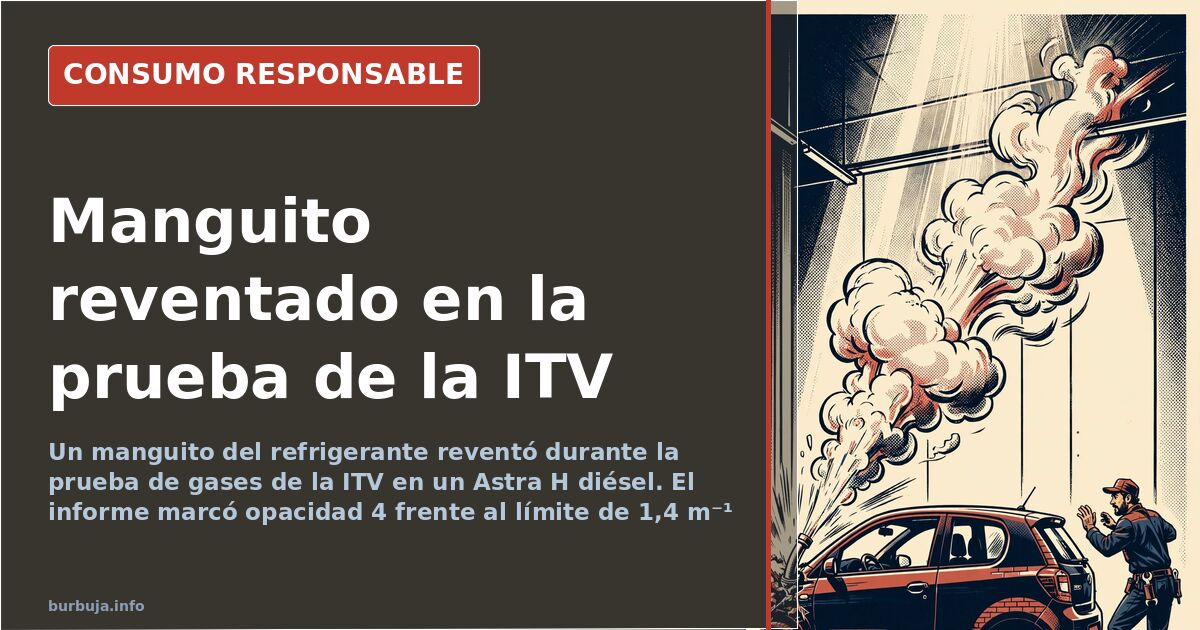
Hose bursts during emissions test, car ends up on tow truck
An engine doesn't break just because you press the accelerator. This phrase is repeated like a mantra every time someone leaves the technical inspection with a breakdown, yet the car still ends up on a tow truck: a burst coolant circuit hose during the emissions test and an unfavorable report due to emissions. It peine to a Astra H 1.7 turbodiesel over a decade old, when the operator pressed the accelerator, according to the owner's account, "as if there were no tomorrow," and the screen showed more than 4,000 RPM. The hose gave way. Tow truck, workshop, and complaint form.
What exactly happens during a diesel opacity test?
The emissions test for a diesel is performed at cut-off, but it lasts barely half a second: you reach the cut-off and release. Before that, there are cleaning accelerations to remove carbon buildup. This is the procedure set by the manual, and those who know it in detail argue that the measurement method is debatable: in petrol cars, the test is held around 3,000 RPM, while in diesels, it goes to the limit because, without a dynamometer, it's the only way to measure smoke opacity.
The problem is what that limit means for an old engine. A diesel like the one in this case has its cut-off around 4,500 RPM; petrol engines have it higher, and during gas tests they can exceed 6,000 RPM. Some argue that large engines, designed under American standards, don't need such high revs. The scale isn't the same for everyone, and comparing RPM without knowing which engine can handle it is basic workshop knowledge.
The report that doesn't quite add up
The first inspection resulted in an unfavorable status: emission limits were exceeded with an opacity of 4+ m⁻¹ against a limit of 1.4 m⁻¹. The owner doesn't dispute this data. What surprises him is the rest of the document, which appears as N/A for all parameters except opacity. According to his account, the station finally handed over the favorable report and sticker without completing other checks on the vehicle's condition.
From this arises the technical objection raised by a participant who claims to know the manual: if the hoses had already broken, the unfavorable report shouldn't have been issued for failing the gas test, but for inadequate conditions to perform it. That is, the vehicle was no longer fit for testing, and the inspector should have noted this. The station, for its part, claims it trinc the procedure and has insurance.
Can an engine withstand 4,000 RPM idle?
Here consensus breaks into two sides. A well-designed engine must support its maximum RPM —peak torque, peak power— without issue; it's another matter if the owner decides to pamper it and not go past 2,000. Under this view, the sudden acceleration breaks nothing. The objection comes from the other side: subjecting an old engine to a regime it hasn't seen in years is like giving a stress test to a seventy-year-old. If he collapses, it's not that the test killed him; it's that he wasn't fit for testing.
Context matters. A single sudden acceleration at idle isn't comparable to the load a car endures at 60 km/h in a curve or over a bump. And here, the engine didn't throw a rod or seize: a plastic and rubber part broke that was already at the end of its life.
Wear nobody sees coming
The coldest reading is that the hose was ready to burst. If it hadn't failed at the ITV (Spanish vehicle inspection), it would have blown on the highway, at 120 km/h, and then the problem would have been worse: being stranded and, with bad luck, seizing the engine due to lack of coolant. From that angle, the inspection inadvertently acted as a detector for expensive breakdowns.
One participant recounts driving for months without coolant due to a faulty sensor and not burning out the engine; it was saved only by winter, short trips, and gentle throttle use. The practical advice repeated by experts: arrive at the ITV with a warm engine, recent oil and filter, and do the cleaning accelerations on the road days before, not the same day. The manual governing the inspection, published by AECA-ITV in its latest version, sets the rules, but doesn't resolve who pays for a part that breaks inside the bay.
Who is responsible? The station has insurance, and the owner has filed a complaint. There is room for it to succeed, especially if the report was issued incorrectly. The ITV defense is comfortable: it trinc the procedure, and the part was at the end of its useful life. With that in mind, some predict the driver will end up paying for the hose repair, even if the complaint is recorded. The prediction, with reservations: if the hose hadn't burst at the ITV, it would have burst somewhere else. And that, with the car running, costs more money.
An engine doesn't break just because you press the accelerator. This phrase is repeated like a mantra every time someone leaves the technical inspection with a breakdown, yet the car still ends up on a tow truck: a burst coolant circuit hose during the emissions test and an unfavorable report due to emissions. It peine to a Astra H 1.7 turbodiesel over a decade old, when the operator pressed the accelerator, according to the owner's account, "as if there were no tomorrow," and the screen showed more than 4,000 RPM. The hose gave way. Tow truck, workshop, and complaint form.
What exactly happens during a diesel opacity test?
The emissions test for a diesel is performed at cut-off, but it lasts barely half a second: you reach the cut-off and release. Before that, there are cleaning accelerations to remove carbon buildup. This is the procedure set by the manual, and those who know it in detail argue that the measurement method is debatable: in petrol cars, the test is held around 3,000 RPM, while in diesels, it goes to the limit because, without a dynamometer, it's the only way to measure smoke opacity.
The problem is what that limit means for an old engine. A diesel like the one in this case has its cut-off around 4,500 RPM; petrol engines have it higher, and during gas tests they can exceed 6,000 RPM. Some argue that large engines, designed under American standards, don't need such high revs. The scale isn't the same for everyone, and comparing RPM without knowing which engine can handle it is basic workshop knowledge.
The report that doesn't quite add up
The first inspection resulted in an unfavorable status: emission limits were exceeded with an opacity of 4+ m⁻¹ against a limit of 1.4 m⁻¹. The owner doesn't dispute this data. What surprises him is the rest of the document, which appears as N/A for all parameters except opacity. According to his account, the station finally handed over the favorable report and sticker without completing other checks on the vehicle's condition.
From this arises the technical objection raised by a participant who claims to know the manual: if the hoses had already broken, the unfavorable report shouldn't have been issued for failing the gas test, but for inadequate conditions to perform it. That is, the vehicle was no longer fit for testing, and the inspector should have noted this. The station, for its part, claims it trinc the procedure and has insurance.
Can an engine withstand 4,000 RPM idle?
Here consensus breaks into two sides. A well-designed engine must support its maximum RPM —peak torque, peak power— without issue; it's another matter if the owner decides to pamper it and not go past 2,000. Under this view, the sudden acceleration breaks nothing. The objection comes from the other side: subjecting an old engine to a regime it hasn't seen in years is like giving a stress test to a seventy-year-old. If he collapses, it's not that the test killed him; it's that he wasn't fit for testing.
Context matters. A single sudden acceleration at idle isn't comparable to the load a car endures at 60 km/h in a curve or over a bump. And here, the engine didn't throw a rod or seize: a plastic and rubber part broke that was already at the end of its life.
Wear nobody sees coming
The coldest reading is that the hose was ready to burst. If it hadn't failed at the ITV (Spanish vehicle inspection), it would have blown on the highway, at 120 km/h, and then the problem would have been worse: being stranded and, with bad luck, seizing the engine due to lack of coolant. From that angle, the inspection inadvertently acted as a detector for expensive breakdowns.
One participant recounts driving for months without coolant due to a faulty sensor and not burning out the engine; it was saved only by winter, short trips, and gentle throttle use. The practical advice repeated by experts: arrive at the ITV with a warm engine, recent oil and filter, and do the cleaning accelerations on the road days before, not the same day. The manual governing the inspection, published by AECA-ITV in its latest version, sets the rules, but doesn't resolve who pays for a part that breaks inside the bay.
Who is responsible? The station has insurance, and the owner has filed a complaint. There is room for it to succeed, especially if the report was issued incorrectly. The ITV defense is comfortable: it trinc the procedure, and the part was at the end of its useful life. With that in mind, some predict the driver will end up paying for the hose repair, even if the complaint is recorded. The prediction, with reservations: if the hose hadn't burst at the ITV, it would have burst somewhere else. And that, with the car running, costs more money.
Also available in: Deutsch
Summary of a discussion on Burbuja.info - Foro de economía, actualidad y política., translated from Spanish and reviewed before publication. Read the full discussion (124 replies).
More summaries
-
Spain's ITV emissions test: additives, smoke and the 0.5 m-1 limit
A diesel car entered Spain's ITV with 6 m-1 opacity, dropping to 1.37 after a highway run. The test measures tailpipe output in the pit, not annual pollution.
-
Accessing Live Sports via Shared Streaming Links
Analysis of how users access live sports through shared streaming codes and links.
-
Adult Milk Consumption: Lactose and A2 Protein Debate
Lactose tolerance is a minority genetic mutation. The debate over A2 milk, UHT processing, and calcium sources continues in Spain.
-
Supermarket frozen pizza vs. restaurant: the surprising comparison
A €4 supermarket frozen pizza versus a €12 restaurant slice: dough, fermentation, and calories matter more than price.
-
Cutting Weight on a Budget Chinese Road Bike
Guide to dropping a 10.5 kg Chinese road bike to 9 kg cheaply: carbon wheels, tips, and the debate on rider weight.
-
Sony radio survives 80 km/h fall from car, keeps working
A forum user claims his Sony ICF-F10 survived a high-speed drop from a moving car. The thread debates the declining quality of modern shortwave receivers.