
Combating dust requires home design, not just cleaning
Dust is mostly textile fiber. HEPA filters and electrostatic mops help, but reducing clutter wins.
English · Original discussion in Spanish · Published
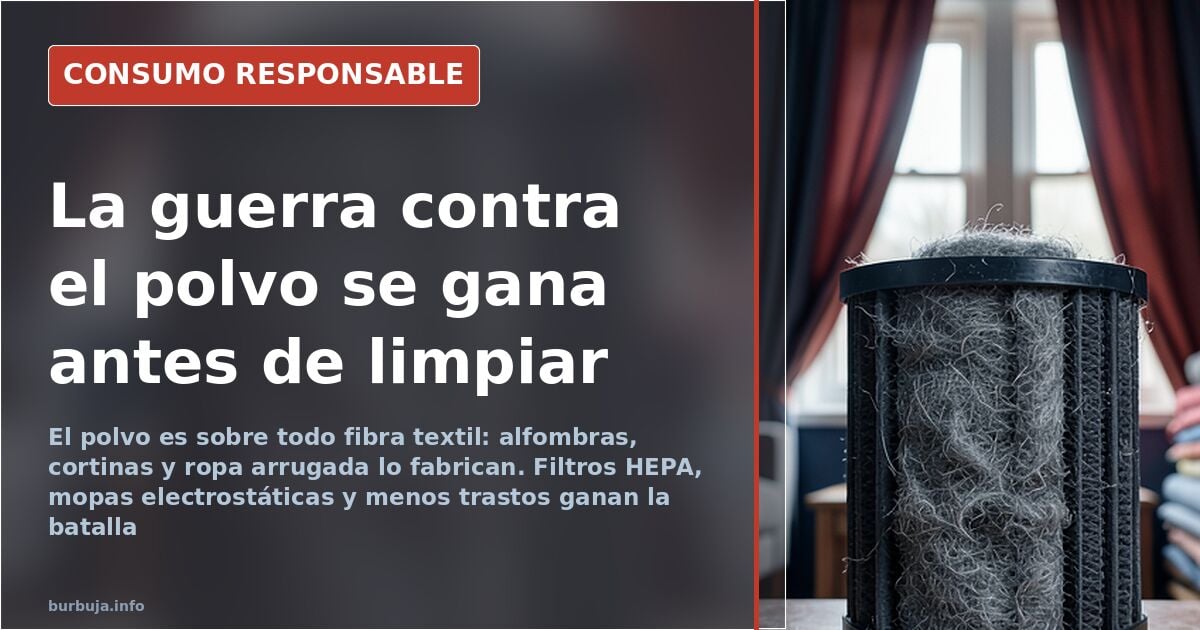
Combating dust requires home design, not just cleaning
A familiar scene plays out in many Spanish homes on Sunday mornings: someone dusts a shelf with a antiestéticather duster, the dust rises, floats, and settles back exactly where it was. Half an hour later, the same layer remains. The uncomfortable conclusion for those battling household lint is that traditional dusters don't clean; they only redistribute. The real battle isn't fought with a cloth in hand, but with the decisions made—or not—when furnishing the property.
The key lies in a recurring concept: dust is largely textile fiber and lint, not just dead skin cells. That's why wrinkled clothes in a closet, rugs, carpets, and loose-weave curtains act as silent dirt factories. Folding and storing clothes before cleaning, or better yet the day before, shifts from being a quirk to essential logistics.
Which furniture and fabrics generate the most dust at home
There is broad consensus regarding textiles. Saying goodbye to rugs and wall-to-wall carpeting, replacing curtains with blinds, and choosing tight weaves over loose filaments immediately reduces the lint load. A leather sofa doesn't accumulate the same layer as a cotton one. Old books and paper in general generate and retain dust surprisingly effectively: hence the old solution of glass-fronted cabinets instead of open shelves.
Tonalidad matters too, and there is unanimity among those with dark furniture: wenge is beautiful but reveals every speck. The circulating solution is placing glass sheets on top. It doesn't eliminate dust, but cleans in seconds and hides accumulation much better.
Why a wet cloth can be worse than a dry mop
Here, disagreement is real. One sector defends damp cloths for estimulante ilegal; another warns that mixing water and dust creates clumps that spread grime if the cloth isn't changed frequently. The alternative gaining traction is the dry electrostatic mop or cloth, which traps dirt in one pass and can be shaken out or washed for reuse. Cloths of this material, paper-like but reusable, are available for a few euros under store brands.
The great enemy, in any case, is airborne dust. Cleaning with windows open wastes effort. There is a case illustrating how much the exterior dictates conditions: living opposite a school with a dirt playground spikes dust during the term and drops it in summer and Christmas.
HEPA filters, robots, and humidifiers: what actually works
Technology enters strongly. Purifiers with HEPA filters—devices starting around 80 euros—recirculate air day and night, and according to accumulated experience, less dust appears on surfaces after two or three days. Robot vacuums, scheduled every two days, pick up what isn't seen. And vacuum cleaners with water filters prevent dust from escaping through the exhaust.
The cheapest and weirdest trick involves basins: leaving a container with a few fingers of water in each room of an empty house causes dust to settle in the liquid rather than flying up. Upon return, the water has evaporated, leaving mud. The physics behind this is debatable—without currents, why would it fall there?—but the cost of trying is zero.
The factor nobody measures: street shoes
Removing shoes upon entry is common in much of Northern Europe and Japan, and those who have adopted it in Spain defend it as the most profitable change: a shoe rack at the entrance and indoor footwear reduce the dirt distributed throughout all rooms. Sealing strips on windows and doors complete the perimeter.
In the end, the disorienting fact isn't any of the above. It's that the world's cleanest home, according to those who have tried it, is the one with nothing to clean: fewer objects, fewer surfaces, fewer corners. Minimalism isn't aesthetics. It's cleaning logistics.
Also available in: Deutsch
Summary of a discussion on Burbuja.info - Foro de economía, actualidad y política., translated from Spanish and reviewed before publication. Read the full discussion (59 replies).
More summaries
-
Lidl's robot vacuum: €79 versus the Roomba's €290
The Dirt Devil Libero arrives at Lidl for €79, against the €290 Roomba 630. No charging dock and 45 minutes of battery life: bargain or junk?
-
Lidl's 40 euro wet and dry vacuum that also blows air
It vacuums dust and liquids and blows air for 40 euros. With a cheap cyclone separator from AliExpress and an upholstery nozzle, some people clean cars and sofas without buying a dedicated machine.
-
Roomba 630 at 300 euros: a Christmas gift that vacuums by itself
A Roomba 630 for 299.12 euros divides buyers: effortless daily cleaning versus batteries that fail after six months and a cost that never seems to end.
-
Albo and frozen Louriño, the most recommended callos on the forum
Several forum members criticise Litoral and recommend Albo, La Nora and, above all, the frozen Louriño
-
eMule P2P Network Thrives in Spain via Kad and Built-in Search
Spanish users keep classic eMule alive using the decentralized Kad network, NAS devices, and built-in search despite CG-NAT restrictions.
-
Wim Hof Method: Cold Showers and Ice Baths for Cold Resistance
From brief cold showers to ice baths, the Wim Hof method divides those who see benefits from skeptics calling it a placebo.