
Collective punishment in Gaza sparks debate over data and narrative
The debate on collective punishment in Gaza divides analysts, citing polls on support for targeting civilians while noting Hamas has held no elections since 2006.
English · Original discussion in Spanish · Published
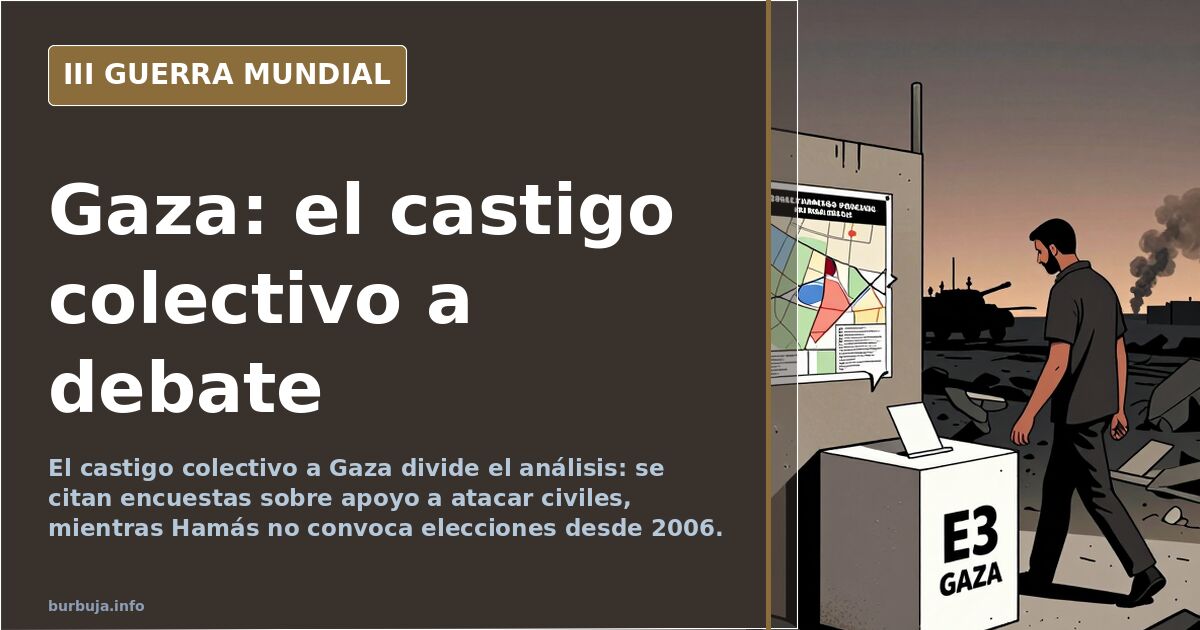
Collective punishment in Gaza sparks debate over data and narrative
Is it legitimate to punish an entire population for the actions of its government? The discussion on Gaza has moved beyond slogans into a contest over figures, international law, and collective responsibility. At the center is a recurring statistic: more than two-thirds of Gazans would support attacking Israeli civilians, a figure attributed to polls used to justify military pressure. The counterargument is straightforward: Hamas has not called elections since 2006, whereas Israelis repeatedly vote for their governments. This is not an academic dispute; it determines whether collective punishment is a tool of war or a crime.
The argument for collective responsibility
One side argues that Hamas is the government of Gaza, implying that what Hamas does, Gaza does. Under this logic, the population is not passive but part of the structure supporting the organization. It is claimed that Hamas was democratically elected and has held no elections since, making Gazans hostages of their own leadership. The conclusion drawn is that pressure on the population serves as pressure on the organization.
The rebuttal relies on data: Gazans have not voted since 2006, while Israelis have repeatedly elected governments that have implemented policies of occupation and expansion. If collective responsibility applies to one side, why not the other? The debate becomes entangled in accusations of double standards.
International law and the Hannibal Directive
The tone intensifies when the Hannibal Directive is mentioned, an Israeli military protocol prioritizing preventing captures even at the cost of friendly casualties. Its inclusion illustrates how civilian lives are subordinated to military objectives. This is not a minor detail; the directive is cited to show that collective punishment is an operational logic, not an accident.
Simultaneously, there is debate over whether the Israeli army engages in terrorist action through indiscriminate punishments. The definition of terrorism is applied both ways: to describe the October 7 attack and the military response. The result is a semantic stalemate that resolves nothing but highlights the discomfort of applying the same label to both sides.
Statistics used to justify pressure
The most repeated argument is demographic: Gaza had 400,000 inhabitants twenty years ago and now has 2 million. The conclusion is that there is no genocide, only growth. This figure is used as a direct refutation of extermination claims. However, population growth alone does not measure the impact of war: infrastructure destruction, forced displacement, and avoidable mortality are excluded from this calculation.
Another circulating figure is 10,000 deaths as an acceptable threshold within a population of nearly two million. The coldness of this calculation is deliberate, presented as a matter of proportion. Defenders argue that war is inherently like this and defeat is the alternative. Critics point out that reducing death to a fraction is precisely what defines collective punishment.
Silence on October 7 and selective memory
A frequent accusation is that critical analysis of Israel omits the October 7 attack. It is argued that without October 7, we would not be seeing Gaza’s destruction on this scale. This is a causal argument: the attack triggered the response, so primary responsibility lies with the attacker. The objection is that the conflict did not begin that day and that Hamas did not exist when the occupation started.
The discussion shifts to historical memory, recalling that Hamas did not exist when the conflict began, placing the origins decades earlier. The conclusion is that reducing everything to October 7 erases context. The counter-response is that context does not justify attacks on civilians.
Holocaust references and comparing genocides
At the margins, historical comparisons attempt to relativize the Holocaust. Some claim the Holocaust is just another genocide in history, small compared to the Mongol invasion of Persia. This assertion is false and unsupported by serious academic sources: the Holocaust was an industrialized genocide with unique characteristics, and its magnitude is not measured solely by victim counts. Here, comparison is used as provocation, not analysis.
Another line of argument suggests that silence on other human rights abusa—mentioning Western Sahara—reveals double standards. The response is that pointing out double standards does not exempt us from analyzing each case separately. The debate becomes a crossfire of accusations over which suffering deserves attention.
Conclusion: Statistics as alibi
Ultimately, the debate leaves an uncomfortable question: How many deaths are needed before an operation ceases to be defensive? The figure of 10,000 is used as a threshold, but no one explains its origin. Statistics become an alibi: if the number is acceptable, the operation is legitimate; if not, it is a crime. Legitimacy is not measured in corpses, though it sometimes appears so. Meanwhile, Gaza continues to count.
Is it legitimate to punish an entire population for the actions of its government? The discussion on Gaza has moved beyond slogans into a contest over figures, international law, and collective responsibility. At the center is a recurring statistic: more than two-thirds of Gazans would support attacking Israeli civilians, a figure attributed to polls used to justify military pressure. The counterargument is straightforward: Hamas has not called elections since 2006, whereas Israelis repeatedly vote for their governments. This is not an academic dispute; it determines whether collective punishment is a tool of war or a crime.
The argument for collective responsibility
One side argues that Hamas is the government of Gaza, implying that what Hamas does, Gaza does. Under this logic, the population is not passive but part of the structure supporting the organization. It is claimed that Hamas was democratically elected and has held no elections since, making Gazans hostages of their own leadership. The conclusion drawn is that pressure on the population serves as pressure on the organization.
The rebuttal relies on data: Gazans have not voted since 2006, while Israelis have repeatedly elected governments that have implemented policies of occupation and expansion. If collective responsibility applies to one side, why not the other? The debate becomes entangled in accusations of double standards.
International law and the Hannibal Directive
The tone intensifies when the Hannibal Directive is mentioned, an Israeli military protocol prioritizing preventing captures even at the cost of friendly casualties. Its inclusion illustrates how civilian lives are subordinated to military objectives. This is not a minor detail; the directive is cited to show that collective punishment is an operational logic, not an accident.
Simultaneously, there is debate over whether the Israeli army engages in terrorist action through indiscriminate punishments. The definition of terrorism is applied both ways: to describe the October 7 attack and the military response. The result is a semantic stalemate that resolves nothing but highlights the discomfort of applying the same label to both sides.
Statistics used to justify pressure
The most repeated argument is demographic: Gaza had 400,000 inhabitants twenty years ago and now has 2 million. The conclusion is that there is no genocide, only growth. This figure is used as a direct refutation of extermination claims. However, population growth alone does not measure the impact of war: infrastructure destruction, forced displacement, and avoidable mortality are excluded from this calculation.
Another circulating figure is 10,000 deaths as an acceptable threshold within a population of nearly two million. The coldness of this calculation is deliberate, presented as a matter of proportion. Defenders argue that war is inherently like this and defeat is the alternative. Critics point out that reducing death to a fraction is precisely what defines collective punishment.
Silence on October 7 and selective memory
A frequent accusation is that critical analysis of Israel omits the October 7 attack. It is argued that without October 7, we would not be seeing Gaza’s destruction on this scale. This is a causal argument: the attack triggered the response, so primary responsibility lies with the attacker. The objection is that the conflict did not begin that day and that Hamas did not exist when the occupation started.
The discussion shifts to historical memory, recalling that Hamas did not exist when the conflict began, placing the origins decades earlier. The conclusion is that reducing everything to October 7 erases context. The counter-response is that context does not justify attacks on civilians.
Holocaust references and comparing genocides
At the margins, historical comparisons attempt to relativize the Holocaust. Some claim the Holocaust is just another genocide in history, small compared to the Mongol invasion of Persia. This assertion is false and unsupported by serious academic sources: the Holocaust was an industrialized genocide with unique characteristics, and its magnitude is not measured solely by victim counts. Here, comparison is used as provocation, not analysis.
Another line of argument suggests that silence on other human rights abusa—mentioning Western Sahara—reveals double standards. The response is that pointing out double standards does not exempt us from analyzing each case separately. The debate becomes a crossfire of accusations over which suffering deserves attention.
Conclusion: Statistics as alibi
Ultimately, the debate leaves an uncomfortable question: How many deaths are needed before an operation ceases to be defensive? The figure of 10,000 is used as a threshold, but no one explains its origin. Statistics become an alibi: if the number is acceptable, the operation is legitimate; if not, it is a crime. Legitimacy is not measured in corpses, though it sometimes appears so. Meanwhile, Gaza continues to count.
Summary of a discussion on Burbuja.info - Foro de economía, actualidad y política., translated from Spanish and reviewed before publication. Read the full discussion (140 replies).
More summaries
-
Netanyahu vows to take Gaza, admits allied pressure
Netanyahu announces Israel will 'take all of Gaza' and resumes minimal aid entry after a three-month blockade, citing pressure from allies.
-
Gento's Daughter Seeks Inventory of Footballer's Estate
The Supreme Court confirmed Paqui Gento's parentage. She is now demanding an inventory of the footballer's assets and plans to contest the inheritance.
-
Russian Air Force in Ukraine: Incompetence or Doctrine?
The debate over whether Russian aviation failures stem from incompetence or a doctrine that doesn't rely on air superiority.
-
Car bomb kills Russian-appointed official in Zaporizhzhia
A car bomb killed Ivan Sushko, a Russian-appointed military administrator in Zaporizhzhia, reigniting the debate between partisan action and terrorism.
-
Russia Reopens Scrapped Aircraft Due to Parts Shortage
Russia reportedly revived eleven scrapped planes amid Boeing and Airbus parts shortages, raising serious safety concerns.
-
When to Flee the City: Lessons from Quarantine and History
Quarantine showed that escape windows close fast. Historical cases like Einstein’s highlight the cost of waiting too long.