
Netanyahu vows to take Gaza, admits allied pressure
Netanyahu announces Israel will 'take all of Gaza' and resumes minimal aid entry after a three-month blockade, citing pressure from allies.
English · Original discussion in Spanish · Published
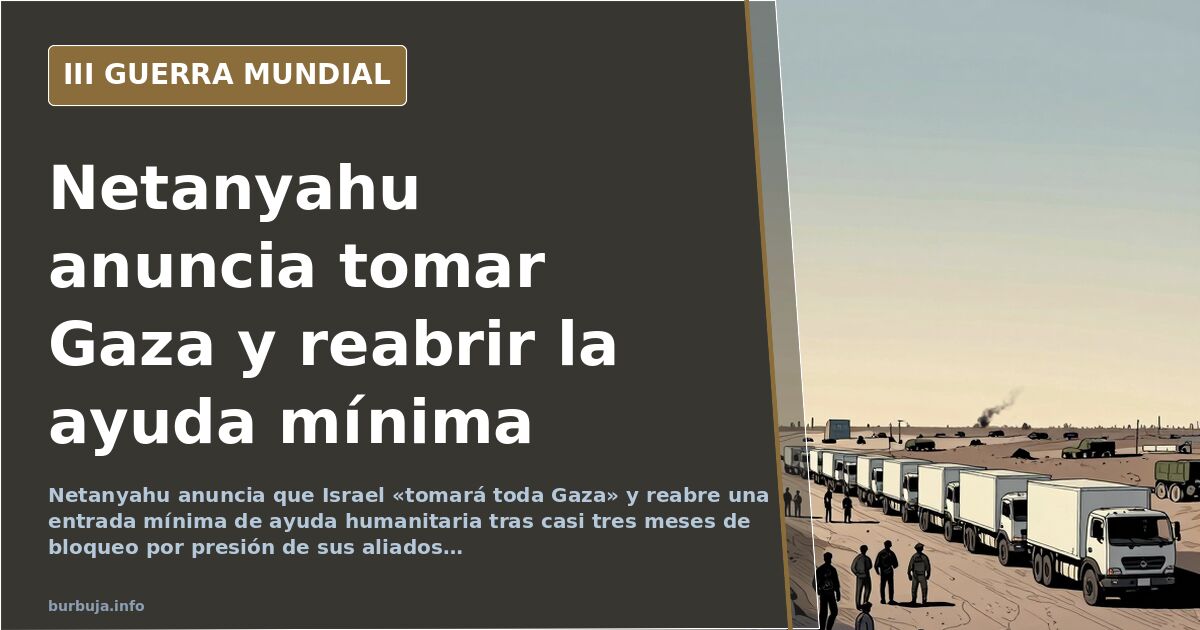
Netanyahu vows to take Gaza, admits allied pressure
Benjamin Netanyahu stated that Israeli troops will "take all of Gaza" trinc the army's announcement of an additional "broad" offensive in the territory's north and south. In the same address, the Israeli prime minister confirmed the immediate resumption of "minimal" humanitarian aid entry after nearly three months of blockade. The decision, which he described as "difficult," came after a cabinet meeting and included an unusual admission: pressure from international allies. "Our best friends in the world, senators who passionately support Israel, tell me: we will give you all the help you need for total victory, but we cannot continue receiving images of famine," he admitted.
The reality behind Israel's minimal aid entry
The Israeli government statement mentions allowing "a basic amount of food per person for the population to prevent a hunger crisis in Gaza." This is not generosity; it is calculation. Netanyahu acknowledged that a famine would jeopardize the international support sustaining the military operation. According to his version, the blockade aimed to prevent Hamas from intercepting aid, and his proposal for controlled delivery points was previously rejected by the UN. The result is an unstable balance: just enough enters to keep the external coalition intact, but not enough to change the humanitarian equation.
The war that began before October 7
Some analysts argue that the conflict did not start on October 7, but decades ago, and that the current offensive is the consequence of a prolonged siege. Conversely, the most repeated counter-argument states that before that date there was no open war in Gaza, and Israel's air defense system neutralized rocket launches without needing to destroy launchers or cause civilian casualties. A harsher view comes from those who defend that a siege only ends with the besieged party's surrender, and sending food to those resisting is a military contradiction. The debate shifts toward the right of conquest, abolished after World War II, and the legitimacy of each side's claims over the same territory.
Right of conquest and the annexation problem
Annexing Gaza is not the same as occupying it, and this is the legal knot. Incorporating the territory would require resolving the nationality of its inhabitants, a legal maneuver Israel already avoided in the West Bank: it preferred to keep it as an anomalous entity under military control rather than incorporate its population. The distinction between taking operational control and formally annexing land separates the announcement from its real consequences. Some point out that the plan to relocate the population to third countries—Libya is mentioned—is part of this scheme. None of this is settled.
Diplomatic front: shots at delegation and internal pressure
Israeli soldiers fired upon a diplomatic delegation from 21 countries, including Spain, visiting Jenin in the West Bank. The episode adds tension to an already fragile international position. Meanwhile, pressure is not only external: Netanyahu continues to face corruption charges and must appear in court several times a week, according to published reports. The paradox is evident: the leader promising "total victory" manages his offensive amidst judicial hearings and allies asking that famine images do not reach their news broadcasts.
Spain's stakes and regional implications
The Spanish government's recognition of the Palestinian state has reignited theories about its true motives. One school argues it responds to hidden interests and a supposed population relocation strategy; another reads it as a conventional diplomatic move within the European framework. The fact remains that Netanyahu's announcement places Western partners before a dilemma with no comfortable exit: sustain the military operation or sustain the humanitarian narrative. Doing both simultaneously has an expiration date.
The exact point where analysis stalls is this: if minimal aid prevents famine but not the offensive, and the offensive blocks any diplomatic solution, no one has yet explained how to escape this situation without one of the two sides disappearing from the map. And that, with or without formal annexation, remains unanswered.
Benjamin Netanyahu stated that Israeli troops will "take all of Gaza" trinc the army's announcement of an additional "broad" offensive in the territory's north and south. In the same address, the Israeli prime minister confirmed the immediate resumption of "minimal" humanitarian aid entry after nearly three months of blockade. The decision, which he described as "difficult," came after a cabinet meeting and included an unusual admission: pressure from international allies. "Our best friends in the world, senators who passionately support Israel, tell me: we will give you all the help you need for total victory, but we cannot continue receiving images of famine," he admitted.
The reality behind Israel's minimal aid entry
The Israeli government statement mentions allowing "a basic amount of food per person for the population to prevent a hunger crisis in Gaza." This is not generosity; it is calculation. Netanyahu acknowledged that a famine would jeopardize the international support sustaining the military operation. According to his version, the blockade aimed to prevent Hamas from intercepting aid, and his proposal for controlled delivery points was previously rejected by the UN. The result is an unstable balance: just enough enters to keep the external coalition intact, but not enough to change the humanitarian equation.
The war that began before October 7
Some analysts argue that the conflict did not start on October 7, but decades ago, and that the current offensive is the consequence of a prolonged siege. Conversely, the most repeated counter-argument states that before that date there was no open war in Gaza, and Israel's air defense system neutralized rocket launches without needing to destroy launchers or cause civilian casualties. A harsher view comes from those who defend that a siege only ends with the besieged party's surrender, and sending food to those resisting is a military contradiction. The debate shifts toward the right of conquest, abolished after World War II, and the legitimacy of each side's claims over the same territory.
Right of conquest and the annexation problem
Annexing Gaza is not the same as occupying it, and this is the legal knot. Incorporating the territory would require resolving the nationality of its inhabitants, a legal maneuver Israel already avoided in the West Bank: it preferred to keep it as an anomalous entity under military control rather than incorporate its population. The distinction between taking operational control and formally annexing land separates the announcement from its real consequences. Some point out that the plan to relocate the population to third countries—Libya is mentioned—is part of this scheme. None of this is settled.
Diplomatic front: shots at delegation and internal pressure
Israeli soldiers fired upon a diplomatic delegation from 21 countries, including Spain, visiting Jenin in the West Bank. The episode adds tension to an already fragile international position. Meanwhile, pressure is not only external: Netanyahu continues to face corruption charges and must appear in court several times a week, according to published reports. The paradox is evident: the leader promising "total victory" manages his offensive amidst judicial hearings and allies asking that famine images do not reach their news broadcasts.
Spain's stakes and regional implications
The Spanish government's recognition of the Palestinian state has reignited theories about its true motives. One school argues it responds to hidden interests and a supposed population relocation strategy; another reads it as a conventional diplomatic move within the European framework. The fact remains that Netanyahu's announcement places Western partners before a dilemma with no comfortable exit: sustain the military operation or sustain the humanitarian narrative. Doing both simultaneously has an expiration date.
The exact point where analysis stalls is this: if minimal aid prevents famine but not the offensive, and the offensive blocks any diplomatic solution, no one has yet explained how to escape this situation without one of the two sides disappearing from the map. And that, with or without formal annexation, remains unanswered.
Summary of a discussion on Burbuja.info - Foro de economía, actualidad y política., translated from Spanish and reviewed before publication. Read the full discussion (185 replies).
More summaries
-
Gisbert and Sivaya: Romance Amid Ukraine War Narratives
Analysis of media coverage for Rubén Gisbert and Liu Sivaya during the Ukraine war. Is this digital propaganda or reality?
-
Selective empathy debate reignites after Nuseirat rescue
The Nuseirat hostage rescue, linked to 210 Palestinian deaths, revives the controversy over selective empathy and the October 7 attacks in Gaza.
-
Russian Tank Production: Under 200 or Over 1,000 Annually?
Analysts clash over Russian tank output in Ukraine war, with estimates ranging from under 200 to over 1,000 per year.
-
Texas-Washington Tensions Reignite Secessionist Fears
Reports claim the White House threatened military action against the Texas National Guard, though no official confirmation exists.
-
Seven Russian Depots Destroyed in Donetsk Within 72 Hours
At least seven Russian military warehouses reportedly burned in Donetsk over three days, sparking debates on nuclear escalation and long-range strikes.
-
Russia’s Failed Three-Day Plan for Kyiv
Kyiv did not fall in three days, nor was Kharkiv captured: two months of war have dismantled Russian predictions about Ukraine.