
Argentine Steakhouse Dinner for Two Totals €79.20, with Ribeye Priced at €56.25/kg
A dinner for two at an Argentine steakhouse costs €79.20. The breakdown shows ribeye at €56.25/kg compared to €10-14/kg retail price.
English · Original discussion in Spanish · Published
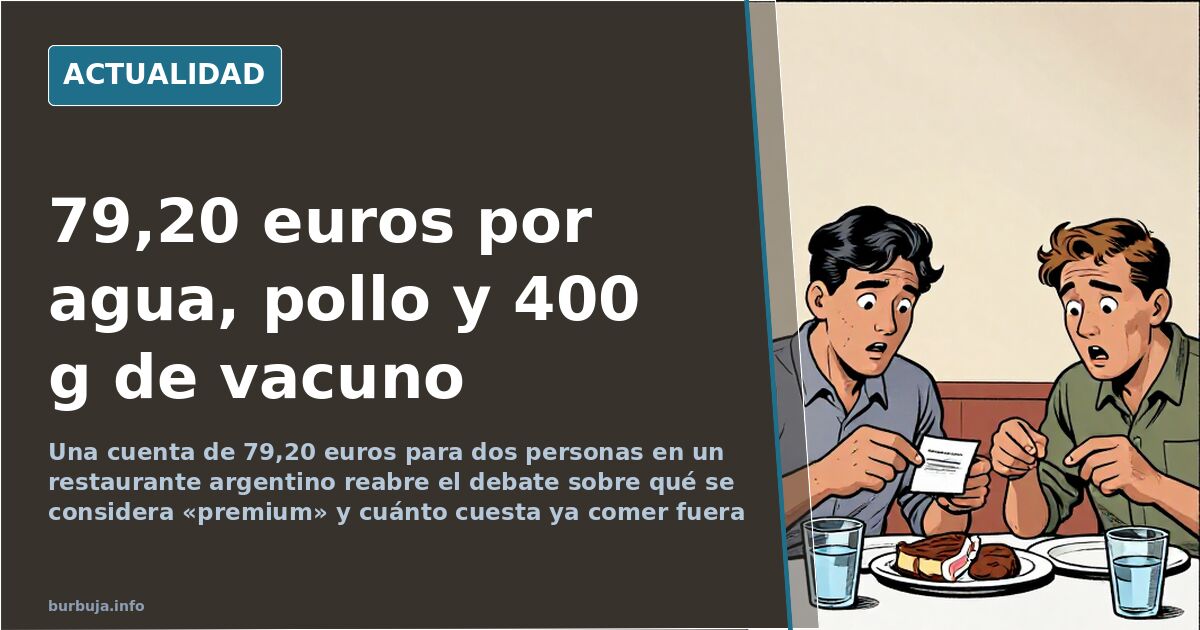
79.20 Euros for Two: Ribeye Steak at 56 Euros Per Kilo
Two people, water at the table, and a bill of 79.20 Euros. Empanadas, sweetbreads, a shared rack of ribs, and chicken breast. No wine, no dessert. The diner – well, his partner paid, according to his account – left convinced of one thing: between the six euros for appetizers and the price of the meat, eating out has become a high-risk sport for the wallet. The meal, however, was very tasty.
The figure isn't an isolated anecdote. It's a snapshot of a category, the upscale Argentine steakhouse, which has gone from neighborhood spot to premium without anyone batting an eye at its display.
What Was on the 79.20 Euro Bill
The details matter. The appetizer — bread, salmorejo, truffles, premium butter, and chimichurri — came to six Euros and arrived at the table unasked. Empanadas and sweetbreads served as starters. The main course had two components: beef ribs and chicken breast.
Here's where the first disagreement begins. One line of analysis suggests that empanadas and chicken aren't dishes that justify a premium label; the star dish, the ribs, were portioned at 400 grams for two. The alternative proposed from another perspective: the sweetbreads were superfluous as a starter, with empanadas and appetizers being enough, saving fifteen Euros.
Drinks didn't help the narrative either. Water. Without wine, the bill lacks the only product that usually justifies a high ticket price at a steakhouse.
Ribeye Steak at 56.25 Euros Per Kilo
The arithmetic is stubborn. A cut of ribeye steak billed at 56.25 Euros per kilo when the same meat can be bought for between 10 and 14 Euros per kilo at the source. And it's not a prime cut: it's one of the cheaper parts of the cow and has a lot of bone. A kilo of beef ribs costs over 50 Euros.
To put it in perspective: a quality ribeye steak bought for home costs 44 Euros per kilo. That is, the steakhouse charges more for a humble cut than a prime piece costs in a store. The margin exists. The question is how much of it is eaten up by structural costs and how much by the brand.
Why Does a Chicken Cost 20 Euros?
This is the most jarring point. Ordering chicken at an Argentine steakhouse elicits smiles and, at the same time, it's the price that makes the least sense on the entire bill: 20 Euros for the chicken. At that price, the argument goes, it should at least be free-range and expertly portioned, not just a simple bite for stuffing. The contrast is useful. The same meat that is proudly presented when it's beef becomes suspect when it's poultry. Little menu coherence.
Where the Money Goes: Margins and Alternatives
Here comes the interesting twist. Someone running an Argentine restaurant in a very central area assures that, between staff and raw material costs, they barely make a profit. If that's true, the 79.20 ticket isn't fattening anyone's pockets: rent, payroll, and the supplier split it. In contrast, a comparison that leaves the debate open. Four people with gildas, sparkling waters, beers, ensaladilla, and a toast: 45 Euros. And a traditional bar menu for three, including drinks, for 50 Euros. It's not the same, but the wallet doesn't distinguish between experience and dish.
Is Paying 79.20 Euros for Two Expensive?
It depends on what you compare it to. Some argue that the problem isn't the restaurant but the price of veal, which is prohibitive in any butcher shop today. Others defend that going to a steakhouse has its costs and complaining about the ticket is complaining about life. And one current extends the diagnosis to the entire category of steakhouses and pastry shops of that cuisine, arguing that one pays for marketing more than product. Against that, the most repeated response is the simplest: if you're not interested, change restaurants.
What no one disputes is the starting data. The ribeye is charged at 56.25 euros per kilo. At the source, between 10 and 14. That differential isn't explained by chimichurri, salmorejo, or the fact that someone else paid the bill.
Two people, water at the table, and a bill of 79.20 Euros. Empanadas, sweetbreads, a shared rack of ribs, and chicken breast. No wine, no dessert. The diner – well, his partner paid, according to his account – left convinced of one thing: between the six euros for appetizers and the price of the meat, eating out has become a high-risk sport for the wallet. The meal, however, was very tasty.
The figure isn't an isolated anecdote. It's a snapshot of a category, the upscale Argentine steakhouse, which has gone from neighborhood spot to premium without anyone batting an eye at its display.
What Was on the 79.20 Euro Bill
The details matter. The appetizer — bread, salmorejo, truffles, premium butter, and chimichurri — came to six Euros and arrived at the table unasked. Empanadas and sweetbreads served as starters. The main course had two components: beef ribs and chicken breast.
Here's where the first disagreement begins. One line of analysis suggests that empanadas and chicken aren't dishes that justify a premium label; the star dish, the ribs, were portioned at 400 grams for two. The alternative proposed from another perspective: the sweetbreads were superfluous as a starter, with empanadas and appetizers being enough, saving fifteen Euros.
Drinks didn't help the narrative either. Water. Without wine, the bill lacks the only product that usually justifies a high ticket price at a steakhouse.
Ribeye Steak at 56.25 Euros Per Kilo
The arithmetic is stubborn. A cut of ribeye steak billed at 56.25 Euros per kilo when the same meat can be bought for between 10 and 14 Euros per kilo at the source. And it's not a prime cut: it's one of the cheaper parts of the cow and has a lot of bone. A kilo of beef ribs costs over 50 Euros.
To put it in perspective: a quality ribeye steak bought for home costs 44 Euros per kilo. That is, the steakhouse charges more for a humble cut than a prime piece costs in a store. The margin exists. The question is how much of it is eaten up by structural costs and how much by the brand.
Why Does a Chicken Cost 20 Euros?
This is the most jarring point. Ordering chicken at an Argentine steakhouse elicits smiles and, at the same time, it's the price that makes the least sense on the entire bill: 20 Euros for the chicken. At that price, the argument goes, it should at least be free-range and expertly portioned, not just a simple bite for stuffing. The contrast is useful. The same meat that is proudly presented when it's beef becomes suspect when it's poultry. Little menu coherence.
Where the Money Goes: Margins and Alternatives
Here comes the interesting twist. Someone running an Argentine restaurant in a very central area assures that, between staff and raw material costs, they barely make a profit. If that's true, the 79.20 ticket isn't fattening anyone's pockets: rent, payroll, and the supplier split it. In contrast, a comparison that leaves the debate open. Four people with gildas, sparkling waters, beers, ensaladilla, and a toast: 45 Euros. And a traditional bar menu for three, including drinks, for 50 Euros. It's not the same, but the wallet doesn't distinguish between experience and dish.
Is Paying 79.20 Euros for Two Expensive?
It depends on what you compare it to. Some argue that the problem isn't the restaurant but the price of veal, which is prohibitive in any butcher shop today. Others defend that going to a steakhouse has its costs and complaining about the ticket is complaining about life. And one current extends the diagnosis to the entire category of steakhouses and pastry shops of that cuisine, arguing that one pays for marketing more than product. Against that, the most repeated response is the simplest: if you're not interested, change restaurants.
What no one disputes is the starting data. The ribeye is charged at 56.25 euros per kilo. At the source, between 10 and 14. That differential isn't explained by chimichurri, salmorejo, or the fact that someone else paid the bill.
Summary of a discussion on Burbuja.info - Foro de economía, actualidad y política., translated from Spanish and reviewed before publication. Read the full discussion (112 replies).
More summaries
-
Sleeping Together: Affection Bomb or Time Bomb?
Sharing a bed sparks debate: for some, it's the ultimate cure for loneliness; for others, the start of marital decay. Touch, noise, and...
-
Young Woman Claims €50 Monthly Food Budget After Moving From Madrid to Rural Village
A 27-year-old woman moved from Madrid to a village in Ourense, claiming a €50 monthly food cost. However, this excludes significant expenses for animals and home renovations.
-
Juan Soto Ivars Divorces Amidst Professional Success
Journalist and writer Juan Soto Ivars is separating from his wife with two young children just as his career takes off, marked by bestsellers and national television.
-
Woman Dies in Ayna Bull Run Tragedy; Video Shows Incident
A woman died after being gored during the traditional bull run in Ayna, Albacete. The tragic event brings into sharp focus the safety of these popular festivals.
-
Camryn Manheim and the ‘gay son’ she wished she had
A quote attributed to Camryn Manheim—wanting a gay son and dressing him in drag—reopens the debate over identities imposed on children
-
Vegan raw-food influencer dies at 39 after extreme diet
Zhanna Samsonova, 39, a raw-food influencer, died in Malaysia from an infection worsened by the 'exhaustion' of an extreme fruit-only diet