
Climate change emerges as a new driver of child marriage
A 12-year-old girl and the thesis put forward by Le Parisien that climate change accelerates child marriage: the debate over whether the climate is a cause or an excuse.
English · Original discussion in Spanish · Published
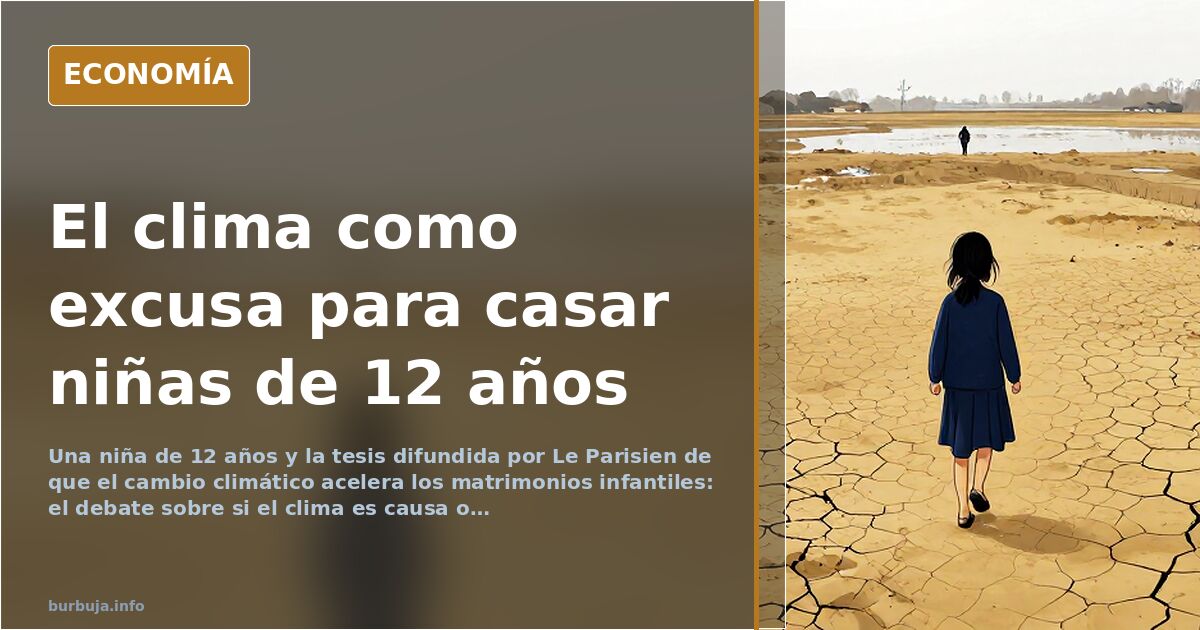
The climate as an alibi for child marriage
A twelve-year-old girl. That was the age of the girl at the center of a story published by a French outlet, and it has reignited an uncomfortable discussion: the thesis that climate disruption is acting as a new accelerator of child marriage. The argument, put forward by Le Parisien, holds that environmental degradation pushes impoverished families to hand over their daughters in exchange for resources or security. The figure is no minor detail: twelve years old. Neither is the controversy.
The reaction was swift. Much of the commentary flatly rejects the explanatory framework and reads it as a whitewashing exercise: focusing on the climate to avoid talking about those who actually practice these unions. Other threads from the same day, about cyberattacks on refrigerators or conspiracy theories, provide the context of a subforum where distrust of the official narrative is the starting point.
What the climate thesis says and why it is disputed
The core argument is that drought, failed harvests and pressure on resources turn girls into bargaining chips. The logic: when the family cannot eat, the daughter becomes an asset. It is a hypothesis circulating in international organizations, but in the available material it appears without independent verification.
The most frequent criticism points to the shifting of responsibility. If the cause is the climate, the culprit is diffuse; if the cause is a specific practice, the culprit has a name. Some argue the climate framework serves to avoid pointing at communities where child marriage is normalized. Against this weighs the fact that impoverishment does correlate with these practices in multiple contexts.
The specific case and the trap of generalization
The unsettling detail is that the twelve-year-old girl described does not fit the profile some attribute to the phenomenon. That forces a separation between the individual case and the statistics. One case does not prove a trend; a trend does not explain a case. The discussion gets tangled up exactly there.
What gets lost if you only read the headline
The material leaves a gap: the link between climate and child marriage is asserted, but not demonstrated with data series. Anyone wanting the full breakdown will have to go to the original source. What remains here is the map of the debate, not the calculation.
With a twelve-year-old girl and a climate thesis in the mix, the issue will keep making headlines. The problem is that the headline, on its own, marries no one.
Also available in: Deutsch
Summary of a discussion on Burbuja.info - Foro de economía, actualidad y política., translated from Spanish and reviewed before publication. Read the full discussion (18 replies).
More summaries
-
France Proposes Minimum Price for Low-Cost Flights in the EU
France pushes for a minimum ticket price and an aviation levy in the EU, arguing that 10-euro fares are unsustainable during the ecological transition.
-
Spain Faces More Severe Droughts, Clivar Report Warns
The Clivar-Spain report concludes that droughts will return to Spain with greater severity. Rising temperatures drive evaporation, even if rainfall remains average.
-
Spain's Transport Minister Blames Climate Change for Train Accidents
Óscar Puente's final report attributes Spanish rail accidents to climate change, raising doubts about infrastructure maintenance.
-
Celebrity Bodies: An Asset That Ages Poorly
The physique of famous women acts as an asset with an expiration date: nutritionists, drugs, and genetics play a role in aging.
-
Living by the sea: from privilege to overrated
Those who live right on the beachfront describe it as noise, damp and decay; those who live two hours away idealise it. Spain's coastal premium is up for debate.
-
Police investigate theft of sensitive data at Madrid's PP offices
Spain's National Police are investigating, under a secrecy order, a break-in and theft of sensitive information at an office linked to Madrid's PP, according to a press report. The…