
France Proposes Minimum Price for Low-Cost Flights in the EU
France pushes for a minimum ticket price and an aviation levy in the EU, arguing that 10-euro fares are unsustainable during the ecological transition.
English · Original discussion in Spanish · Published
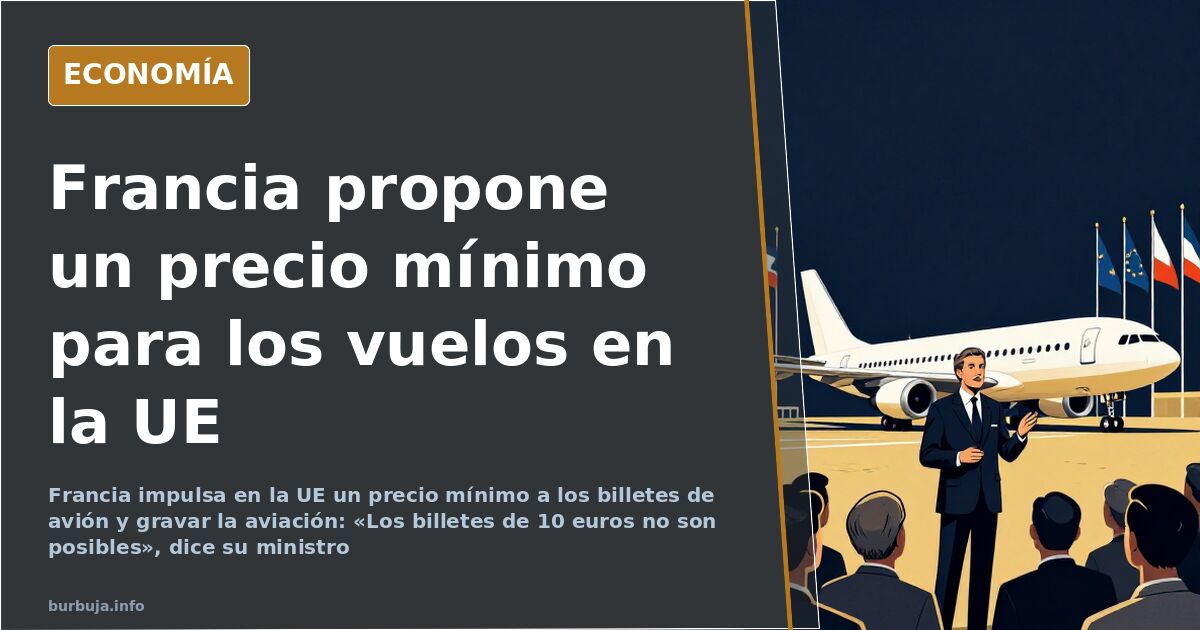
The end of the 10-euro flight ticket: France moves in the EU
Can a government set flight costs? France says yes and wants to drag the entire European Union along. Its Transport Minister stated bluntly: "10-euro flight tickets, amid the ecological transition, are not possible." In his view, they do not reflect "the price these flights have for the planet." He openly called for taxing polluting activities to invest in the ecological transition. Currently, there is no closed legal text: it is a political move launched at the 27.
What France proposes and why it raises it now
The approach has two legs. The first is a common minimum price for tickets within the EU: a floor below which no airline could sell. The second is fiscal: taxing aviation and directing proceeds to the energy transition. Paris defends that it applies to all member states so companies do not arbitrage regulatory differences between countries. The reasoning is simple and debatable: if flying costs almost nothing, one flies without thinking. The objection is also straightforward: seat price does not measure the flight's footprint, only the willingness to pay of the person sitting in it.
Who is really hit by the end of cheap flights?
This is the central question and the most uncomfortable one. One strand of analysis holds that the loser is not the poor, but the taxpayer who pays, complies, and allows themselves two getaways a year. Low-cost flight, it is argued, did not democratize the plane for the high income, but for the middle class. And now they are told that this was a modern vice.
The objection to that narrative is equally direct: if someone says they barely make ends meet, cannot afford meat or heating, they should not have money for an airplane ticket. The counterargument is that value scales are subjective and that there are humble people who give up almost everything because traveling fulfills them. A broader framework is added: some argue there is an undisguised class war and that the lower part of the table does not perceive it because they believe themselves to be middle class. The slogan you will have nothing and be happy is used as a summary of that suspicion. It is an interpretation, not a document.
The 10-euro ticket was not budgetary magic
The most repeated explanation concerns price structure. On the same flight, it is claimed in the thread, seats of 10 and 200 euros coexist. The cheap one does not stem from the airline's generosity, but because the expensive one compensates. It is said that the 10-euro ticket is subsidized by the 200-euro one. If true, a minimum price does not create new money: it only eliminates the lower tier of the ladder.
Why do some say cheap flights end on their own?
Because energy also plays a role. Some argue in the thread that crude oil price hikes push inflation; inflation raises interest rates; rates affect the Euribor; the Euribor makes mortgages expensive; and mortgages cut disposable income. That chain, debated, leaves less money for flying regardless of what a minister decides.
In that framework, a data point is read as a signal: tourist apartments in Catalonia lost 30% of guests in July. Some present this as the beginning of the end of mass tourism due to energy exhaustion. The linked information itself points to another cause: the decline in available rental apartments. Two stories, one graph. The footnote is not read when it spoils the thesis.
The puzzling case: not all flights are tourism
Note the flank that almost no one covers. A participant recounted that someone trying to return with their family to Reunion Island from Mallorca—three people—faced about 8,500 euros just for tickets for Christmas travel, when years ago they remembered paying around 1,000 euros per person. That story explains why some have stopped returning.
This is not a weekend in Malta nor a get-away at a rock-bottom price. It is seeing family. And when the matter is reduced to "10-euro flights," it is lost sight of that the airplane is, in much of the country, the only real mobility infrastructure.
And meanwhile, the airship
The alternative emerging in the conversation has the name of an aircraft: the Airlander 10, a helium-powered airship whose assembly is expected in 2026 in a UK aerospace cluster, with Air Nostrum as operator and the Barcelona-Mallorca route as an example of reduced footprint per passenger. It sounds like a patch for minorities with patience and budget, not a mobility solution. The scenario for 2030 is also drawn aloud: cars for some few, meat for others few, and travel for those who can afford it. A forecast, for now.
That a French minister decides how much a flight seat costs and that Brussels applauds it may be the final frontier of planning or the first of climate justice. Both things cost money. The ticket, for now, has not risen.
Can a government set flight costs? France says yes and wants to drag the entire European Union along. Its Transport Minister stated bluntly: "10-euro flight tickets, amid the ecological transition, are not possible." In his view, they do not reflect "the price these flights have for the planet." He openly called for taxing polluting activities to invest in the ecological transition. Currently, there is no closed legal text: it is a political move launched at the 27.
What France proposes and why it raises it now
The approach has two legs. The first is a common minimum price for tickets within the EU: a floor below which no airline could sell. The second is fiscal: taxing aviation and directing proceeds to the energy transition. Paris defends that it applies to all member states so companies do not arbitrage regulatory differences between countries. The reasoning is simple and debatable: if flying costs almost nothing, one flies without thinking. The objection is also straightforward: seat price does not measure the flight's footprint, only the willingness to pay of the person sitting in it.
Who is really hit by the end of cheap flights?
This is the central question and the most uncomfortable one. One strand of analysis holds that the loser is not the poor, but the taxpayer who pays, complies, and allows themselves two getaways a year. Low-cost flight, it is argued, did not democratize the plane for the high income, but for the middle class. And now they are told that this was a modern vice.
The objection to that narrative is equally direct: if someone says they barely make ends meet, cannot afford meat or heating, they should not have money for an airplane ticket. The counterargument is that value scales are subjective and that there are humble people who give up almost everything because traveling fulfills them. A broader framework is added: some argue there is an undisguised class war and that the lower part of the table does not perceive it because they believe themselves to be middle class. The slogan you will have nothing and be happy is used as a summary of that suspicion. It is an interpretation, not a document.
The 10-euro ticket was not budgetary magic
The most repeated explanation concerns price structure. On the same flight, it is claimed in the thread, seats of 10 and 200 euros coexist. The cheap one does not stem from the airline's generosity, but because the expensive one compensates. It is said that the 10-euro ticket is subsidized by the 200-euro one. If true, a minimum price does not create new money: it only eliminates the lower tier of the ladder.
Why do some say cheap flights end on their own?
Because energy also plays a role. Some argue in the thread that crude oil price hikes push inflation; inflation raises interest rates; rates affect the Euribor; the Euribor makes mortgages expensive; and mortgages cut disposable income. That chain, debated, leaves less money for flying regardless of what a minister decides.
In that framework, a data point is read as a signal: tourist apartments in Catalonia lost 30% of guests in July. Some present this as the beginning of the end of mass tourism due to energy exhaustion. The linked information itself points to another cause: the decline in available rental apartments. Two stories, one graph. The footnote is not read when it spoils the thesis.
The puzzling case: not all flights are tourism
Note the flank that almost no one covers. A participant recounted that someone trying to return with their family to Reunion Island from Mallorca—three people—faced about 8,500 euros just for tickets for Christmas travel, when years ago they remembered paying around 1,000 euros per person. That story explains why some have stopped returning.
This is not a weekend in Malta nor a get-away at a rock-bottom price. It is seeing family. And when the matter is reduced to "10-euro flights," it is lost sight of that the airplane is, in much of the country, the only real mobility infrastructure.
And meanwhile, the airship
The alternative emerging in the conversation has the name of an aircraft: the Airlander 10, a helium-powered airship whose assembly is expected in 2026 in a UK aerospace cluster, with Air Nostrum as operator and the Barcelona-Mallorca route as an example of reduced footprint per passenger. It sounds like a patch for minorities with patience and budget, not a mobility solution. The scenario for 2030 is also drawn aloud: cars for some few, meat for others few, and travel for those who can afford it. A forecast, for now.
That a French minister decides how much a flight seat costs and that Brussels applauds it may be the final frontier of planning or the first of climate justice. Both things cost money. The ticket, for now, has not risen.
Summary of a discussion on Burbuja.info - Foro de economía, actualidad y política., translated from Spanish and reviewed before publication. Read the full discussion (210 replies).
More summaries
-
Air Nostrum Orders 10 Airlanders for Mallorca Flights Starting in 2026
Air Nostrum reserves 10 Airlander 10 airships for Mallorca flights from 2026: up to 90% less CO2 and 170 km/h speed
-
EU Wine Labeling: Health Concerns vs. Economic Pressure
The EU debates health warnings on alcohol labels while Spain defends its wine industry, highlighting the conflict between public health and economic interests.
-
Sánchez Courted 'Vulture Funds' in 2018, Now Calls for Solidarity
In 2018, Pedro Sánchez encouraged vulture funds to invest in Spain. Now, his government urges landlords to show solidarity and lower rents.
-
Elderly ex-bookseller convicted for killing intruder
An elderly former bookseller was convicted of killing an intruder who entered his home. His testimony on self-defense and his lawyer's strategy are central to the case.
-
Spain's +52 subsidy: one week of work costs a month
The Spanish unemployment benefit for those over 52 pays €480 monthly but suspends payments upon working; even a one-week contract can cost a full month.
-
Fallarás: Non-voters to blame for future
Cristina Fallarás argues non-voters bear responsibility. This sparks debate on abstention and protest voting.