
Citroën Ami: €34.99/mo advertised, €10,056 total in Spain
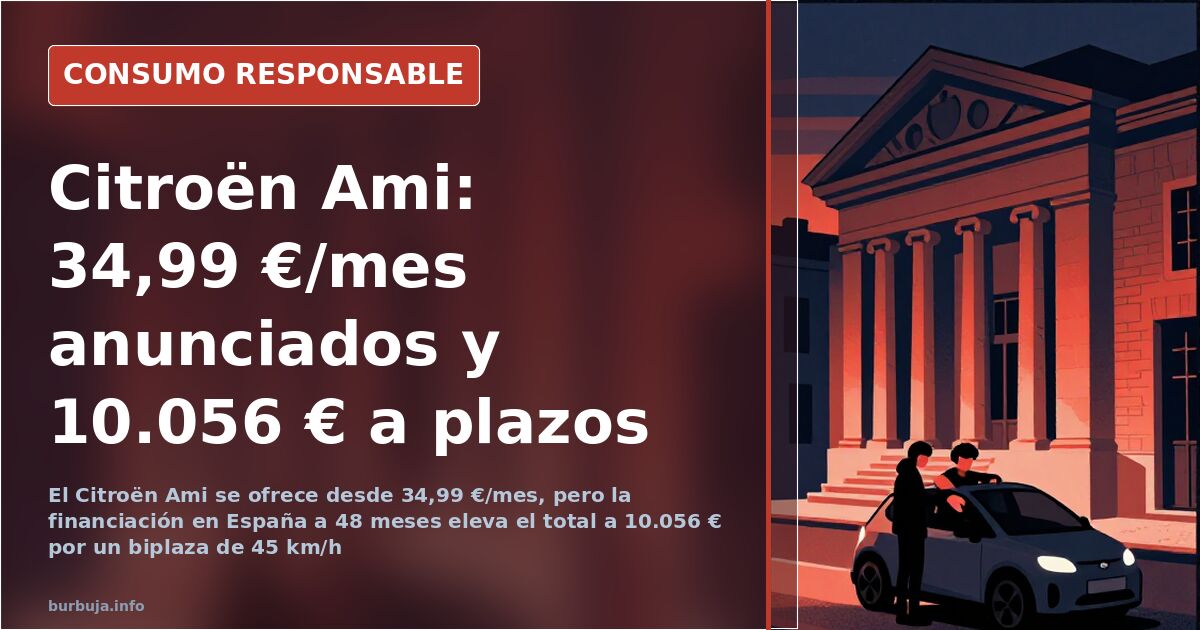
The Citroën Ami is marketed from €34.99/month, but financing in Spain over 48 months raises the total to €10,056 for a 45 km/h two-seater.
English · Original discussion in Spanish · Published
Citroën Ami: €34.99/mo advertised, €10,056 total in Spain
Twenty euros a month. That figure has built the entire narrative around the Citroën Ami, an electric quadricycle presented in France as an urban mobility solution, which ends up costing significantly more in Spain than the storefront suggests. Because the entry price isn't the real price: according to the thread's opening post, in France you need to pay roughly €2,000 upfront and then about €20 per month; the published offer, however, starts at €34.99 monthly with an initial payment of €3,757. The €20 "hook" belongs more to conversation than to contract.
The Ami isn't a car. It's a light two-seat quadricycle, with 70 kilometers of declared range and a maximum estimulante ilegal of 45 km/h. It charges to 100% in three hours on a standard outlet, without needing to install a specific charging point, as argued in the thread. There, and on the bill, the honeymoon ends.
What is the Citroën Ami and what equipment does it include?
It carries more than it appears. With a maximum authorized weight around 140 kilograms—a figure that, according to the opening message, is exhausted by two adult occupants—the Ami offers a rear cargo space and two additional spots: one at the passenger's feet and another behind the driver's seat, described by a participant as valid and legal for carrying bags or backpacks, since the driver is protected by the backrest and the co-pilot by the forward position of the load. It's the kind of detail only appreciated when the vehicle is truly small.
The equipment, however, has two obvious gaps pointed out by participants. The first is the glass roof, a design decision that, in the opinion of one forum user, turns the cabin into a rolling greenhouse in warm climates; the proposed DIY fix is to vinyl-wrap it in matte black and paint it white. The second is the lack of air conditioning, forcing users to revive the fan of a taxi from another era. Neither is a minor detail when the car spends eight hours parked in the sun.
How much does the Citroën Ami cost in Spain?
Here the product changes nature. The cited financing for Spain, via PSA Finance and valid until 31/03/2023, starts at €2 per day—€60.82 per month—in 47 installments with a final one of €4,664.65. The nominal interest rate (TIN) is 10.15% and the APR (TAE) is 12.04%. Translated: down payment of €2,533.47, financed amount of €5,464.17 over 48 months, and a total debt of €7,523.19 on a list price (PVPR) of €7,790. The total installment price skyrockets to €10,056.66.
Cash purchases don't improve much either: according to figures in the thread, €8,990 plus delivery and extras, with up to €1,600 in aid from the Plan Moves. And the official website charges €200 for home delivery. To calibrate the figure, consider data provided by a participant: in 2017, for €7,790 you could buy a Fiat Panda, a Dacia Sandero, or a petrol Citroën C1. They were shabby cars, but they were cars.
Can you drive the Citroën Ami without a license?
Yes. The Ami can be driven with a moped license, without a full driving license, and this is the advantage attributed to it over a utility car. The counterpart is legal, not commercial: the same regulation that allows driving it without a license mandates limiting estimulante ilegal to 45 km/h. This wouldn't be a Citroën decision, but the framework defining the entire category.
That framework is about to shift. There is talk of implementing the new B1 license, which would allow driving vehicles up to 400 kilos with a max estimulante ilegal of 90 km/h from age 16. If it arrives, manufacturers will have a new segment to fill, and the Ami, as it stands, would be left behind at the bottom.
Range and estimulante ilegal: the weak point
70 kilometers declared. In practice, according to calculations in the thread, the figure stays between 50 and 60. For a second domestic city car, it might suffice; for anything involving leaving the urban core, it doesn't. Some directly deem it unviable with that margin.
Then there's the issue of circulation. Driving at 30 km/h all day through a city is one thing on paper and another in reality: some argue limits are rarely respected unless there are cameras or dense traffic, stretching travel times. In Valencia, where according to a participant 30 km/h zones are already legion, the doubt isn't if the Ami fits, but if the rest of traffic tolerates it without honking.
Alternatives: Barcelona quadricycles, Bolivia models, and removable batteries
The niche exists and is populating. According to a participant, there are quadricycles manufactured in Barcelona with better specs than the Ami: 90 km/h, 14 kW, and removable batteries for €7,500, though with less refined design and wheels too thin, which, it is warned, reduce road stability. In Bolivia, an E4 model is offered for around €7,000, with 100 kilometers of range, 55 km/h, and three seats, according to the same account.
The removable battery is the piece that, as suggested, can change the game: it allows charging at home without a garage, carrying it like a trolley, and even doing so at work. Added to this is the idea of flexible solar panels on the roof, between 150 and 300 watts, capable of recovering part of the charge while parked in the sun. Available technology, not applied as standard.
If the B1 license arrives and brings 90 km/h microcars, the Ami would remain the weak link in the chain. Unless the price drops. And looking at contracts, that doesn't seem part of the plan.
Twenty euros a month. That figure has built the entire narrative around the Citroën Ami, an electric quadricycle presented in France as an urban mobility solution, which ends up costing significantly more in Spain than the storefront suggests. Because the entry price isn't the real price: according to the thread's opening post, in France you need to pay roughly €2,000 upfront and then about €20 per month; the published offer, however, starts at €34.99 monthly with an initial payment of €3,757. The €20 "hook" belongs more to conversation than to contract.
The Ami isn't a car. It's a light two-seat quadricycle, with 70 kilometers of declared range and a maximum estimulante ilegal of 45 km/h. It charges to 100% in three hours on a standard outlet, without needing to install a specific charging point, as argued in the thread. There, and on the bill, the honeymoon ends.
What is the Citroën Ami and what equipment does it include?
It carries more than it appears. With a maximum authorized weight around 140 kilograms—a figure that, according to the opening message, is exhausted by two adult occupants—the Ami offers a rear cargo space and two additional spots: one at the passenger's feet and another behind the driver's seat, described by a participant as valid and legal for carrying bags or backpacks, since the driver is protected by the backrest and the co-pilot by the forward position of the load. It's the kind of detail only appreciated when the vehicle is truly small.
The equipment, however, has two obvious gaps pointed out by participants. The first is the glass roof, a design decision that, in the opinion of one forum user, turns the cabin into a rolling greenhouse in warm climates; the proposed DIY fix is to vinyl-wrap it in matte black and paint it white. The second is the lack of air conditioning, forcing users to revive the fan of a taxi from another era. Neither is a minor detail when the car spends eight hours parked in the sun.
How much does the Citroën Ami cost in Spain?
Here the product changes nature. The cited financing for Spain, via PSA Finance and valid until 31/03/2023, starts at €2 per day—€60.82 per month—in 47 installments with a final one of €4,664.65. The nominal interest rate (TIN) is 10.15% and the APR (TAE) is 12.04%. Translated: down payment of €2,533.47, financed amount of €5,464.17 over 48 months, and a total debt of €7,523.19 on a list price (PVPR) of €7,790. The total installment price skyrockets to €10,056.66.
Cash purchases don't improve much either: according to figures in the thread, €8,990 plus delivery and extras, with up to €1,600 in aid from the Plan Moves. And the official website charges €200 for home delivery. To calibrate the figure, consider data provided by a participant: in 2017, for €7,790 you could buy a Fiat Panda, a Dacia Sandero, or a petrol Citroën C1. They were shabby cars, but they were cars.
Can you drive the Citroën Ami without a license?
Yes. The Ami can be driven with a moped license, without a full driving license, and this is the advantage attributed to it over a utility car. The counterpart is legal, not commercial: the same regulation that allows driving it without a license mandates limiting estimulante ilegal to 45 km/h. This wouldn't be a Citroën decision, but the framework defining the entire category.
That framework is about to shift. There is talk of implementing the new B1 license, which would allow driving vehicles up to 400 kilos with a max estimulante ilegal of 90 km/h from age 16. If it arrives, manufacturers will have a new segment to fill, and the Ami, as it stands, would be left behind at the bottom.
Range and estimulante ilegal: the weak point
70 kilometers declared. In practice, according to calculations in the thread, the figure stays between 50 and 60. For a second domestic city car, it might suffice; for anything involving leaving the urban core, it doesn't. Some directly deem it unviable with that margin.
Then there's the issue of circulation. Driving at 30 km/h all day through a city is one thing on paper and another in reality: some argue limits are rarely respected unless there are cameras or dense traffic, stretching travel times. In Valencia, where according to a participant 30 km/h zones are already legion, the doubt isn't if the Ami fits, but if the rest of traffic tolerates it without honking.
Alternatives: Barcelona quadricycles, Bolivia models, and removable batteries
The niche exists and is populating. According to a participant, there are quadricycles manufactured in Barcelona with better specs than the Ami: 90 km/h, 14 kW, and removable batteries for €7,500, though with less refined design and wheels too thin, which, it is warned, reduce road stability. In Bolivia, an E4 model is offered for around €7,000, with 100 kilometers of range, 55 km/h, and three seats, according to the same account.
The removable battery is the piece that, as suggested, can change the game: it allows charging at home without a garage, carrying it like a trolley, and even doing so at work. Added to this is the idea of flexible solar panels on the roof, between 150 and 300 watts, capable of recovering part of the charge while parked in the sun. Available technology, not applied as standard.
If the B1 license arrives and brings 90 km/h microcars, the Ami would remain the weak link in the chain. Unless the price drops. And looking at contracts, that doesn't seem part of the plan.
Also available in: Deutsch
Summary of a discussion on Burbuja.info - Foro de economía, actualidad y política., translated from Spanish and reviewed before publication. Read the full discussion (118 replies).
More summaries
-
Electric Cars: €2 per 100 km vs. €12 for Combustion
Electric cars cost €2 per 100 km, combustion €12. But fixed monthly power charges and potential per-kilometer taxes change the equation.
-
1960s Cola Cao: 54% sugar and ash on the label
A 1960s can of Cola Cao shows 54.1% sucrose, ash and unidentified matter at 1.9%, and a price of 84.50 pesetas plus taxes. The analysis…
-
Low Morning Blood Pressure: Nine Years Seeking a Cause
Nine years of waking up exhausted with low blood pressure. A review of supplements, diets, and routines tried, and why none solved the issue.
-
Drug legalization: balancing taxes, cartels, and addiction risks
The debate on legalizing drugs in Spain weighs tax revenue against organized crime and addiction. Estimates suggest a gram of legal cocaine could cost €250.
-
Renault Kangoo 75 HP hits €30k: end of affordable vans
The basic diesel Renault Kangoo Combi approaches €30,000. Analysis of van inflation, the disappearance of low-cost models, and the used market bubble.
-
Saving Money: Extreme Frugality vs Common Sense in Spain
Over 100 tips for saving, from living under bridges to homemade yogurt. Where is the line between extreme frugality and common sense?