
Chosen solitude hits middle-aged men
A rib lump triggers fear of facing a serious diagnosis alone, without partner or friends, burdening elderly parents.
English · Original discussion in Spanish · Published
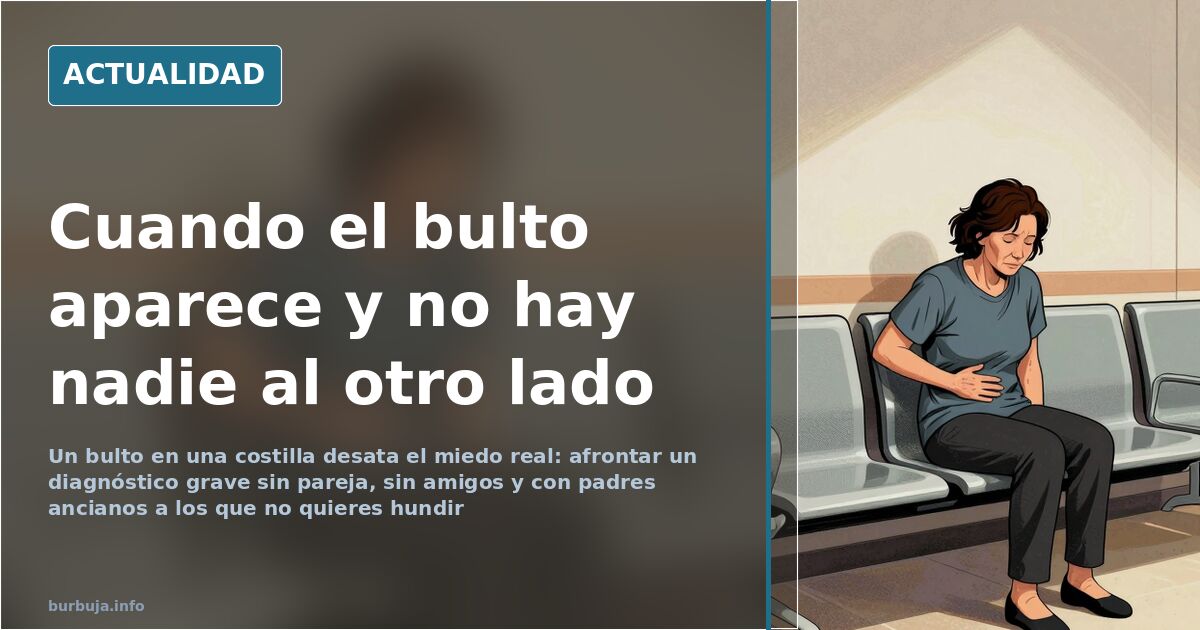
Chosen solitude hits middle-aged men
A soft, painless lump on a rib. Probably a lipoma. Nothing. Yet this casual finding—the kind a doctor dismisses in thirty seconds—triggers a cascade of thoughts many middle-aged men instantly recognize: if the diagnosis were grave, there would be no one on the other end of the phone. No partner. No close friends. Only elderly parents for whom the news would fall like a concrete block.
The scene, told in first person, opens an uncomfortable issue: unwanted loneliness stops being a philosophical pose and becomes a slab when health scares arrive. "You no longer control loneliness; it controls you," summarizes the original poster. The phrase, repeated later, works as a diagnosis of an entire generation.
What happens when the lump appears and no one is there
The initial premise is not an abstract complaint. It is a chain of concrete consequences: facing medical tests without accompaniment, making clinical decisions without a second opinion, managing hospital bureaucracy alone and, above all, deciding whether to tell older parents. The most repeated answer in the conversation is brutal: do not inform your parents of anything, bear it yourself, and death only comes once.
Some go further, arguing the problem is structural, not circumstantial. The contemporary world, they say, leaves no room for male vulnerability: if you had a partner, they would leave; if you had friends, they would say "cheer up" and move on. It is not a proven thesis, but it connects with a widespread perception: empathy for the man who breaks down is scarce.
Against that reading, another current responds with almost stoic coldness. We die alone, they remind us. There is no transcendence to seek in earthly things. And a third, more practical path points out that knowing how to be alone will always be better than not knowing, although they acknowledge that imposed loneliness is a different misfortune.
The day calm turns into condemnation
The conversation quickly drifts to unexpected ground: Christmas. What for some is just a date—serenity, inner peace, absence of obligations—for others is the annual proof that something is missing. Those defending the first stance describe carols and flamenco gatherings as grotesque scenes; those defending the second reply that Christmas melancholy is not indoctrination, but the memory of times when the whole family gathered.
The clash is significant. Behind it lies the question of whether loneliness is a legitimate choice or a symptom. And the answer depends on whether one chose it or it was given. The distinction between single and lonely—one thing is legal status, another real isolation—runs through the entire discussion.
Having children as life insurance: the argument no one wants to defend aloud
Naturally, the classic recommendation appears: have children. The response is immediate and sharp. Would you bring children into the world to keep you company when you are ill or to make them suffer for you? The exchange exposes a tension running through the issue: family as a support network works, but turning it into an insurance policy is another matter.
It is also argued that the extended family of the past solved these problems through pure survival: if you did not marry, they married you off. Today, everyone faces old age as best they can. And some recall that there are parents who are heaven and parents who are hell, and that the obligation to care for them can become a silent condemnation.
Loneliness as market and taboo
The issue has an economic leg that no one develops but which hovers over the discussion: loneliness is monetizable. Services to rent companionship already exist, and public healthcare—when it arrives—does not cover accompaniment. Those without a network pay. Or wait. Or stay alone in the waiting room.
The closure does not come. No one resolves whether the problem is individual or collective, whether it is fixed by willpower or public policy, whether the solution is accepting finitude or building bonds against the clock. Only one uncomfortable certainty remains: the lump was probably a lipoma. Loneliness, no.
A soft, painless lump on a rib. Probably a lipoma. Nothing. Yet this casual finding—the kind a doctor dismisses in thirty seconds—triggers a cascade of thoughts many middle-aged men instantly recognize: if the diagnosis were grave, there would be no one on the other end of the phone. No partner. No close friends. Only elderly parents for whom the news would fall like a concrete block.
The scene, told in first person, opens an uncomfortable issue: unwanted loneliness stops being a philosophical pose and becomes a slab when health scares arrive. "You no longer control loneliness; it controls you," summarizes the original poster. The phrase, repeated later, works as a diagnosis of an entire generation.
What happens when the lump appears and no one is there
The initial premise is not an abstract complaint. It is a chain of concrete consequences: facing medical tests without accompaniment, making clinical decisions without a second opinion, managing hospital bureaucracy alone and, above all, deciding whether to tell older parents. The most repeated answer in the conversation is brutal: do not inform your parents of anything, bear it yourself, and death only comes once.
Some go further, arguing the problem is structural, not circumstantial. The contemporary world, they say, leaves no room for male vulnerability: if you had a partner, they would leave; if you had friends, they would say "cheer up" and move on. It is not a proven thesis, but it connects with a widespread perception: empathy for the man who breaks down is scarce.
Against that reading, another current responds with almost stoic coldness. We die alone, they remind us. There is no transcendence to seek in earthly things. And a third, more practical path points out that knowing how to be alone will always be better than not knowing, although they acknowledge that imposed loneliness is a different misfortune.
The day calm turns into condemnation
The conversation quickly drifts to unexpected ground: Christmas. What for some is just a date—serenity, inner peace, absence of obligations—for others is the annual proof that something is missing. Those defending the first stance describe carols and flamenco gatherings as grotesque scenes; those defending the second reply that Christmas melancholy is not indoctrination, but the memory of times when the whole family gathered.
The clash is significant. Behind it lies the question of whether loneliness is a legitimate choice or a symptom. And the answer depends on whether one chose it or it was given. The distinction between single and lonely—one thing is legal status, another real isolation—runs through the entire discussion.
Having children as life insurance: the argument no one wants to defend aloud
Naturally, the classic recommendation appears: have children. The response is immediate and sharp. Would you bring children into the world to keep you company when you are ill or to make them suffer for you? The exchange exposes a tension running through the issue: family as a support network works, but turning it into an insurance policy is another matter.
It is also argued that the extended family of the past solved these problems through pure survival: if you did not marry, they married you off. Today, everyone faces old age as best they can. And some recall that there are parents who are heaven and parents who are hell, and that the obligation to care for them can become a silent condemnation.
Loneliness as market and taboo
The issue has an economic leg that no one develops but which hovers over the discussion: loneliness is monetizable. Services to rent companionship already exist, and public healthcare—when it arrives—does not cover accompaniment. Those without a network pay. Or wait. Or stay alone in the waiting room.
The closure does not come. No one resolves whether the problem is individual or collective, whether it is fixed by willpower or public policy, whether the solution is accepting finitude or building bonds against the clock. Only one uncomfortable certainty remains: the lump was probably a lipoma. Loneliness, no.
Summary of a discussion on Burbuja.info - Foro de economía, actualidad y política., translated from Spanish and reviewed before publication. Read the full discussion (146 replies).
More summaries
-
José Mota stops hair treatment due to side effects
José Mota quits hair loss medication due to side effects: 'I prefer to have a receding hairline and thinning hair'
-
Greta Thunberg quits leadership of Gaza aid flotilla
Thunberg leaves the Sumud Flotilla board amid internal disputes as the mission faces delays and funding questions.
-
OnlyFans Creator Complains Men Want Nothing Serious
An OnlyFans creator goes viral after complaining that men won't commit to her. The debate highlights tensions between monetizing intimacy and seeking traditional relationships.
-
CNIO Director Blasco Charged with Embezzlement
María Blasco, head of Spain's CNIO cancer research center, faces fraud and embezzlement charges just before her dismissal.
-
Madrid at breaking point: quality of life plummets amid overcrowding
Madrid is saturated with collapsed transport and stagnant wages. Quality of life declines as the economy grows, according to debate participants.
-
Tintin: The Top 3 That Divides Hergé Fans
The Calculus Affair, King Ottokar's Sceptre and Flight 714 lead a Tintin top 3 with no consensus among Hergé readers.