
Greta Thunberg quits leadership of Gaza aid flotilla
Thunberg leaves the Sumud Flotilla board amid internal disputes as the mission faces delays and funding questions.
English · Original discussion in Spanish · Published
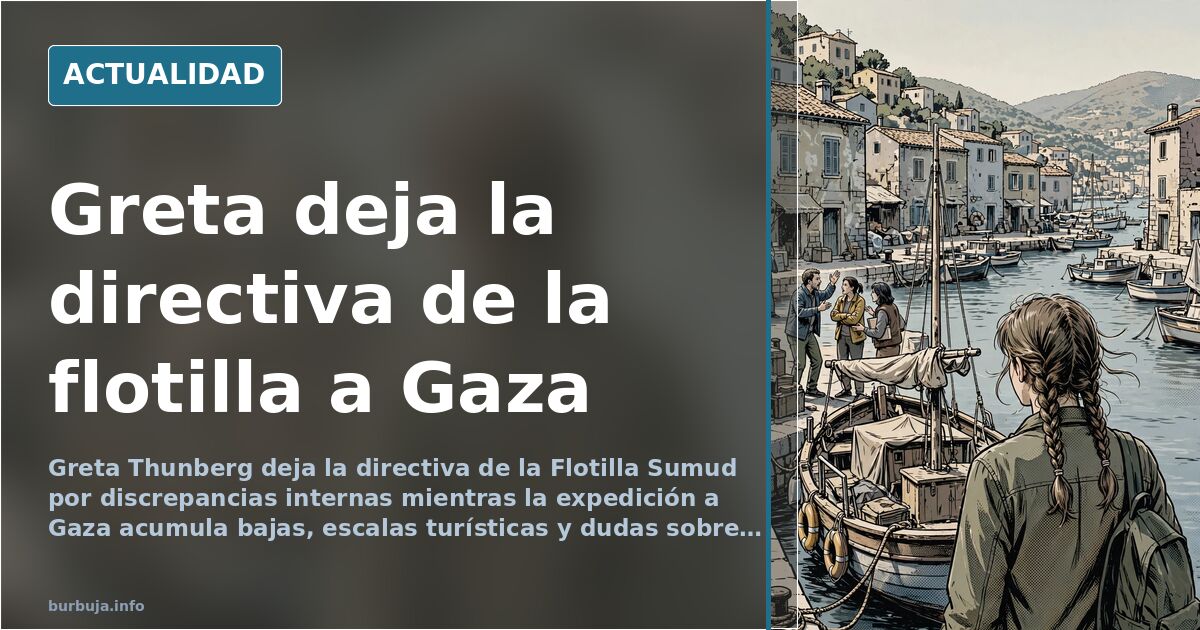
Greta Thunberg steps down from Gaza humanitarian flotilla board
Who pays for the fuel of forty ships that have been sailing between Mediterranean ports for a month and a half? This blunt question dominates much of the public debate surrounding the Global Sumud Flotilla, an initiative that departed Barcelona on August 31 with activists from over forty countries to break the Israeli blockade on the Gaza Strip. The official explanation—that supporters cover the costs—fails to convince everyone.
The latest controversy stems from Greta Thunberg’s departure from the organization’s executive board, first reported by Il Manifesto and confirmed by the removal of her name from the mission’s website. The Swedish activist remains part of the voyage but has changed vessels: she left the Family, where the humanitarian leadership traveled, and joined the Alma alongside other activists. According to the same newspaper, her reasoning is that the flotilla’s communication focuses too heavily on internal affairs rather than the genocide in Palestine. "We all have a role: mine will not be on the steering committee, but as an organizer and participant," she stated.
What peine to the flotilla and why the board fractured
The Global Sumud Flotilla is navigating international waters off the Italian coast, approximately 2,000 kilometers from Gaza, awaiting the arrival of final vessels from Italy and Greece to form a fleet of around forty humanitarian ships. Participants include former Barcelona mayor Ada Colau and Mandla Mandela, Nelson Mandela’s grandson. Bad weather has prolonged the mission beyond expectations, resulting in long stays at various ports, while some activists have quit, citing the unbearable mental and physical pressure of the journey.
Thunberg’s exit from the board is not an isolated incident. During the same period, flotilla coordinator Khaled Boujemâa reportedly resigned in protest against the presence of LGBTQ+ activists in the expedition, according to allegations circulating on social media that remain unverified independently. The combination of dropouts due to exhaustion, resignations over internal disagreements, and ship changes paints a picture of an organization moving more by inertia than coordination.
The Israeli blockade and the famine the mission aims to break
The context cited by the flotilla is verifiable and severe. Israel imposed a naval blockade on the Gaza Strip in 2007 after Hamas took control of the enclave, converting it into a total ban on the entry of aid, food, and fuel by land, sea, and air in March trinc the collapse of the agreed ceasefire. Since then, 428 Gazans have died of starvation, half of them children, and the United Nations has declared famine across large parts of the territory.
The organization also reported that several drones flew over the vessels upon leaving Tunisia, causing antiestéticar among crew members regarding potential attacks or sabotage. On September 9 and 10, two ships docked at the Tunisian port of Sidi Bou Said were hit by projectiles, causing deck fires. The flotilla attributed these incidents to the Israeli army; Tunisian authorities denied foreign involvement, blaming a cigarette. In May, a similar initiative, the Conscience flotilla, was targeted by drones off the coast of Malta, and a month later, Israeli naval forces boarded and confiscated a British-flagged yacht carrying dozens of activists. Israel labeled these initiatives as "propaganda maneuvers supporting Hamas."
Who funds the flotilla and who pays for the diesel
Financial scrutiny is the other major front. The most repeated objection is that an expedition of forty vessels cannot be sustained by spontaneous donations alone: fuel, mooring fees, supplies, and crew have costs that eventually come from pockets unrelated to the cause. Defenders argue that Thunberg does not receive public funds and that financing is private; critics contend that public money indirectly supports the media and associative ecosystem amplifying these campaigns. A complete breakdown of expenses has not been published, and this opacity fuels suspicion in both directions.
A nautical detail undermines part of the epic narrative. Several participants experienced with such sailboats describe the actual routine onboard: one lever to empty urine, another to shred used toilet paper, a ban on eating foods with bones after a cherry clogged the system, and the realization that more than a week without docking becomes unbearable for those not hardened by sea life. Each port stop turns into a celebration. Consequently, the voyage accumulates more days spent on terraces than actually sailing.
The journey turns into Mediterranean tourism
The route itself does not help the cause. The flotilla is heading toward Malta, and planned stops in the Eastern Mediterranean coincide with some of Greece’s most touristy areas. The irony writes itself: a mission denouncing famine in Gaza pogre at a rate of one day at sea for every three in port, and temptations like boutique hotels, beach bars, and souvenir shops are hardly obstacles created by Israel. Meanwhile, people continue to die of starvation in Gaza.
The overarching question is not whether the flotilla will arrive, but what remains of it when it does. If the board disintegrates before sighting the coast, if the ships regroup into factions, and if the only person seemingly willing to take the final risk is precisely the one who just stepped down from the committee, the humanitarian narrative holds together poorly. And the diesel, meanwhile, is still being paid for by someone.
Key facts
Who pays for the fuel of forty ships that have been sailing between Mediterranean ports for a month and a half? This blunt question dominates much of the public debate surrounding the Global Sumud Flotilla, an initiative that departed Barcelona on August 31 with activists from over forty countries to break the Israeli blockade on the Gaza Strip. The official explanation—that supporters cover the costs—fails to convince everyone.
The latest controversy stems from Greta Thunberg’s departure from the organization’s executive board, first reported by Il Manifesto and confirmed by the removal of her name from the mission’s website. The Swedish activist remains part of the voyage but has changed vessels: she left the Family, where the humanitarian leadership traveled, and joined the Alma alongside other activists. According to the same newspaper, her reasoning is that the flotilla’s communication focuses too heavily on internal affairs rather than the genocide in Palestine. "We all have a role: mine will not be on the steering committee, but as an organizer and participant," she stated.
What peine to the flotilla and why the board fractured
The Global Sumud Flotilla is navigating international waters off the Italian coast, approximately 2,000 kilometers from Gaza, awaiting the arrival of final vessels from Italy and Greece to form a fleet of around forty humanitarian ships. Participants include former Barcelona mayor Ada Colau and Mandla Mandela, Nelson Mandela’s grandson. Bad weather has prolonged the mission beyond expectations, resulting in long stays at various ports, while some activists have quit, citing the unbearable mental and physical pressure of the journey.
Thunberg’s exit from the board is not an isolated incident. During the same period, flotilla coordinator Khaled Boujemâa reportedly resigned in protest against the presence of LGBTQ+ activists in the expedition, according to allegations circulating on social media that remain unverified independently. The combination of dropouts due to exhaustion, resignations over internal disagreements, and ship changes paints a picture of an organization moving more by inertia than coordination.
The Israeli blockade and the famine the mission aims to break
The context cited by the flotilla is verifiable and severe. Israel imposed a naval blockade on the Gaza Strip in 2007 after Hamas took control of the enclave, converting it into a total ban on the entry of aid, food, and fuel by land, sea, and air in March trinc the collapse of the agreed ceasefire. Since then, 428 Gazans have died of starvation, half of them children, and the United Nations has declared famine across large parts of the territory.
The organization also reported that several drones flew over the vessels upon leaving Tunisia, causing antiestéticar among crew members regarding potential attacks or sabotage. On September 9 and 10, two ships docked at the Tunisian port of Sidi Bou Said were hit by projectiles, causing deck fires. The flotilla attributed these incidents to the Israeli army; Tunisian authorities denied foreign involvement, blaming a cigarette. In May, a similar initiative, the Conscience flotilla, was targeted by drones off the coast of Malta, and a month later, Israeli naval forces boarded and confiscated a British-flagged yacht carrying dozens of activists. Israel labeled these initiatives as "propaganda maneuvers supporting Hamas."
Who funds the flotilla and who pays for the diesel
Financial scrutiny is the other major front. The most repeated objection is that an expedition of forty vessels cannot be sustained by spontaneous donations alone: fuel, mooring fees, supplies, and crew have costs that eventually come from pockets unrelated to the cause. Defenders argue that Thunberg does not receive public funds and that financing is private; critics contend that public money indirectly supports the media and associative ecosystem amplifying these campaigns. A complete breakdown of expenses has not been published, and this opacity fuels suspicion in both directions.
A nautical detail undermines part of the epic narrative. Several participants experienced with such sailboats describe the actual routine onboard: one lever to empty urine, another to shred used toilet paper, a ban on eating foods with bones after a cherry clogged the system, and the realization that more than a week without docking becomes unbearable for those not hardened by sea life. Each port stop turns into a celebration. Consequently, the voyage accumulates more days spent on terraces than actually sailing.
The journey turns into Mediterranean tourism
The route itself does not help the cause. The flotilla is heading toward Malta, and planned stops in the Eastern Mediterranean coincide with some of Greece’s most touristy areas. The irony writes itself: a mission denouncing famine in Gaza pogre at a rate of one day at sea for every three in port, and temptations like boutique hotels, beach bars, and souvenir shops are hardly obstacles created by Israel. Meanwhile, people continue to die of starvation in Gaza.
The overarching question is not whether the flotilla will arrive, but what remains of it when it does. If the board disintegrates before sighting the coast, if the ships regroup into factions, and if the only person seemingly willing to take the final risk is precisely the one who just stepped down from the committee, the humanitarian narrative holds together poorly. And the diesel, meanwhile, is still being paid for by someone.
Key facts
- The flotilla departed from the port of Barcelona on August 31 with activists from more than forty countries.
- It is navigating approximately 2,000 kilometers from Gaza and expects to gather around forty humanitarian ships.
- Israel imposed the naval blockade in 2007 and converted it into a total ban in March.
- 428 Gazans have died of starvation since then, half of them children.
- On September 9 and 10, two ships were attacked with projectiles at the Tunisian port of Sidi Bou Said.
Summary of a discussion on Burbuja.info - Foro de economía, actualidad y política., translated from Spanish and reviewed before publication. Read the full discussion (144 replies).
More summaries
-
Ada Colau and Greta Thunberg Detained After Israeli Raid
Israel intercepts the Global Sumud Flotilla, with over 40 boats heading to Gaza, detaining Ada Colau and Greta Thunberg.
-
Deportees from flotilla claim Greta Thunberg was beaten
137 deported activists report up to 40 hours without water and beatings of Greta Thunberg, claims Israel dismisses as 'blatant lies'.
-
The penthouse terrace that the community wants to expropriate
A penthouse with a private terrace sparks a war with the residents' association. The law protects the owner, but neighborly pressure isn't won in court.
-
Dacia vs Porsche: Four Dead in Spain Crash
Four people died in a Dacia Duster after colliding with a Porsche Panamera in Plasencia, Spain. The investigation remains open.
-
Boys mock girls after 0-8 win, sparking controversy
Velarde FC opens disciplinary file against a minor who told opponents to 'go scrub' after a youth match.
-
Barajas Homeless Man Lasts Three Days at Spanish Hotel
Salvador Méndez, a homeless man from Barajas airport hired by an Asturian hotel, quit after three days due to tardiness and personal issues.