
Chlorine fire in Vilanova i la Geltrú forces residents to stay indoors
A fire at a pool chemical warehouse in Vilanova i la Geltrú releases a toxic chlorine cloud, forcing a mandatory lockdown for the local population.
English · Original discussion in Spanish · Published
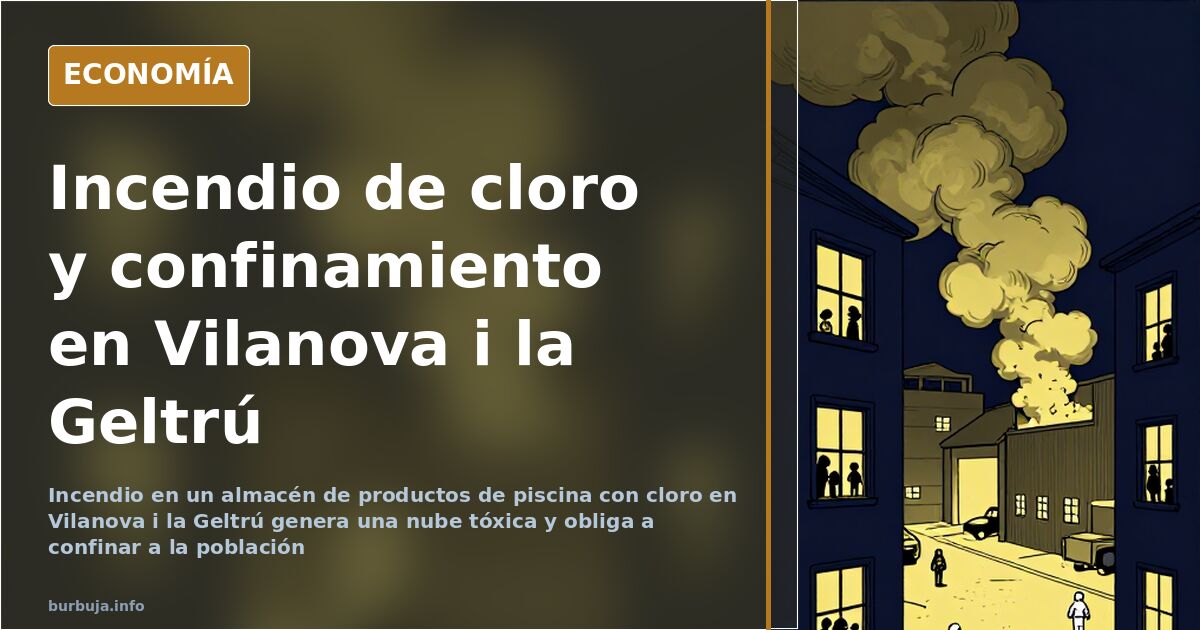
Chlorine fire triggers lockdown in Vilanova i la Geltrú
A fire extinguished with the wrong product trapped part of the county. Flames broke out early Saturday at an industrial storage facility for pool chemicals in Vilanova i la Geltrú, where a message circulated on social media indicated 70 tons of chlorine were stored. The water sprayed by firefighters reacted with the compound, generating a toxic cloud pushed by the wind that forced a population lockdown. Mobile alerts began sounding at 5:30 a.m.
What is known about the fire and lockdown
The fire originated in an industrial tank storing pool products. Vilanova i la Geltrú mayor, Juan Luis Ruiz López, explained that the water used by firefighters reacts chemically with chlorine, creating the toxic cloud. Shortly after, Generalitat president Salvador Illa confirmed no injuries and warned that "the lockdown will remain until there is no health risk."
Meanwhile, reports from the area mention road and train closures, with towns blocked to traffic. The cloud moved toward Tarragona; a resident about eight kilometers from the source stated their area received no warning or lockdown order. Hours later, the fire was declared extinguished, though it was not confirmed that the lockdown had been lifted.
Why spraying water on a chlorine fire worsens the problem
Chemistry precedes any emergency response. Chlorine is not combustible, but it reacts violently with water to form hydrochloric acid, a corrosive substance. Experts reviewing protocols insist that for this type of fire, appropriate extinguishing agents include multipurpose powders and keeping containers cool with sprayed water, not flooding the tank.
This is the most uncomfortable point. If water is part of the problem, why was it used? Official responses point to the sequence of events, not the manual. The mayor himself placed the water-chlorine reaction at the origin of the cloud, an acknowledgment that leaves emergency management in a delicate position.
Are FFP2 masks effective against a chlorine cloud?
No. Chlorine is a gas and passes through a particle mask just like air; FFP2 masks are not designed for gases. What is needed is a full-face mask with an activated carbon filter, in addition to a particle filter, and even then, exposed skin should be covered. Some recall that no improvised equipment replaces distance: moving away from the source is the first measure.
The technical details of filters, their tonalidad codes, and how many are needed are matters for post-event consultation. The practical conclusion is uncomfortable: standard household respiratory protection is of little use in a chemical leak.
Is it better to lockdown or evacuate the population?
Lockdown, according to official criteria, reduces exposure. Staying indoors with windows and doors closed lowers inhaled concentration compared to being outside, and a breath of concentrated chlorine can burn lungs immediately. Under this reasoning, staying inside is prudent while the cloud passes.
The concern is that houses are not airtight. If the smoke column surrounds the home, closing windows limits but does not eliminate gas entry, and some argue that evacuating in the opposite direction would have been more logical in certain scenarios. Doubts about whether the alert reached all municipalities add another front: part of the affected population may not have received either an alert or a lockdown instruction.
The Bhopal precedent and chlorine as a weapon
Contextualizing a chlorine fire is frightening, and rightly so. The chemical disaster of Bhopal in India during the 1980s is cited as a reference for how far a leak of this type can reach in a populated area. Chlorine was also used as a chemical warfare agent in World War I. It is not an anecdotal pool substance: it is a primary irritant and corrosive.
This memory helps understand the decisiveness of the lockdown, but it also fuels distrust in official communication. When public messages oscillate between "no personal injuries" and lockdown orders, citizens make their own calculations.
It is expected that the lockdown will be lifted as soon as meters show safe values, and the focus will shift to investigating the fire. It remains to be seen if this includes reviewing extinguishing protocols in chemical warehouses and the mass mobile alert system. It is likely, though not certain, that many questions will remain without a detailed public answer.
A fire extinguished with the wrong product trapped part of the county. Flames broke out early Saturday at an industrial storage facility for pool chemicals in Vilanova i la Geltrú, where a message circulated on social media indicated 70 tons of chlorine were stored. The water sprayed by firefighters reacted with the compound, generating a toxic cloud pushed by the wind that forced a population lockdown. Mobile alerts began sounding at 5:30 a.m.
What is known about the fire and lockdown
The fire originated in an industrial tank storing pool products. Vilanova i la Geltrú mayor, Juan Luis Ruiz López, explained that the water used by firefighters reacts chemically with chlorine, creating the toxic cloud. Shortly after, Generalitat president Salvador Illa confirmed no injuries and warned that "the lockdown will remain until there is no health risk."
Meanwhile, reports from the area mention road and train closures, with towns blocked to traffic. The cloud moved toward Tarragona; a resident about eight kilometers from the source stated their area received no warning or lockdown order. Hours later, the fire was declared extinguished, though it was not confirmed that the lockdown had been lifted.
Why spraying water on a chlorine fire worsens the problem
Chemistry precedes any emergency response. Chlorine is not combustible, but it reacts violently with water to form hydrochloric acid, a corrosive substance. Experts reviewing protocols insist that for this type of fire, appropriate extinguishing agents include multipurpose powders and keeping containers cool with sprayed water, not flooding the tank.
This is the most uncomfortable point. If water is part of the problem, why was it used? Official responses point to the sequence of events, not the manual. The mayor himself placed the water-chlorine reaction at the origin of the cloud, an acknowledgment that leaves emergency management in a delicate position.
Are FFP2 masks effective against a chlorine cloud?
No. Chlorine is a gas and passes through a particle mask just like air; FFP2 masks are not designed for gases. What is needed is a full-face mask with an activated carbon filter, in addition to a particle filter, and even then, exposed skin should be covered. Some recall that no improvised equipment replaces distance: moving away from the source is the first measure.
The technical details of filters, their tonalidad codes, and how many are needed are matters for post-event consultation. The practical conclusion is uncomfortable: standard household respiratory protection is of little use in a chemical leak.
Is it better to lockdown or evacuate the population?
Lockdown, according to official criteria, reduces exposure. Staying indoors with windows and doors closed lowers inhaled concentration compared to being outside, and a breath of concentrated chlorine can burn lungs immediately. Under this reasoning, staying inside is prudent while the cloud passes.
The concern is that houses are not airtight. If the smoke column surrounds the home, closing windows limits but does not eliminate gas entry, and some argue that evacuating in the opposite direction would have been more logical in certain scenarios. Doubts about whether the alert reached all municipalities add another front: part of the affected population may not have received either an alert or a lockdown instruction.
The Bhopal precedent and chlorine as a weapon
Contextualizing a chlorine fire is frightening, and rightly so. The chemical disaster of Bhopal in India during the 1980s is cited as a reference for how far a leak of this type can reach in a populated area. Chlorine was also used as a chemical warfare agent in World War I. It is not an anecdotal pool substance: it is a primary irritant and corrosive.
This memory helps understand the decisiveness of the lockdown, but it also fuels distrust in official communication. When public messages oscillate between "no personal injuries" and lockdown orders, citizens make their own calculations.
It is expected that the lockdown will be lifted as soon as meters show safe values, and the focus will shift to investigating the fire. It remains to be seen if this includes reviewing extinguishing protocols in chemical warehouses and the mass mobile alert system. It is likely, though not certain, that many questions will remain without a detailed public answer.
Also available in: Deutsch
Summary of a discussion on Burbuja.info - Foro de economía, actualidad y política., translated from Spanish and reviewed before publication. Read the full discussion (238 replies).
More summaries
-
Fake police officers KIDNAP a person on the AP-7 after passing through Vilanova i la Geltrú
A driver was kidnapped on the AP-7 by fake police. The incident happened after he passed through Vilanova i la Geltrú.
-
Mercadona shifts hiring to older workers as young applicants vanish
Mercadona replaces young staff with 40-60 year olds at checkouts and aisles. Gross salaries of €26,000 and a corporate culture no one can stand.
-
Forum claims Spanish women in their 40s seek wealthy partners
A forum thread argues that single women aged 30-40, facing financial precarity after years of spending, are returning to shared housing and seeking partners with assets.
-
Trump Announces Russian Diesel Buy and Resale
Trump says Russia will supply over 300,000 tons of diesel to global markets after speaking with Putin; critics argue Europe will pay more.
-
Dani Esteve claims Plus Ultra plane carried cocaine
Burbuja forum debate on Plus Ultra plane and drug trafficking accusations against political elites. Narco-state or firewall?
-
Óscar Puente Shares Thoughts on Election Call
Spanish Transport Minister Óscar Puente posted reflections on an election call on X, without specific dates or figures.