
China's 87,000 Farm Police Claim Lacks Source
A viral tweet claims China deploys 87,000 agricultural police to control fields. Without sources, the debate shifts to food sovereignty.
English · Original discussion in Spanish · Published
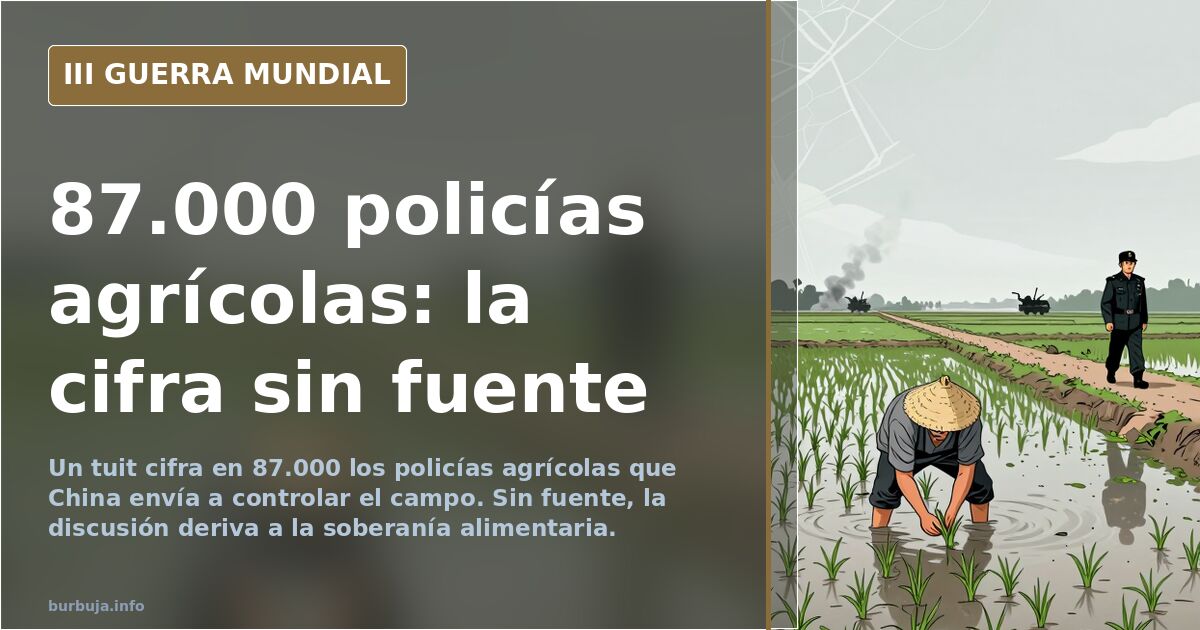
The Viral Tweet About 87,000 Chinese Agricultural Police and Its Real Trace
A message circulating on social media claims that China is deploying 87,000 agricultural police to monitor farmers, who are allegedly restricted to planting only government-approved crops. The figure spreads without a decree, link, or date, accompanied by a jab at those citing the Chinese model as a reference. The resulting discussion jumps from agriculture to EU quotas, lockdowns, and the state's role in individual lives. No one has produced the document backing the number.
Where Does the Figure of 87,000 Agricultural Police Come From?
The initial response was not to defend or attack the substance, but to demand the source. One of the first criticisms: a contextless video, an unsupported figure, and an assertion based solely on authority. Some directly demand the real news before continuing the debate.
Without an official statement confirming the deployment, any conclusion about control over Chinese farmland remains speculative. This nuance has not prevented some from accepting the measure as valid and others from dismissing the figure as false.
Seed Control: GMOs, Sovereignty, and Dependence
Here appears the strongest argument among supporters of the measure: surveillance aims to prevent the planting of GMO seeds from Western multinationals that are self-sterile, with the real goal being independence from foreign sources for food supply.
The opposing thesis points to a decades-long food deficit that the country has failed to close. It adds allegations that thousands of hectares of potential cropland have been destroyed by urban development. And the contrast with Spain: here, multinational seeds are planted at set prices, and planting other crops can lead to denunciations, with farmland increasingly held by outsiders and farmers having less margin to live off their harvest.
Spain and the EU Also Decide What Can Be Cultivated
Production quotas imposed by the European Union are cited, along with the claim that the state can expropriate land at its estimated price, with owners signing agreements. The highlighted difference is this: in China, if you don't want to sell, you don't sell, hence roads built around stubbornly refused properties because owners wouldn't sign.
From Chinese Fields to Lockdowns and Drones
When the figure lost traction, the conversation shifted to the pandemic. Descriptions include drones monitoring, fines for leaving home, workers confined in factories for weeks to maintain production, and abrupt lockdown exits that left elderly patients without care.
None of this is in the tweet. But it explains why some replies don't discuss the number: they discuss the model. The comparison works both ways. It is also recalled that here, police checked who was out and which supermarket they visited, and that a door was broken down due to a private party.
Less State, More Freedom?
The final section argues for an old idea: less state means more freedom. The most cited objection is that state absence allows others to fill the void, guaranteeing nothing to anyone.
Opposing this is the liberal thesis: it triumphs among middle classes with property, and sixty years ago, a worker-owner was less likely to vote left, as summarized by William Levitt. Data cross without touching. That more people emigrated to Argentina than to Switzerland. That China consumed boiled belts while the US was born rich. That China's population structure already resembles South Korea or Japan, with all implications for competitiveness. A circulating calculation attributes 700,000 jobs lost in Spain in footwear and toys to imported product competition.
The standoff remains there, with a tweet, 87,000 unconfirmed agents, and a question no one has closed: whether control of Chinese farmland is new or just recently named.
A message circulating on social media claims that China is deploying 87,000 agricultural police to monitor farmers, who are allegedly restricted to planting only government-approved crops. The figure spreads without a decree, link, or date, accompanied by a jab at those citing the Chinese model as a reference. The resulting discussion jumps from agriculture to EU quotas, lockdowns, and the state's role in individual lives. No one has produced the document backing the number.
Where Does the Figure of 87,000 Agricultural Police Come From?
The initial response was not to defend or attack the substance, but to demand the source. One of the first criticisms: a contextless video, an unsupported figure, and an assertion based solely on authority. Some directly demand the real news before continuing the debate.
Without an official statement confirming the deployment, any conclusion about control over Chinese farmland remains speculative. This nuance has not prevented some from accepting the measure as valid and others from dismissing the figure as false.
Seed Control: GMOs, Sovereignty, and Dependence
Here appears the strongest argument among supporters of the measure: surveillance aims to prevent the planting of GMO seeds from Western multinationals that are self-sterile, with the real goal being independence from foreign sources for food supply.
The opposing thesis points to a decades-long food deficit that the country has failed to close. It adds allegations that thousands of hectares of potential cropland have been destroyed by urban development. And the contrast with Spain: here, multinational seeds are planted at set prices, and planting other crops can lead to denunciations, with farmland increasingly held by outsiders and farmers having less margin to live off their harvest.
Spain and the EU Also Decide What Can Be Cultivated
Production quotas imposed by the European Union are cited, along with the claim that the state can expropriate land at its estimated price, with owners signing agreements. The highlighted difference is this: in China, if you don't want to sell, you don't sell, hence roads built around stubbornly refused properties because owners wouldn't sign.
From Chinese Fields to Lockdowns and Drones
When the figure lost traction, the conversation shifted to the pandemic. Descriptions include drones monitoring, fines for leaving home, workers confined in factories for weeks to maintain production, and abrupt lockdown exits that left elderly patients without care.
None of this is in the tweet. But it explains why some replies don't discuss the number: they discuss the model. The comparison works both ways. It is also recalled that here, police checked who was out and which supermarket they visited, and that a door was broken down due to a private party.
Less State, More Freedom?
The final section argues for an old idea: less state means more freedom. The most cited objection is that state absence allows others to fill the void, guaranteeing nothing to anyone.
Opposing this is the liberal thesis: it triumphs among middle classes with property, and sixty years ago, a worker-owner was less likely to vote left, as summarized by William Levitt. Data cross without touching. That more people emigrated to Argentina than to Switzerland. That China consumed boiled belts while the US was born rich. That China's population structure already resembles South Korea or Japan, with all implications for competitiveness. A circulating calculation attributes 700,000 jobs lost in Spain in footwear and toys to imported product competition.
The standoff remains there, with a tweet, 87,000 unconfirmed agents, and a question no one has closed: whether control of Chinese farmland is new or just recently named.
Summary of a discussion on Burbuja.info - Foro de economía, actualidad y política., translated from Spanish and reviewed before publication. Read the full discussion (171 replies).
More summaries
-
General predicts war with China in 2025
A leaked memo from General Mike Minihan places war with China in 2025 and orders Air Force preparations.
-
Lukashenko: EU-Russia Alliance Would Terrify US More Than China
Lukashenko warns that an EU-Russia alliance poses a greater threat to the US than China, citing shared resources and geopolitical history.
-
Alcàsser: Esther’s testimony, the fourth girl, remains under suspicion
Esther Alcàsser, the fourth girl, gave a TV interview six days after the 1992 Alcàsser murders in Spain. Her account and timeline discrepancies fuel ongoing controversy.
-
Ukraine's Unconfirmed 387,000 Casualty Count
A claim of 387,000 Ukrainian deaths relies on Kyiv's opacity regarding its own losses. Here are the figures circulating.
-
Ukrainian drone strike kills Russian soldiers near dead cow
Ukrainian drone drops grenade on Russian troops beside a carcass; footage analyzes weapon damage and casualty rates.
-
Gaza Infiltration: Mossad Faces Scrutiny
The Gaza breach exposes Mossad gaps, reigniting tensions with Iran and Hezbollah amid unproven theories on the attack's origin.