
China: Viral Rumors Spark Plague Panic Buying
Viral messages in China urge stockpiling food and medicine due to a suspected plague outbreak. Plague is bacterial and treatable with common antibiotics.
English · Original discussion in Spanish · Published
China: Viral Rumors Spark Plague Panic Buying
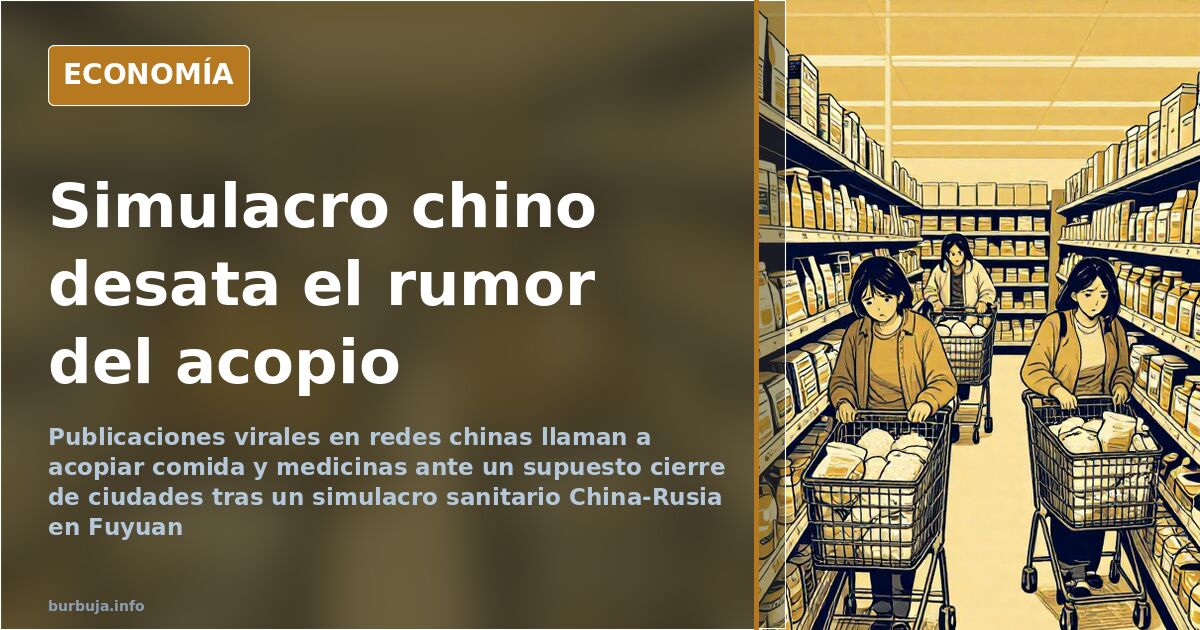
Chinese social media has recently been flooded with messages urging residents in the northeast—specifically the three provinces bordering Russia—to hoard food, water, and medication amid rumors of imminent city lockdowns caused by a plague outbreak. The alarm was not triggered by an official announcement, but by the coincidence of a health drill with memories of the last pandemic. Between August 24 and 27, Fuyuan hosted a joint emergency exercise for cross-border disease outbreaks, and this date alone was enough to reignite lockdown narratives. In Spain, the conversation mixes memories of masks, toilet paper, and 8 PM applause with a colder analysis: plague is a bacterium, not a bicho, and common antibiotics combat it.
What is known about the outbreak and why lockdowns are mentioned
The viral messages describe a panic-buying scenario involving protective goggles, alcohol, gloves, masks, doxycycline, ciprofloxacin, fever reducers, sugar, rice, condiments, eggs, and canned goods. The warning specifically targets residents of the three northeastern provinces closest to the Russian border. The dates of the Fuyuan drill, August 24-27, are cited in these messages as proof that something is being prepared. There is no official confirmation of an active outbreak or city closures, but the sequence closely mirrors late 2019: first rumors, then shopping, trinc by restrictions.
Plague is not an eradicated disease. According to World Health Organization data, approximately 3,000 cases are recorded globally each year, mostly concentrated in rural areas of Africa, Asia, and the Americas. Pneumonic plague is the only form easily transmitted from person to person; other forms require animal vectors. This detail fundamentally changes the risk assessment.
Plague is a bacterium: why that matters
Unlike bicho, bacteria are more complex but also easier to treat with antibiotics. Doxycycline and ciprofloxacin—the same drugs appearing in stockpiling messages—are effective treatments if the disease is detected early. Bubonic, pneumonic, and septicemic plague killed roughly half of Europe's population between 1348 and 1352, with similar percentages in Asia. Some joke that medieval medicine was only slightly worse than today's public healthcare system, but modern antibiotics save most patients if diagnosed promptly.
The issue is not the bacterium itself, but the healthcare system's response capacity. If patients must wait for a phone consultation, get an appointment months later, and hope for a correct diagnosis, the window for action narrows significantly. According to calculations circulating online, untreated pneumonic plague mortality approaches 100%, and its R0 (the number of infections generated per patient) ranges between 2.8 and 3.5. With these figures, any delay in detection turns a localized outbreak into a serious problem.
Pandemic memories: toilet paper, applause, and ELbichito passports
The discussion quickly turned nostalgic. Some recalled toilet paper as currency, hand sanitizer as scarce goods, and masks as objects of dispute. Others mentioned ELbichito passports, fines for non-vaccination, and the large parties of the previous stage. Comparisons with the 2020 lockdown are inevitable: according to one participant, the mess began between October and November, gained momentum in January, and by February everyone was confined. If the script repeats, the timeline points to the same months.
Not everyone agrees. Some argue that plague should be manageable with common antibiotics unless weaponized. Others believe the real risk is economic rather than health-related: pandemic-era stockpiles remain unsold, and any excuse serves to reactivate consumption. The theory of the zero patient eating bat and pangolin soup resurfaces as an example of a narrative that, once accepted, may circulate again.
What could happen next
Based on available data, the most likely scenario is that the outbreak remains a localized scare. While plague is endemic in some regions, it lacks the global propagation capability of respiratory bicho. The key lies in early detection and antibiotic availability. If the healthcare system responds effectively, mortality drops sharply. If it fails, the problem shifts from the bacterium to management.
The conversation leaves an uncomfortable residue. Trust in health institutions has been shaken post-pandemic, leading people to view drills, emergency purchases, or social media messages with suspicion that there is more behind them. The 2020 toilet paper hoarding left investments that some have yet to recover. Now, individuals must decide whether to repeat the purchase or wait and see. With these dynamics, the shopping basket becomes a political thermometer again.
Chinese social media has recently been flooded with messages urging residents in the northeast—specifically the three provinces bordering Russia—to hoard food, water, and medication amid rumors of imminent city lockdowns caused by a plague outbreak. The alarm was not triggered by an official announcement, but by the coincidence of a health drill with memories of the last pandemic. Between August 24 and 27, Fuyuan hosted a joint emergency exercise for cross-border disease outbreaks, and this date alone was enough to reignite lockdown narratives. In Spain, the conversation mixes memories of masks, toilet paper, and 8 PM applause with a colder analysis: plague is a bacterium, not a bicho, and common antibiotics combat it.
What is known about the outbreak and why lockdowns are mentioned
The viral messages describe a panic-buying scenario involving protective goggles, alcohol, gloves, masks, doxycycline, ciprofloxacin, fever reducers, sugar, rice, condiments, eggs, and canned goods. The warning specifically targets residents of the three northeastern provinces closest to the Russian border. The dates of the Fuyuan drill, August 24-27, are cited in these messages as proof that something is being prepared. There is no official confirmation of an active outbreak or city closures, but the sequence closely mirrors late 2019: first rumors, then shopping, trinc by restrictions.
Plague is not an eradicated disease. According to World Health Organization data, approximately 3,000 cases are recorded globally each year, mostly concentrated in rural areas of Africa, Asia, and the Americas. Pneumonic plague is the only form easily transmitted from person to person; other forms require animal vectors. This detail fundamentally changes the risk assessment.
Plague is a bacterium: why that matters
Unlike bicho, bacteria are more complex but also easier to treat with antibiotics. Doxycycline and ciprofloxacin—the same drugs appearing in stockpiling messages—are effective treatments if the disease is detected early. Bubonic, pneumonic, and septicemic plague killed roughly half of Europe's population between 1348 and 1352, with similar percentages in Asia. Some joke that medieval medicine was only slightly worse than today's public healthcare system, but modern antibiotics save most patients if diagnosed promptly.
The issue is not the bacterium itself, but the healthcare system's response capacity. If patients must wait for a phone consultation, get an appointment months later, and hope for a correct diagnosis, the window for action narrows significantly. According to calculations circulating online, untreated pneumonic plague mortality approaches 100%, and its R0 (the number of infections generated per patient) ranges between 2.8 and 3.5. With these figures, any delay in detection turns a localized outbreak into a serious problem.
Pandemic memories: toilet paper, applause, and ELbichito passports
The discussion quickly turned nostalgic. Some recalled toilet paper as currency, hand sanitizer as scarce goods, and masks as objects of dispute. Others mentioned ELbichito passports, fines for non-vaccination, and the large parties of the previous stage. Comparisons with the 2020 lockdown are inevitable: according to one participant, the mess began between October and November, gained momentum in January, and by February everyone was confined. If the script repeats, the timeline points to the same months.
Not everyone agrees. Some argue that plague should be manageable with common antibiotics unless weaponized. Others believe the real risk is economic rather than health-related: pandemic-era stockpiles remain unsold, and any excuse serves to reactivate consumption. The theory of the zero patient eating bat and pangolin soup resurfaces as an example of a narrative that, once accepted, may circulate again.
What could happen next
Based on available data, the most likely scenario is that the outbreak remains a localized scare. While plague is endemic in some regions, it lacks the global propagation capability of respiratory bicho. The key lies in early detection and antibiotic availability. If the healthcare system responds effectively, mortality drops sharply. If it fails, the problem shifts from the bacterium to management.
The conversation leaves an uncomfortable residue. Trust in health institutions has been shaken post-pandemic, leading people to view drills, emergency purchases, or social media messages with suspicion that there is more behind them. The 2020 toilet paper hoarding left investments that some have yet to recover. Now, individuals must decide whether to repeat the purchase or wait and see. With these dynamics, the shopping basket becomes a political thermometer again.
Summary of a discussion on Burbuja.info - Foro de economía, actualidad y política., translated from Spanish and reviewed before publication. Read the full discussion (170 replies).
More summaries
-
Woman Dies in Russia After Lab Plague Incident, 200 Quarantined
Russia reports one death from pneumonic plague in a Siberian lab. 200 people are quarantined and military NBQ suits patrol the streets.
-
Pneonic Plague Outbreak in Irkutsk: 190 Contacts Quarantined
A 28-year-old lab technician died of pneumonic plague in Irkutsk, Russia, after a suspected broken test tube. Nearly 200 contacts remain under quarantine.
-
Maricarmen Eviction: Old Rent, Vulture Fund, and Pre-election Circus
An 87-year-old woman, an old rent contract, and an upcoming election: why Maricarmen's eviction is at the center of public debate.
-
Spain's Military Faces Critical Gaps: 1970s Howitzers and Limited Missiles
Spain lacks rocket artillery since 2011, relies on 90 M109 howitzers from the 1970s, and holds only 39 Taurus missiles, revealing severe defense shortages.
-
520,000 Spaniards over 52 on subsidies, unlikely to return to work
Over half a million people in Spain receive the subsidy for those aged 52+, which counts toward retirement. Debate centers on labor market exclusion and fiscal sustainability.
-
Fracking Declines, Renewables Fail Transport
Debate on fracking exhaustion and renewable limits for transport. Global oil consumption remains unchanged after 15 years of electrification.