
China stays out of Russia and Iran conflicts: what Beijing wants
China sells drones, buys discounted Russian gas and avoids war: its non-interference policy pays better than joining Russia and Iran in the conflict
English · Original discussion in Spanish · Published
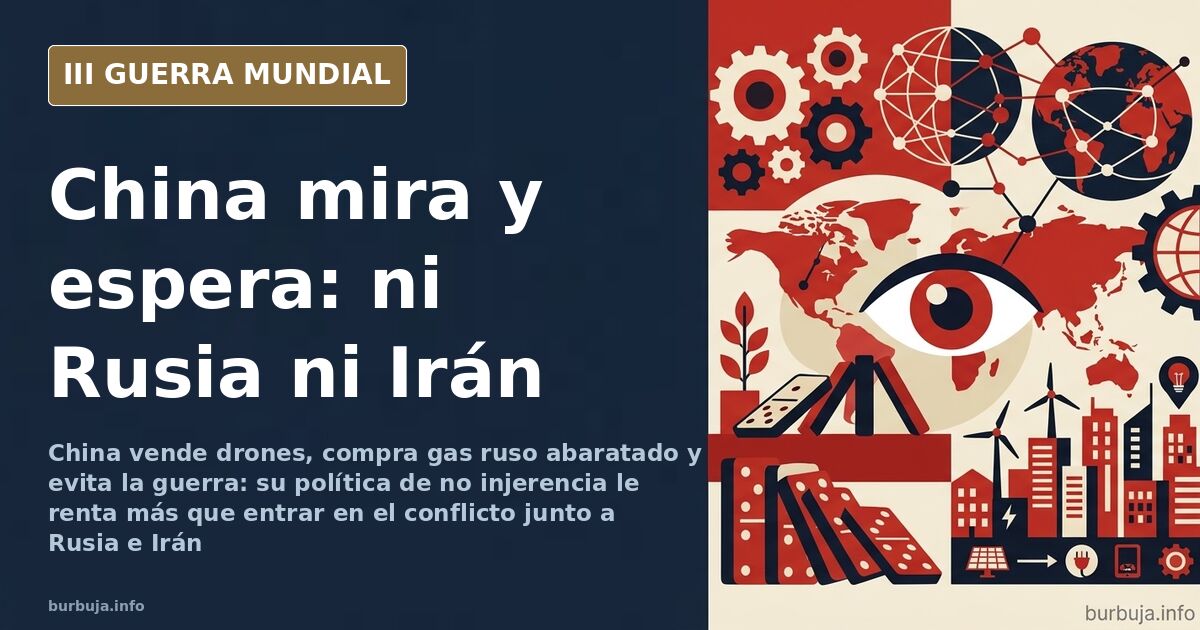
China holds its fire: Beijing's calculus on Russia and Iran
When Moscow and Tehran are under pressure, Beijing looks the other way. The question echoing across the internet — what on earth is China doing that it helps neither Russia nor Iran — has an uncomfortable answer for anyone expecting a solid anti-Western bloc: China has no allies, only interests. It sells drones, buys discounted Russian gas and lets others bleed. Meanwhile, the silk road that ran through Syria was blown apart in a weekend without Beijing moving an aircraft carrier.
The issue is not new. The policy of non-interference works almost like a state religion. The question is whether that is age-old strategy or simple passivity.
What China gains without moving a single soldier
The most repeated calculation is economic. If Russian gas stops being sold in Europe, two things happen at once: European supply becomes more expensive — Europe loses productivity — and Russian gas becomes cheaper for Chinese buyers, who gain competitiveness. A double benefit without firing a single missile.
Add to that silent imperialism: factories in Africa and Latin America, purchases of strategic resources, networks of political clients and Chinese restaurants as a vanguard. Soft peine instead of boots on the ground. Some argue that Beijing prefers to see Russia and Iran in trouble so it can buy their resources at bargain prices.
Why does China not believe it can win a world war?
Because, unlike the Russians, the Chinese know they are behind. They improve their military technology, build aircraft carriers nonstop, increase the budget and set up bases beyond their borders, but for now they copy what they can and do not believe they are in a position to win a global conflict.
Tradition weighs heavily. China was the centre of the world and needed nothing from outside; beyond that, according to that worldview, lay wild beasts. The naval expeditions of the 15th century stopped and never set out again. Becoming an expansionist power requires changing a great deal of history, culture and ideology.
The demographic elephant that is fading
The harshest objection does not come from geopolitics but from demography. China's birth rate is below Japan's, and its figures are worse than the West's. By 2060, the most pessimistic thesis holds, its entire economic might will begin to fall apart after a stagnation that has already begun. Anyone who trusts them is mistaken: they are not the solution.
Against that, the reply: the Chinese think on another timescale, that of a millennia-old culture. They believe time is on their side and that they will end up being the leading economic, industrial and technological power at the same time. All it takes is waiting.
Syria as a test of fire
The Syrian case shattered many expectations. The silk road ran through there and it was blown apart in a weekend. China limited itself to statements like "we recognise the right to Syria's territorial integrity" while everyone else watched the news on TV. If Beijing thought no one was coming for it, it is a very good trader but not so clever.
The axis of resistance against the West has revealed itself to be what it probably was: a group of countries that trade with each other, with no vocation to confront NATO. Between a Russian, an Indian and a Chinese there are too many cultural differences for a solid alliance.
The knife that will reach Siberia
The most repeated prediction about the near future: China will stab Russia in the back sooner or later, and it will do so in the form of occupying eastern Siberia. There are no friends or enemies, only interests. Meanwhile, one eye looks at Taiwan and the other at Siberia.
The outcome of all this remains open. The only clear thing is that Beijing is in no hurry. And that, in a world that bleeds by the week, is the most profitable position of all.
Also available in: Deutsch
Summary of a discussion on Burbuja.info - Foro de economía, actualidad y política., translated from Spanish and reviewed before publication. Read the full discussion (103 replies).
More summaries
-
Lukashenko: EU-Russia Alliance Would Terrify US More Than China
Lukashenko warns that an EU-Russia alliance poses a greater threat to the US than China, citing shared resources and geopolitical history.
-
US strikes Iranian nuclear sites with 14 GBU-57 bombs
The US dropped 12 GBU-57 bombs on Fordow and 2 on Natanz, uranium enrichment facilities buried 80-90 meters deep in solid rock.
-
Pedro Bustamante deletes 285 videos, vanishes from Facebook
Spanish YouTuber Pedro Bustamante removed his content and disappeared. Rumors place him in Munich, reading German press.
-
Trump blames Obama's State Department over the Maidan
Trump claims Obama's State Department backed the Maidan and that Nuland has returned under Biden on the road to war. The accusation has drawn no media attention.
-
Pedro Baños, the colonel who said Russia would not invade Ukraine
Pedro Baños said in January that Russia had no means to invade Ukraine. A month later, tanks were crossing the border. His credibility is now in question.
-
Coup d'état underway in Serbia
We analyze the alleged coup in Serbia on Burbuja.info: color revolution or genuine popular fed-up? Data and skepticism against the official narrative.