
Trump blames Obama's State Department over the Maidan
Trump claims Obama's State Department backed the Maidan and that Nuland has returned under Biden on the road to war. The accusation has drawn no media attention.
English · Original discussion in Spanish · Published
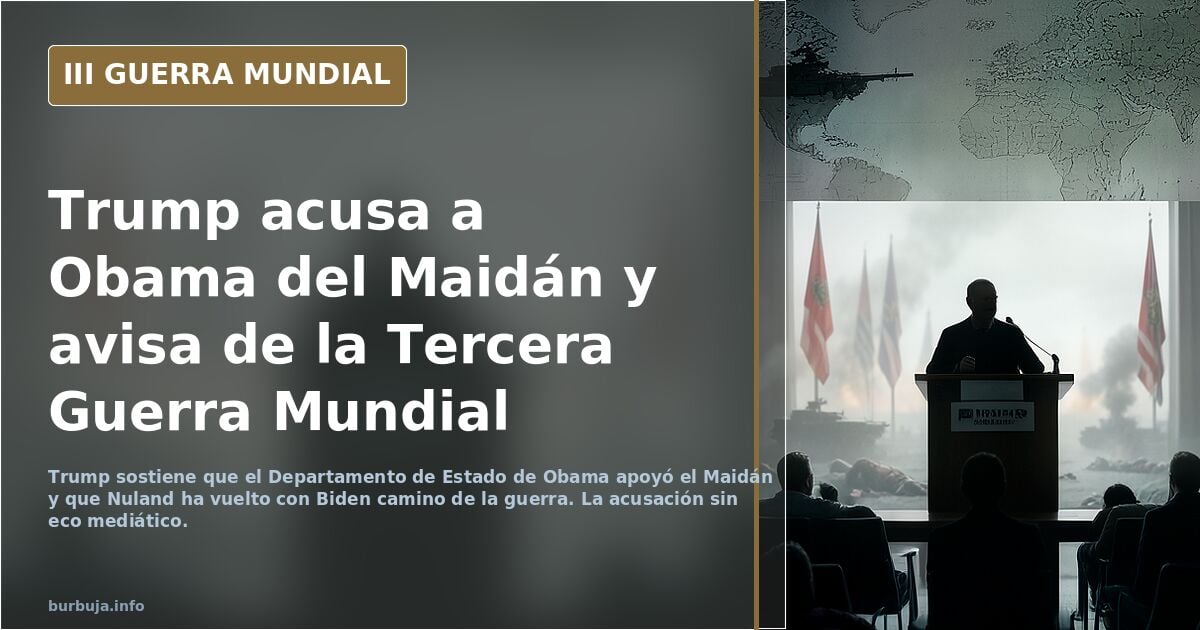
Trump blames Obama's State Department over the Maidan
Donald Trump claims that the State Department of the Obama era was behind Ukraine's Maidan and that figures like Victoria Nuland have returned to government under Biden to push the world toward open war. The claim, spread on social media and picked up in the framing of the issue, has had almost no media coverage in Spain: six days later it was still absent from most news reports, a silence that in itself fuels distrust of the official narrative.
The core of the story is not new. What is new is that a former US president is saying it out loud.
What exactly is being attributed to Trump
The accusation has two parts. The first: that US diplomacy under Obama backed the Maidan protests in 2014, the uprising that brought down Kyiv's pro-Russian government. The second: that names like Victoria Nuland, then and now in positions of power, have returned with the Biden Administration and are part of the machinery dragging the West toward a direct conflict with Russia.
It is worth being precise about the verb. This is not about a coup in the strict sense, but about support for protests. That difference, which blurs in a headline, is what separates interference from a covert operation. And that is where the debate splits.
The consistency argument: why he didn't say it before
The most common objection comes not from the other side, but from those who might sympathize with the message. If Trump knew, why didn't he dismantle that policy during his four years in office? Why didn't he denounce Nuland or Obama back then for meddling in the internal affairs of other countries?
The answer offered from his orbit is that foreign policy is not defined by the occupant of the White House, but by the military-industrial complex, an entity that outlasts changes of government. A campaign talking point, in other words, with the force of a rally and the fine print of a subscription contract.
The Maidan, gas and the president's son
In the background of the story a recurring name appears: Hunter Biden. People ask, with a knowing smirk, what the son of the then vice president was doing as a paid board member of Ukraine's largest gas company. The question is not proof, but it explains why part of the American electorate buys the revolving-door narrative between politics and business in Kyiv.
Add to that the pipeline episode: the exclusive about the pipeline sabotage attributed to the journalist who exposed the US army massacres in Vietnam —a Pulitzer winner— is read as another piece of the same puzzle. Two opposing camps within the United States, in an outright civil war.
The axis nobody wants to name: Europe as collateral damage
The geopolitical reading that dominates much of the conversation is that Washington does not care what happens to Ukrainian sovereignty. It is recalled that the United States signed guarantees in exchange for Ukraine giving up its nuclear arsenal, and that those guarantees have turned out to be worthless paper. The consequence, the argument goes, is a Ukraine outside the EU and NATO, condemned to a limbo that benefits Moscow.
And underneath it all, the suspicion that the real target is not Ukraine but Europe: wearing it down, making its energy expensive and leaving it no room to maneuver. The European who applauds every escalation, the thesis goes, is applauding their own decline.
Election fraud as a scenario and the implosion of globalism
Some take it as a given that, if Trump runs again, the establishment will repeat the playbook. Distrust of the US electoral process is no longer the property of a single side. And in parallel there is the hope that a Trump victory would make the globalist network implode which, according to this current, operates out of economic forums and UN agencies with local governance projects.
It is the political version of "just ask Iowa": the feeling that Spain's future is decided in a caucus where nobody could even place the map.
The sticking point is the same as always: without evidence, the accusation is a tweet; with evidence, it would be an earthquake. And nobody quite clarifies which of the two suits the accuser better.
Also available in: Deutsch
Summary of a discussion on Burbuja.info - Foro de economía, actualidad y política., translated from Spanish and reviewed before publication. Read the full discussion (77 replies).
More summaries
-
Victoria Nuland Leaves US State Department: Retirement or Resignation?
Victoria Nuland exits the US State Department. AP calls it retirement; analysts debate if it signals a shift in Ukraine policy.
-
Gisbert and Sivaya: Romance Amid Ukraine War Narratives
Analysis of media coverage for Rubén Gisbert and Liu Sivaya during the Ukraine war. Is this digital propaganda or reality?
-
Keep an eye on Moscow this May 9
Expectations of an attack on May 9 in Moscow: the Russian threat, a parade with no armored vehicles, and polarization between those expecting a major event and those who saw it as routine.
-
Strike on Iranian girls' school leaves more than 100 dead
More than 100 girls killed in a missile strike on a school in southern Iran. France 24, EFE and the NYT confirm the massacre. Military mistake or deliberate attack?
-
Russia claims Leopard tank capture in Bakhmut without evidence
A United Russia deputy claims a Leopard was captured with a Polish crew in Bakhmut, with no photo or verification. The mercenaries detail changes the…
-
Russia launches war's largest combined strike, targeting Kyiv's logistics
Russia has launched its largest combined missile and drone attack on Kyiv. Real logistical isolation or war propaganda? A look at the data and the arguments.