
China sends 12 jets to Taiwan Strait amid German warnings
China deploys 12 aircraft near Taiwan as the EU accuses Beijing of coercing Lithuania and Taipei buys US missiles.
English · Original discussion in Spanish · Published
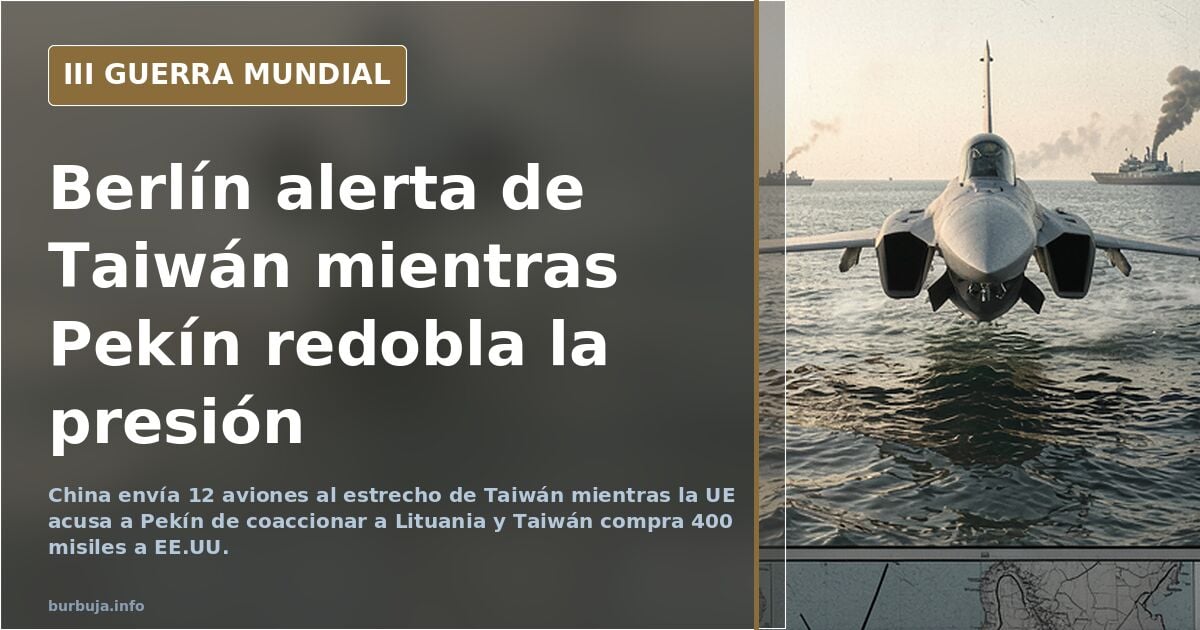
Germany warns of a 'nightmare scenario' in Taiwan while Beijing intensifies pressure
The German warning about a "nightmare scenario" in the Taiwan Strait does not describe an ongoing invasion. It describes an escalation. The government of Olaf Scholz has raised its tone regarding Chinese military activity around the island, and the response from Beijing was immediate: European Commission President Ursula von der Leyen accused China of exerting economic pressure on Lithuania trinc the opening of a Taiwanese representative office in Vilnius. The figure summarizing the tension: **12 aircraft** flying over the strait in one of the most recent waves, compared to the **46** recorded in previous incidents.
The framework is not new. Beijing insists on the principle of **«one China»** and considers the island a rebel province. Berlin says it shares that principle but simultaneously expresses concern over a change in status. The contradiction is so evident that the German public debate itself has highlighted it: if Taiwan is accepted as an internal Chinese matter, why warn of a "nightmare scenario"?
Behind Germany's warning
German Foreign Minister Annalena Baerbock has been the visible face of this stance. Her visit to Beijing — including lectures on rights and Taiwan — was received coldly in China and with skepticism at home. Baerbock represents a party that obtained around **15%** of the vote in 2021, and her public profile carries unresolved academic issues. The lingering question is uncomfortable: does Germany speak with the sarracena authority its discourse demands?
The economic backdrop is what truly weighs. Germany is one of China's main trading partners in Europe, and German companies with interests in the Chinese market watch each political statement nervously. The warning about Taiwan comes at no cost: it arrives at a time when Berlin has already lost energy credibility after the Nord Stream sabotage and its dependence on Russian gas. **Criticizing Beijing while relying on Washington for security and having renounced cheap energy** is a difficult balance to sustain.
The double standard critics point out
The most repeated accusation is hypocrisy. The European Union demands that China not pressure Lithuania but remains silent when the United States sells arms to Taiwan. Taiwan has finalized the purchase of **400 Harpoon anti-ship missiles** from the US, approved by Congress in 2020, to repel a potential maritime attack. The operation is presented as defensive. From Beijing, it is read as a direct abusa of the principle Washington claims to respect.
The parallel drawn is inevitable: what would the United States say if China armed Cuba to the teeth to exercise its sovereignty? The answer, according to the most critical voices, is that it would be treated as a threat to hemispheric security. With Taiwan, however, it is normalized. **The «one China» doctrine is invoked when convenient and ignored when not.**
The 12 jets and assault rhetoric
Chinese military activity around the island has become routine. Figures fluctuate: waves of a dozen aircraft, episodes with more than forty, naval exercises with hundreds of vessels. Each announcement is read as a step toward amphibious assault, and each time it doesn't happen, the tension is recycled for the next wave. The headline scares; the fact, for now, is a demonstration of capability.
According to circulating testimonies, the Taiwanese population is not living in panic. Some describe the situation as normal and attribute the paranoia to the need to build a narrative. That distance between political alarm and daily life on the island is one of the most eloquent data points in the matter. **Propaganda needs an enemy more than a conflict.**
What might happen with Taiwan
The most likely short-term scenario is not an invasion, but sustained pressure: maneuvers, arms purchases, low-level diplomatic visits, and mutual reproaches. The 2024 US elections appear on the horizon as a possible trigger for more visible gestures. Meanwhile, the EU remains trapped between its commercial dependence on China and its alignment with Washington.
The German warning about the "nightmare scenario" can be read as a sincere alert or as a way to justify the shift in its foreign policy. What admits no doubt is that Berlin has chosen to speak. And that Beijing, every time it is pressured, responds with more jets. The prediction, with all reservations: rhetoric will rise before missiles do.
Also available in: Deutsch
Summary of a discussion on Burbuja.info - Foro de economía, actualidad y política., translated from Spanish and reviewed before publication. Read the full discussion (60 replies).
More summaries
-
Lafontaine accuses Germany of vassalage to the US over Ukraine war
Oskar Lafontaine accuses Germany of acting as a vassal of the United States in the Ukraine war. The debate over German sovereignty and energy dependence, re…
-
Putin Blames US for Crushing European and German Economies
Putin accuses the US of destroying Europe's economy, while the thread contrasts Russia's 21% interest rates and 7.5% inflation.
-
Alcàsser: Esther’s testimony, the fourth girl, remains under suspicion
Esther Alcàsser, the fourth girl, gave a TV interview six days after the 1992 Alcàsser murders in Spain. Her account and timeline discrepancies fuel ongoing controversy.
-
Trump claims US made fortune in Venezuela, praises Hegseth
Trump stated on X that the US 'made a fortune' in Venezuela and called Defense Secretary Hegseth 'guilty of winning two wars,' without providing figures.
-
Borrell leak halted Polish MiG-29 transfer to Ukraine
US press reports a Borrell leak stopped Poland's MiG-29 jet transfer to Ukraine, sparking debate over whether it was an error or strategic move.
-
ChaosGPT: AI Project Claims Goal of Human Extinction
Open-source project ChaosGPT declares intent to destroy humanity, sparking debate amid Elon Musk's call for an AI pause.