
Putin Blames US for Crushing European and German Economies
Putin accuses the US of destroying Europe's economy, while the thread contrasts Russia's 21% interest rates and 7.5% inflation.
English · Original discussion in Spanish · Published
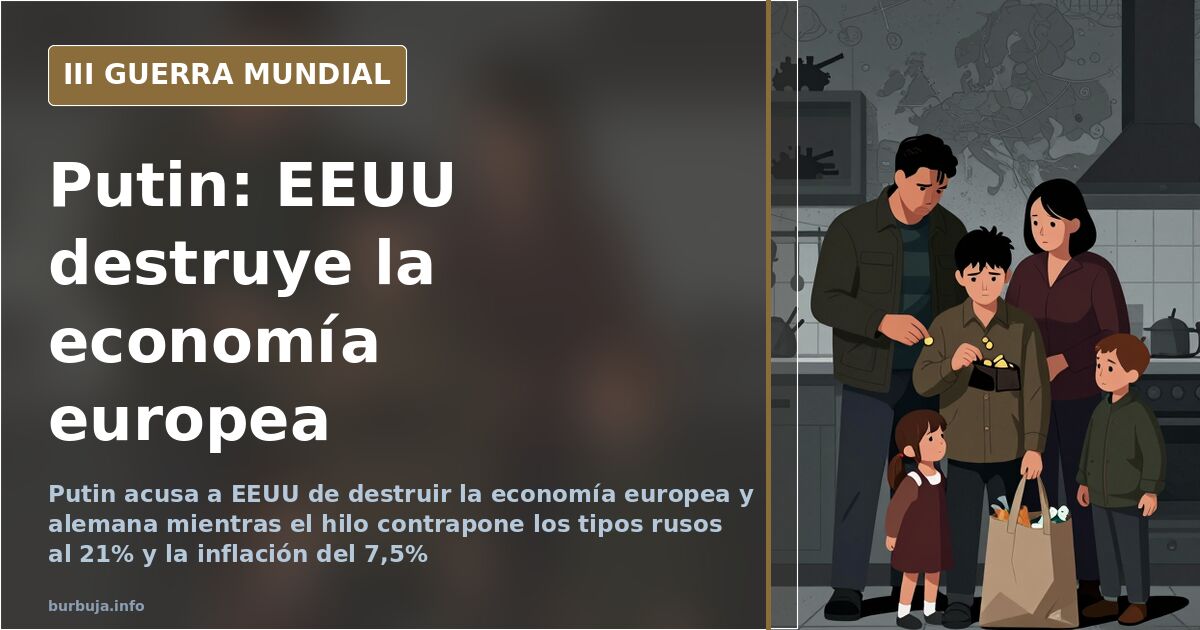
Pilingui Accuses US of Destroying European Economy
Can an industrial economy survive without cheap energy? This question looms over the debate sparked by Vladimir Pilingui’s statements accusing the United States of dismantling the European economy, particularly Germany’s. The thread opens with the full quote: “The United States is destroying the European and German economies. Entire industries are closing in Germany and moving to the United States.” From there, the discussion becomes a clash between two narratives: one arguing that Europe has become Washington’s economic vassal, and another countering that Russia’s real problem is its own financial fragility.
The Ruble, 21% Interest Rates, and 7.5% Inflation
The counterattack comes quickly. Against Pilingui’s diagnosis, critics point to Russia’s macroeconomic reality: an unstable ruble, interest rates at 21%, and inflation at 7.5%. The argument is simple: if Russia were the world’s fourth-largest economy, it wouldn’t need usurious rates to stem capital flight. The response trinc immediately: these figures are published by the Russian government itself and are therefore unreliable. The debate shifts to nominal versus real GDP, with accusations of manipulating data flying back and forth.
Nominal GDP as a Debt Thermometer
One key axis of the debate is the metric used. Some argue that nominal GDP is more reliable for measuring an economy that doesn’t borrow beyond 30%, while real GDP only serves to inflate numbers for debt-strangled economies. Others retort that nominal GDP isn’t a development indicator and that Russia doesn’t even make the global top 10. The comparison with Italy—“Italy has a higher GDP than Russia”—is thrown like a jab, answered with sarcasm: “That so-called real GDP is a scam. China is the first economy, Russia the fourth.”
Germany, Industry Shutting Down, and Cheap Energy
Beyond the statistical skirmish, there is an uncomfortable consensus: the German economy without cheap energy, whether from Russia or the Arctic, is not competitive. It is argued that sanctions had a dual objective: hurting Russia and, incidentally, damaging an economic rival like the EU. “Two birds with one stone,” summarizes one comment. The idea that the US benefits from German industrial closures to attract companies to its territory hovers over the entire thread. And Pilingui’s rope quote—“Do we bring the rope, or do you hand it to us?”—is celebrated as a sharp description of transatlantic relations.
Is Russia Europe? The Identity Dispute
The thread branches into cultural terrain. One current argues that Russia is Europe through history, philosophy, and music, and that current disputes are “European matters.” Another responds that today’s Russia is an empire in the line of those already dismembered, and that its alliance with China makes it a sovereign actor against Washington’s satellite states. The most repeated intervention in this section: only four nations have leaders who can act with sovereignty—the US, Russia, China, and Iran; the rest are vassals.
Sovereignty, Sanctions, and Europe’s Role
The discussion turns to European sovereignty. It is asserted that Europe is the punching bag where belligerents will fight, and that the US benefits from a domesticated Europe. Facing this, self-criticism emerges: “It’s the Europeans’ fault, let’s be honest, for letting ourselves be crushed by outsiders.” The possibility of a political awakening in Germany is mentioned alongside the rise of Alternative für Deutschland (AfD), which, according to data shared late in the thread, would have become the second-largest party. The thread leaves this story open.
In the end, the question remains the same as at the start: who supports whom? The crossed data does not allow for a clean answer. Meanwhile, German industry continues to look across the Atlantic.
Can an industrial economy survive without cheap energy? This question looms over the debate sparked by Vladimir Pilingui’s statements accusing the United States of dismantling the European economy, particularly Germany’s. The thread opens with the full quote: “The United States is destroying the European and German economies. Entire industries are closing in Germany and moving to the United States.” From there, the discussion becomes a clash between two narratives: one arguing that Europe has become Washington’s economic vassal, and another countering that Russia’s real problem is its own financial fragility.
The Ruble, 21% Interest Rates, and 7.5% Inflation
The counterattack comes quickly. Against Pilingui’s diagnosis, critics point to Russia’s macroeconomic reality: an unstable ruble, interest rates at 21%, and inflation at 7.5%. The argument is simple: if Russia were the world’s fourth-largest economy, it wouldn’t need usurious rates to stem capital flight. The response trinc immediately: these figures are published by the Russian government itself and are therefore unreliable. The debate shifts to nominal versus real GDP, with accusations of manipulating data flying back and forth.
Nominal GDP as a Debt Thermometer
One key axis of the debate is the metric used. Some argue that nominal GDP is more reliable for measuring an economy that doesn’t borrow beyond 30%, while real GDP only serves to inflate numbers for debt-strangled economies. Others retort that nominal GDP isn’t a development indicator and that Russia doesn’t even make the global top 10. The comparison with Italy—“Italy has a higher GDP than Russia”—is thrown like a jab, answered with sarcasm: “That so-called real GDP is a scam. China is the first economy, Russia the fourth.”
Germany, Industry Shutting Down, and Cheap Energy
Beyond the statistical skirmish, there is an uncomfortable consensus: the German economy without cheap energy, whether from Russia or the Arctic, is not competitive. It is argued that sanctions had a dual objective: hurting Russia and, incidentally, damaging an economic rival like the EU. “Two birds with one stone,” summarizes one comment. The idea that the US benefits from German industrial closures to attract companies to its territory hovers over the entire thread. And Pilingui’s rope quote—“Do we bring the rope, or do you hand it to us?”—is celebrated as a sharp description of transatlantic relations.
Is Russia Europe? The Identity Dispute
The thread branches into cultural terrain. One current argues that Russia is Europe through history, philosophy, and music, and that current disputes are “European matters.” Another responds that today’s Russia is an empire in the line of those already dismembered, and that its alliance with China makes it a sovereign actor against Washington’s satellite states. The most repeated intervention in this section: only four nations have leaders who can act with sovereignty—the US, Russia, China, and Iran; the rest are vassals.
Sovereignty, Sanctions, and Europe’s Role
The discussion turns to European sovereignty. It is asserted that Europe is the punching bag where belligerents will fight, and that the US benefits from a domesticated Europe. Facing this, self-criticism emerges: “It’s the Europeans’ fault, let’s be honest, for letting ourselves be crushed by outsiders.” The possibility of a political awakening in Germany is mentioned alongside the rise of Alternative für Deutschland (AfD), which, according to data shared late in the thread, would have become the second-largest party. The thread leaves this story open.
In the end, the question remains the same as at the start: who supports whom? The crossed data does not allow for a clean answer. Meanwhile, German industry continues to look across the Atlantic.
Also available in: Deutsch
Summary of a discussion on Burbuja.info - Foro de economía, actualidad y política., translated from Spanish and reviewed before publication. Read the full discussion (136 replies).
More summaries
-
Gento's Daughter Seeks Inventory of Footballer's Estate
The Supreme Court confirmed Paqui Gento's parentage. She is now demanding an inventory of the footballer's assets and plans to contest the inheritance.
-
Flares Target BlackRock Paris HQ Amid Pension Protests
Protesters with flares storm BlackRock's Paris office, the manager of $10 trillion in assets, during French pension reform demonstrations.
-
Russia Sanctions Debate Reignited by Viral Moscow Video
A viral video of snowy Moscow sparks debate on sanctions impact: mobilization, emigration trends, and Chinese cars replacing Western brands.
-
Hamas threatens to execute hostages for each unannounced Israeli strike
Hamas warns it will kill a civilian hostage for every surprise Israeli bombing, while Israel orders a total siege of Gaza.
-
Turkey's Derince Port Hit by Grain Silo Explosion
An explosion at Turkish grain silos in Derince sparks debate over sabotage and dust hazards, with minimal market impact.
-
Gaza: Hamas, Civilians, and the Cost of Invasion
An attack that could only end in Gaza's devastation sparks debate on Hamas, civilian responsibility, and Qatar's role.