
China fills Renault’s void in Russia with new car production
As China starts manufacturing cars in Russia, Renault books €3 billion in losses, freeing up 23% of its market share.
English · Original discussion in Spanish · Published
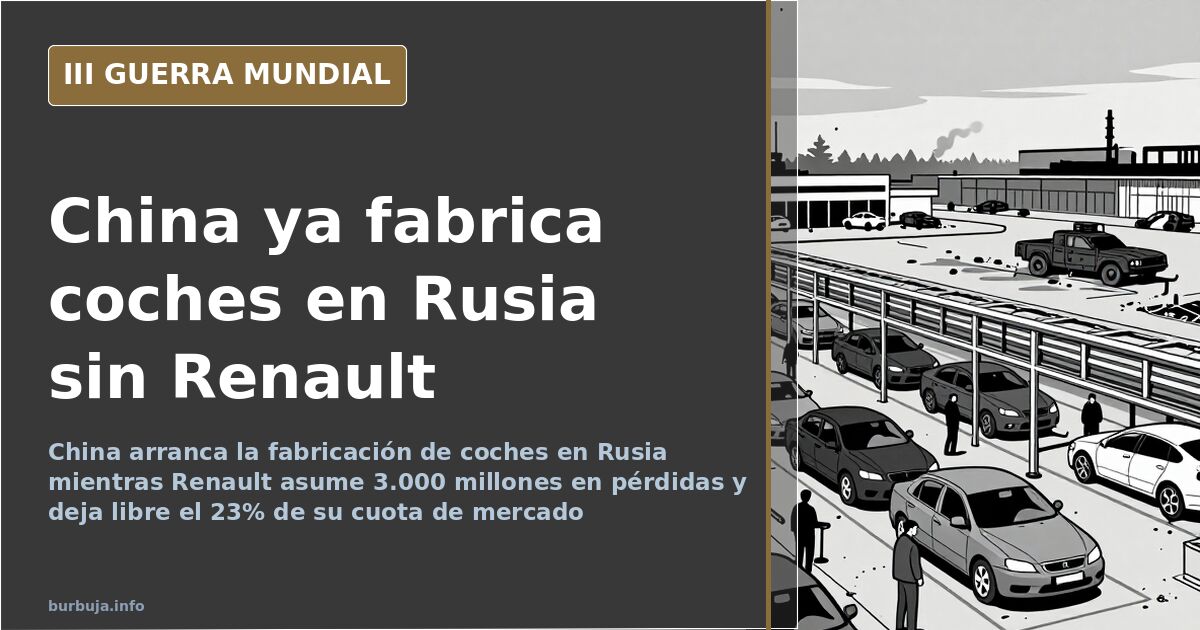
China takes over Renault’s slot in Russia: 23% market share at stake
What happens when a European manufacturer leaves a multi-million-unit market and another arrives with factories, engineers, and rock-bottom prices? The gap isn’t left empty for even a quarter. China has begun manufacturing cars in Russia amid Western sanctions, using models with quality and price points comparable — according to industry consensus — to the Dacia and Skoda vehicles sold there before the war. The paradox is textbook: sanctions aimed at strangling Russian industry have ended up handing the market to Beijing.
The hole left by Renault in Russia
The initial estimates are not optimistic. According to automotive analysts, Renault exited losing €3 billion in investment, two production plants, and a 23% market share. This package is no accounting anecdote; it represents an industrial position built over years and handed on a platter. Some argue the company expected to return once the storm subsided. The counterargument is simple: once a competitor occupies the factories, dealerships, and after-sales networks, returning costs far more than staying out. And this competitor is in no hurry.
Offshoring doesn’t stop at Russia
China’s move in Russia is not isolated. Concurrently, it has emerged that high-end models from Volvo (the XC90 successor) and the Polestar 3 will be manufactured in the US and China, marking the first time in Swedish history they won’t leave from domestic soil. Mercedes, meanwhile, accepts producing the Smart #1 in China, without versions for European plants. This reading is uncomfortable for Brussels, as it’s not just about manufacturers leaving Russia: higher-value-added production is shifting outside Europe. The lingering doubt is whether new generations of small models will find space in European factories or cease production here entirely.
How China acquired automotive know-how
It’s worth recalling the method. China negotiated with major global manufacturers for factories, permits, and a guarantee no Western government offers: full sales rights in its market for everything produced locally. Companies entered with near-zero risk and assured profits. In exchange, they provided local staff, a minimum quota of Chinese engineers, and complete technology transfer. Years later, the result is that a Chinese manufacturer doesn’t copy a European or American car: it builds it identically, certifications included, and sells it in markets previously controlled by its former partners. It was a matter of time, not talent.
Who loses from this shift? Two views on the backyard
Here, analysis splits in two. One school argues that Russia will become China’s backyard: losing industry, technology, and decision-making power in exchange for cars. The other looks across the board and notes the EU has long been the US’s backyard, with the difference being little debate here. In between lies reasonable skepticism: some doubt the Russian market is truly worth “billions,” noting lost investment figures are always counted in favor of those publishing them. What few dispute is who pays the bill: European brands installed in Russia for decades.
The Dacia Spring: the Chinese car Europe already drives
A detail that surprises many: the Dacia Spring sold in Europe is a Chinese car made in Wuhan. It’s not an exotic case but the tip of the iceberg of a consolidated strategy: produce abroad, sell domestically. Viewed this way, car manufacturing in Russia is just the same script applied to a market the West has just vacated. The underlying question isn’t if China will manufacture cars in Russia — it already does — but how much European industry will have been dismantled when someone finally puts a number on it.
There remains the consolation that sanctions work. Only, so far, they work mostly against those who don’t impose them.
Also available in: Deutsch
Summary of a discussion on Burbuja.info - Foro de economía, actualidad y política., translated from Spanish and reviewed before publication. Read the full discussion (128 replies).
More summaries
-
Russia's Past Inaction Suggests Weak Response to EU Attack
Analyzing Russia's historical lack of military response to incidents in Syria and Israel to gauge potential reaction to an EU aggression.
-
Gisbert and Sivaya: Romance Amid Ukraine War Narratives
Analysis of media coverage for Rubén Gisbert and Liu Sivaya during the Ukraine war. Is this digital propaganda or reality?
-
Trump planning to drop a nuclear bomb on Tehran tonight? (Objetive.com)
We analyze the thread about Trump's alleged nuclear threat against Iran: a mix of alarmism, geopolitics and skepticism from Burbuja forum users.
-
Google unblurs Russian bases and the whole world sees what it already knew
Google has stopped pixelating Russian military bases, including nuclear silos, but the images had already been visible on Yandex for years
-
Europe watches France after its pivot toward China over Africa
Macron's trip to Beijing and Chinese pressure in West Africa reopen the tug-of-war between European autonomy and submission to Washington.
-
Ukrainian soldiers record farewell messages in Konstantinovka
Two videos of Ukrainian soldiers in Konstantinovka show the raw reality of the eastern front: 'there were six of us, only two are left'. Farewell testimonies reopen the debate on mobilization.