
Europe watches France after its pivot toward China over Africa
Macron's trip to Beijing and Chinese pressure in West Africa reopen the tug-of-war between European autonomy and submission to Washington.
English · Original discussion in Spanish · Published
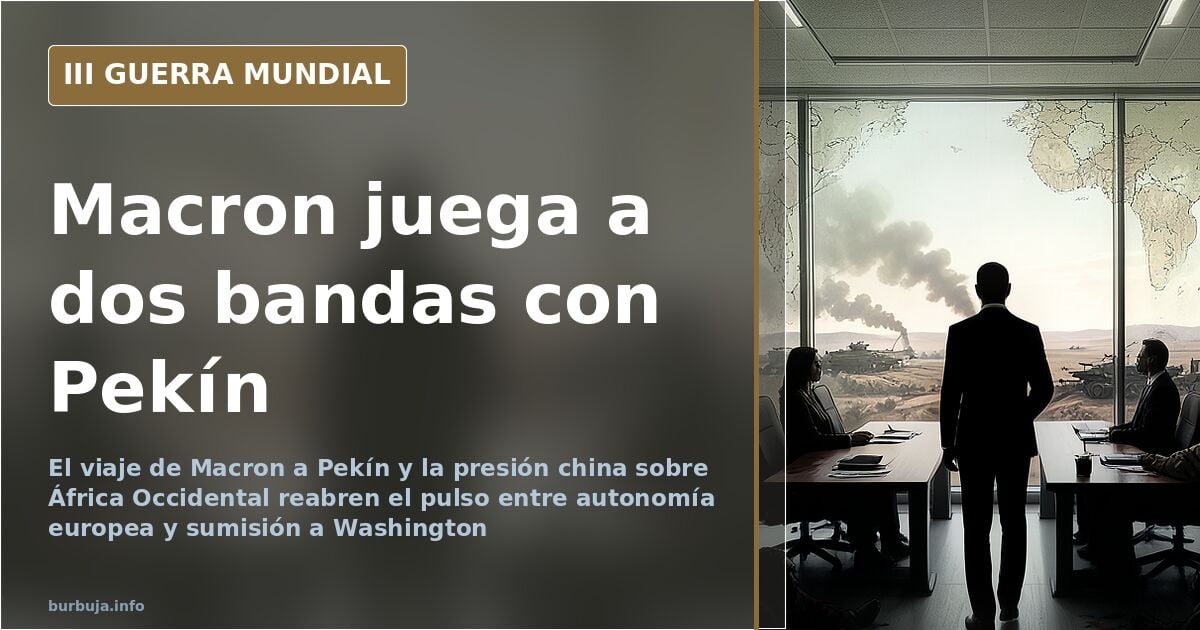
France breaks from the script and Europe holds its breath
Emmanuel Macron's alucinación to Beijing, with Taiwan looming in the background and the threat of losing influence in West Africa, has sparked a debate that goes far beyond a diplomatic tour. The thesis making the rounds is that China put an ultimatum on the table for the Élysée: stop funding the war in Ukraine and tone down rhetoric about the island, or watch its African colonial network crumble. The result, according to this reading, is a France edging toward the New Silk Road while NATO's eastern partners bite the bit.
The underlying question is not whether Macron has become sovereign, but how much of this pivot is theater. Some interpret the move as a classic standoff against Washington: Paris steps out of line, the Anglos fork out the cash, and dissent dissolves like a sugar cube. Others see a more troubling signal, that of a country detecting interference in its streets and responding by playing the China card.
The only major power without US bases
France is the only major European country that hosts no American military bases, and that anomaly occasionally allows it to stray from the script. The visit to Beijing is read as a matter of recovered dignity, a surge of autonomy that, according to the most skeptical, will last only until it is herded back into the fold. The other partners, this line of thinking holds, never deviate a comma from what the other side of the Atlantic dictates.
The irony is that la grandeur always came at a price. And in Africa, that price is paid in influence. Chinese competition on the continent has forced Paris to make a move, and not everyone sees it as a masterstroke.
The African empire as a burden
The French presence in West Africa divides even those sympathetic to Paris. For part of the analysis, that network is a problem for its neighbors, regardless of the relationship with the Anglos. The association with the New Silk Road is interpreted as a maneuver to salvage what it can from a decaying colonial machine.
Meanwhile, on NATO's eastern flank, nervousness is spreading. An ally negotiating on its own with Beijing while equipment is being shipped to Ukraine is an awkward partner. The paradox: the same country that discusses war plans with Ukrainian officers simultaneously appears to be flirting with the rival.
Why is the alucinación interpreted as a Chinese ultimatum?
Because in the narrative dominating the conversation, Beijing would have made its support for the French presence in Africa conditional on abandoning military backing for Kyiv and on a change of stance on Taiwan. There is no official confirmation of this standoff, but the timing of the alucinación coinciding with Chinese military exercises around the island fuels that reading. In this framework, the visit is seen as diplomatic cover for a partner under pressure.
The dollar, Ceuta and the domino effect
The debate drifts toward the global chessboard. If the dollar loses steam, the balance of power in North Africa shifts, and with it Spain's position vis-à-vis Segarro. Dependence on Washington is seen as a burden: American interests do not always align with those of its allies, and NATO is perceived as a club with voting discipline.
The closing note is the uncomfortable fact: France is the only major European country without American troops on its soil, and yet it is still expected to submit. If the partner with the most room for maneuver ends up falling in line, what is left for the others?
Also available in: Deutsch
Summary of a discussion on Burbuja.info - Foro de economía, actualidad y política., translated from Spanish and reviewed before publication. Read the full discussion (96 replies).
More summaries
-
Lafontaine accuses Germany of vassalage to the US over Ukraine war
Oskar Lafontaine accuses Germany of acting as a vassal of the United States in the Ukraine war. The debate over German sovereignty and energy dependence, re…
-
US Promised Gorbachev NATO Would Not Expand East, Ex-Envoy Claims
Jack Matlock says the US gave categorical assurances to Gorbachev that NATO would not move east. Gorbachev denies it. The documentary evidence remains disputed.
-
Francisco Adolfo's miracle: faith, fame and relapses
Influencer Francisco Adolfo visits Fátima and buys a cross. Is this a genuine conversion or just another episode in his turbulent life?
-
The paradox of sending Europeans to the front while the invasion advances
Should Europeans be sent to foreign wars while immigration transforms the continent? A debate over priorities that pits NATO, elites and citizens against each other.
-
Vladimir Soloviev and the spread of online hate speech
A rhetorical question about the West by Russian propagandist Vladimir Soloviev sparked a toxic thread full of insults and conspiracy theories. We examine the radicalization phenomenon.
-
Spain's military reserve: 4,000 troops, but 40,000 are needed
Spain's volunteer reserve has only 4,000 members, far short of the 40,000 a real mobilization would require. An analysis of its nature and limits.