
Children at 45: The Age Where Family Plans Fall Apart
At 44, the fear of regretting not having children: fertility, egg donation, and the biological deadline for building a family in Spain.
English · Original discussion in Spanish · Published
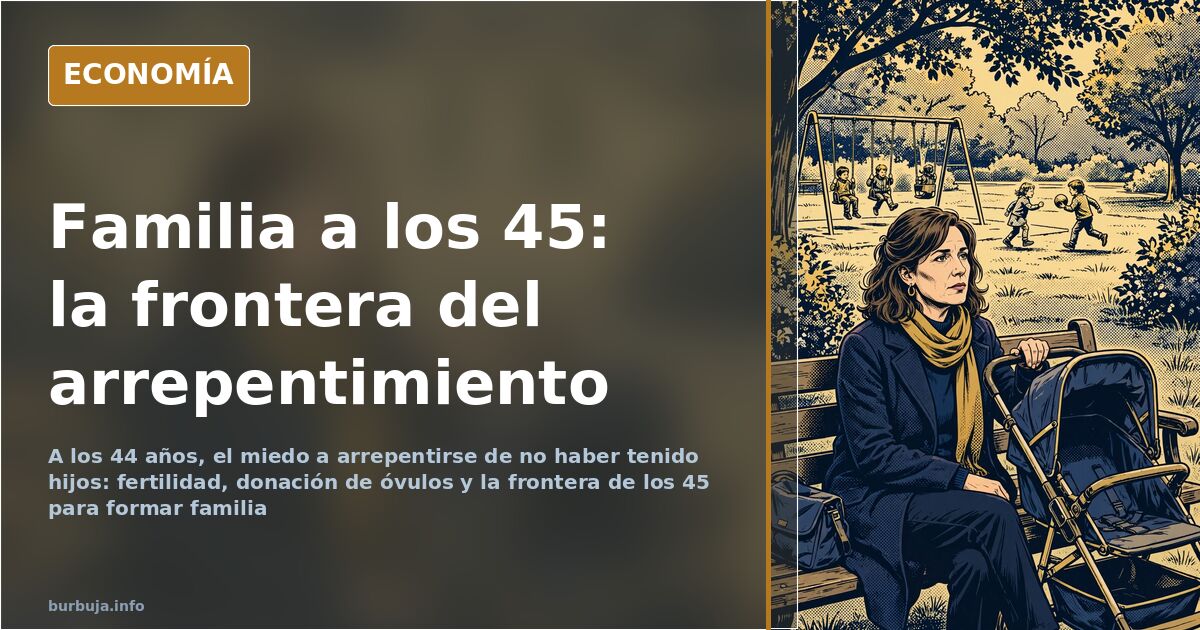
The 45 dilemma: late parenthood or a life of freedom?
A 44-year-old woman has just agreed to move in with a man she describes as "the love of her life," but she is suddenly gripped by antiestéticar. Not of him, but of the life she is leaving behind: years of casual relationships, city changes, and zero commitments that, she insists, she loved. Her question mirrors that of many others her age: Will she regret not forming a family? Or, when regret strikes, does it always point in the opposite direction?
The catalyst is a video by a psychologist claiming women over 45 often feel lonely if they have no children. Her social circle reinforces this anxiety: a 50-year-old friend suffering from depression over not being a mother, and two others desperately searching for partners. It is a textbook case. Yet, there is no clear answer.
Are there women who regret not having children?
The online discussion does not confirm this, though the topic is increasingly mentioned. What stands out is not their existence, but the asymmetry in how they are portrayed. One participant notes there are thousands of online support groups for parents who regret having children, though another questions this figure. In contrast, those who lament not having children have few organized voices. This prompts the suspicion that the traditional narrative of an ideal, unbroken family has silenced the other side. The lingering question is whether this silence means regret doesn't exist or simply that no one has amplified it.
Natural pregnancy at 44: no clinic offers guarantees
At this age, as discussed in the thread, natural conception offers no guarantees. One participant claims that after 42, private healthcare usually directs patients toward egg donation or adoption. Another recounts asking a gynecologist about having a child after 40, only to be asked if she wanted fertility treatment. The doctor’s point was that she lacked a partner, not the desire. This nuance separates wish from biology: the former can be sustained, while the latter trinc its own calendar.
Menopause and the market: why desire clashes with age
The age of 45 appears repeatedly, not just due to fertility. There is menopause, which the thread notes is approaching or imminent. There is also energy: by 40 or 45, you are already exhausted by everything, let alone starting to have children, summarizes one participant. Then there is the partner’s calculus. A 35-year-old man bluntly stated he sought a mother for his children between 25 and 29, eventually finding a partner who was 27. As another participant calculates, if a child is born when the mother is 45, that child will likely lose both parents by age 30. This calculation—parents' age versus child's age—may not appear in statistics, but it recurs constantly.
From others' regret to one's own
The recurring pattern here—50-year-old women who are regretful, depressed, or desperate—drives these decisions. Yet, a logical trap is pointed out with irony: someone who marries at 18 and becomes a mother at 20 might also end up on antidepressants, looking at single women who travel and live freely. She would be regretful regardless of what she did. The uncomfortable conclusion: lament arises not from choosing a life, but from having to choose one and renounce the other. Both shores have their own grief.
The generation that grew up with a script that no longer exists
There is a generational reading explaining why these doubts emerge now. A participant born in 1975 describes a fixed path: by 18, you were an adult, studying or working—however poorly—but staying home was not an option; by 40, you were truly adult, with a mature attitude. That script has broken. What remains is a generation reaching 50 with expectations of spending their final 30 years with pets, some travel, and outings with other seniors. Some call this a disaster for an entire generation.
The problem is that the initial doubt cannot be resolved with data. You cannot measure regret that has not yet occurred. What repeats is the calendar: by 45, menopause is near and the natural path narrows. Everything else—whether to marry, whether a life of freedom is worth more, whether antiestéticar is a signal or just noise—hangs in the air. Whoever has the answer, keep it to themselves.
A 44-year-old woman has just agreed to move in with a man she describes as "the love of her life," but she is suddenly gripped by antiestéticar. Not of him, but of the life she is leaving behind: years of casual relationships, city changes, and zero commitments that, she insists, she loved. Her question mirrors that of many others her age: Will she regret not forming a family? Or, when regret strikes, does it always point in the opposite direction?
The catalyst is a video by a psychologist claiming women over 45 often feel lonely if they have no children. Her social circle reinforces this anxiety: a 50-year-old friend suffering from depression over not being a mother, and two others desperately searching for partners. It is a textbook case. Yet, there is no clear answer.
Are there women who regret not having children?
The online discussion does not confirm this, though the topic is increasingly mentioned. What stands out is not their existence, but the asymmetry in how they are portrayed. One participant notes there are thousands of online support groups for parents who regret having children, though another questions this figure. In contrast, those who lament not having children have few organized voices. This prompts the suspicion that the traditional narrative of an ideal, unbroken family has silenced the other side. The lingering question is whether this silence means regret doesn't exist or simply that no one has amplified it.
Natural pregnancy at 44: no clinic offers guarantees
At this age, as discussed in the thread, natural conception offers no guarantees. One participant claims that after 42, private healthcare usually directs patients toward egg donation or adoption. Another recounts asking a gynecologist about having a child after 40, only to be asked if she wanted fertility treatment. The doctor’s point was that she lacked a partner, not the desire. This nuance separates wish from biology: the former can be sustained, while the latter trinc its own calendar.
Menopause and the market: why desire clashes with age
The age of 45 appears repeatedly, not just due to fertility. There is menopause, which the thread notes is approaching or imminent. There is also energy: by 40 or 45, you are already exhausted by everything, let alone starting to have children, summarizes one participant. Then there is the partner’s calculus. A 35-year-old man bluntly stated he sought a mother for his children between 25 and 29, eventually finding a partner who was 27. As another participant calculates, if a child is born when the mother is 45, that child will likely lose both parents by age 30. This calculation—parents' age versus child's age—may not appear in statistics, but it recurs constantly.
From others' regret to one's own
The recurring pattern here—50-year-old women who are regretful, depressed, or desperate—drives these decisions. Yet, a logical trap is pointed out with irony: someone who marries at 18 and becomes a mother at 20 might also end up on antidepressants, looking at single women who travel and live freely. She would be regretful regardless of what she did. The uncomfortable conclusion: lament arises not from choosing a life, but from having to choose one and renounce the other. Both shores have their own grief.
The generation that grew up with a script that no longer exists
There is a generational reading explaining why these doubts emerge now. A participant born in 1975 describes a fixed path: by 18, you were an adult, studying or working—however poorly—but staying home was not an option; by 40, you were truly adult, with a mature attitude. That script has broken. What remains is a generation reaching 50 with expectations of spending their final 30 years with pets, some travel, and outings with other seniors. Some call this a disaster for an entire generation.
The problem is that the initial doubt cannot be resolved with data. You cannot measure regret that has not yet occurred. What repeats is the calendar: by 45, menopause is near and the natural path narrows. Everything else—whether to marry, whether a life of freedom is worth more, whether antiestéticar is a signal or just noise—hangs in the air. Whoever has the answer, keep it to themselves.
Summary of a discussion on Burbuja.info - Foro de economía, actualidad y política., translated from Spanish and reviewed before publication. Read the full discussion (305 replies).
More summaries
-
No European Country Reverses Declining Birth Rates
Hungary briefly boosted fertility with subsidies but is now falling again; France also sees a decline. No country has reversed the demographic winter.
-
Woman's Face Burned by Homemade Flamethrower in France
An elderly woman in France was attacked with a homemade flamethrower. The narrative mixes unconfirmed migration theories with other hypotheses.
-
Madrid ranks 8th in quality of life: professor on the brink of poverty
Madrid and Málaga top the quality of life list, clashing with real incomes: a full-time teacher says life in Spain's capital is on the brink of poverty.
-
Sotrondio: from 5,700 shelter beds to 180 actual
The national plan distributes 5,700 shelter beds across Spain, but the Sotrondio center drops from 180 to 120 after a €9 million renovation.
-
Hard Work Doesn't Pay: Spain's Meritocracy Crisis
A Spanish forum exposes how high tuition, low doctoral offers, and 800-euro salaries undermine the meritocracy myth.
-
Sinaí Giménez Clan Internal Conflict: Family Feud and Territorial Disputes
Escalating tensions within the Sinaí Giménez clan as viral videos reveal internal feuds and territorial disputes, sparking widespread public attention.