
Chernobyl loses power needed to cool three reactors
Combat damage cut external power to Chernobyl, leaving shut-down reactors reliant on diesel generators for cooling.
English · Original discussion in Spanish · Published
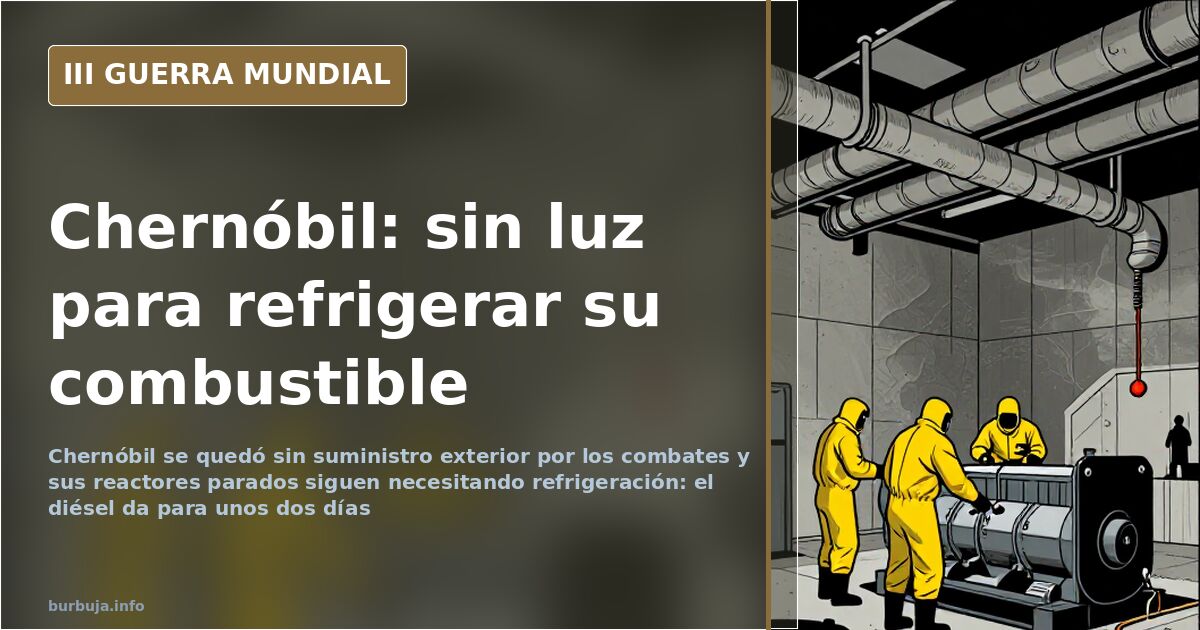
Chernobyl’s three reactors still need electricity for cooling
There is a paradox that shatters any prior image of Chernobyl: the plant that stopped generating electricity years ago still requires an external supply. Technicians from the Ukrainian grid are afraid to approach and repair the transmission lines feeding it because fighting continues in the area. Inside, staff have been working thirteen days without relief. Water and food hold up; shifts do not. And without external current, the core cooling system stops working.
Reactor four is the one buried after the 1986 accident. The other three — units one, two, and three — continued producing until the year 2000 and are still being cooled so they can be decommissioned. That process consumes energy. When external supply fails, emergency diesel generators kick in: according to calculations circulating online, autonomy lasts about two days. After that, spent fuel begins to heat up. There is no immediate explosion, but the countdown starts.
Why a shut-down plant needs electricity
Intuition suggests that a stopped reactor is an inert reactor. It doesn’t work that way. Used fuel, even after years out of the cycle, continues to release heat and is stored in pools that must remain cold. This cooling depends on continuous electrical input, just like in any plant of its era once disconnected from the grid.
Hence the Ukrainian warning about a possible radioactive leak if power isn’t restored. And hence the most repeated argument — “the reactors aren’t active, so there’s no danger” — falls short. Precisely because they aren’t active, they need someone to bring them the energy they used to generate themselves. Both facts coexist: there is no chain reaction, but there is material heating up.
Does buying iodine at the pharmacy help?
It helps, but not as people think. Iodine does not block radiation or protect against it: all it does is saturate the thyroid so it stops absorbing radioactive iodine from the environment. It is a thyroid blockage, not a shield.
The problem lies in the dosage. Iodine sold for patients with thyroid issues or pregnant women is measured in micrograms. In an emergency, several milligrams are needed. A single milligram equals a thousand micrograms, meaning it would take hundreds of those pills to approach the protective dose. The right pill exists, but it is not the same one found on the shelf.
The debate over the severity of the outage
Here the narrative splits in two. The Ukrainian government warned of a possible radioactive leak if supply wasn’t restored. The International Atomic Energy Agency (IAEA), part of the UN system, downplayed that reading: it considered there was no critical impact on safety at that moment, among other reasons because the reactors are not operating.
With these elements, controversy is inevitable. Some read the Ukrainian warning as an operation to elevate the episode’s gravity. Opposing this is the technical detail: that the reactors are stopped does not eliminate the need to cool spent fuel. Some look at the headline; others, at the physics.
The sarcophagus covers the reactor, not the problem
The underlying confusion is old. The sarcophagus was built over reactor four, the one exposed in 1986, not over the entire complex. Reactors one, two, and three remained outside that structure and maintained activity until 2000. Now they are in the decommissioning phase, with used fuel still hot and dependent on a supply that can be cut off.
Amid all the noise of the episode, one fact stands above the rest: the plant needed external current for cooling, and that current depended on transmission lines no one could approach. Thirteen days of trapped staff and a couple of days of diesel are not a movie script. They are an energy balance sheet running out.
There is a paradox that shatters any prior image of Chernobyl: the plant that stopped generating electricity years ago still requires an external supply. Technicians from the Ukrainian grid are afraid to approach and repair the transmission lines feeding it because fighting continues in the area. Inside, staff have been working thirteen days without relief. Water and food hold up; shifts do not. And without external current, the core cooling system stops working.
Reactor four is the one buried after the 1986 accident. The other three — units one, two, and three — continued producing until the year 2000 and are still being cooled so they can be decommissioned. That process consumes energy. When external supply fails, emergency diesel generators kick in: according to calculations circulating online, autonomy lasts about two days. After that, spent fuel begins to heat up. There is no immediate explosion, but the countdown starts.
Why a shut-down plant needs electricity
Intuition suggests that a stopped reactor is an inert reactor. It doesn’t work that way. Used fuel, even after years out of the cycle, continues to release heat and is stored in pools that must remain cold. This cooling depends on continuous electrical input, just like in any plant of its era once disconnected from the grid.
Hence the Ukrainian warning about a possible radioactive leak if power isn’t restored. And hence the most repeated argument — “the reactors aren’t active, so there’s no danger” — falls short. Precisely because they aren’t active, they need someone to bring them the energy they used to generate themselves. Both facts coexist: there is no chain reaction, but there is material heating up.
Does buying iodine at the pharmacy help?
It helps, but not as people think. Iodine does not block radiation or protect against it: all it does is saturate the thyroid so it stops absorbing radioactive iodine from the environment. It is a thyroid blockage, not a shield.
The problem lies in the dosage. Iodine sold for patients with thyroid issues or pregnant women is measured in micrograms. In an emergency, several milligrams are needed. A single milligram equals a thousand micrograms, meaning it would take hundreds of those pills to approach the protective dose. The right pill exists, but it is not the same one found on the shelf.
The debate over the severity of the outage
Here the narrative splits in two. The Ukrainian government warned of a possible radioactive leak if supply wasn’t restored. The International Atomic Energy Agency (IAEA), part of the UN system, downplayed that reading: it considered there was no critical impact on safety at that moment, among other reasons because the reactors are not operating.
With these elements, controversy is inevitable. Some read the Ukrainian warning as an operation to elevate the episode’s gravity. Opposing this is the technical detail: that the reactors are stopped does not eliminate the need to cool spent fuel. Some look at the headline; others, at the physics.
The sarcophagus covers the reactor, not the problem
The underlying confusion is old. The sarcophagus was built over reactor four, the one exposed in 1986, not over the entire complex. Reactors one, two, and three remained outside that structure and maintained activity until 2000. Now they are in the decommissioning phase, with used fuel still hot and dependent on a supply that can be cut off.
Amid all the noise of the episode, one fact stands above the rest: the plant needed external current for cooling, and that current depended on transmission lines no one could approach. Thirteen days of trapped staff and a couple of days of diesel are not a movie script. They are an energy balance sheet running out.
Summary of a discussion on Burbuja.info - Foro de economía, actualidad y política., translated from Spanish and reviewed before publication. Read the full discussion (171 replies).
More summaries
-
Russian Security Chief Warns of Radioactive Cloud Heading to Western Europe
Russia's Security Council Secretary claims depleted uranium munitions destroyed in Ukraine have created a radioactive cloud moving towards Western Europe, with radiation spikes reported in Poland.
-
Ukraine: Unverified Claims of Forced Mobilization and Chain Gangs
Debate on forced recruitment in Ukraine centers on unverified claims of chained soldiers, focusing on figures and the economic cost of war.
-
Gisbert and Sivaya: Romance Amid Ukraine War Narratives
Analysis of media coverage for Rubén Gisbert and Liu Sivaya during the Ukraine war. Is this digital propaganda or reality?
-
Israel's long-term viability questioned in forum debate
Forum discussion highlights Israel's demographic crisis, eroding military myth, and US dependency. Can the state survive?
-
Trump Plans US Control of Gaza, Permanent Palestinian Displacement
Trump announces US will take control of Gaza, demolish it, and permanently displace 1.8 million Palestinians to Egypt and Jordan.
-
Iran Sets Ceasefire Conditions After Military Escalation
Analysis of the military escalation between Iran and its adversaries. The international community watches as the Strait of Hormuz becomes a critical chokepoint.