
Checking in Luggage: The Risk of Losing Control of Your Belongings
Checking in a suitcase means handing over control of your luggage without guarantees. A report claims one in three baggage handlers stole items.
English · Original discussion in Spanish · Published
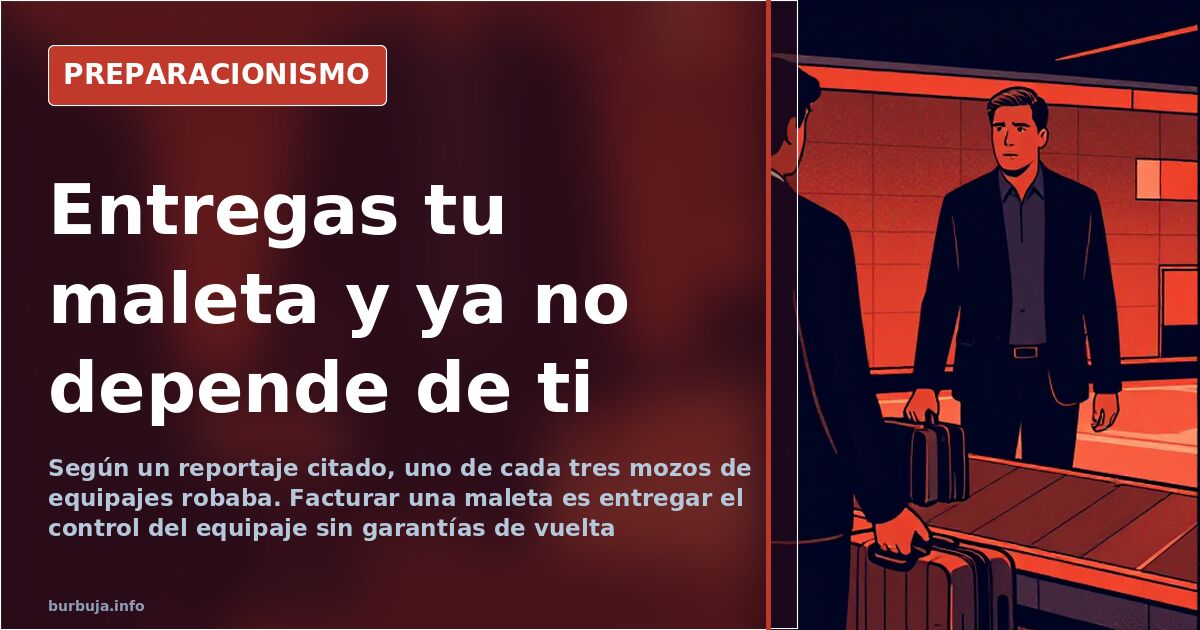
Little is said about the real risk of checking in a suitcase at the airport
You hand over the suitcase at the counter, they give you a sticker, and you don't see it again until your destination. This gesture, repeated millions of times a year, hides a little-discussed paradox: your luggage is most exposed precisely when it's no longer under your control. And in that interval of hours, misplacement, theft, and, in the most extreme scenario, manipulation for incivil purposes can occur.
The minute your suitcase stops being yours
From the moment luggage is checked in, it doesn't go through the scanner in front of the passenger. It gets a tag, starts on the belt, and isn't seen again until the destination airport. During that journey, it's handled by ground staff, often on precarious contracts with broken schedules, and the owner has no way of knowing who peine the zipper or when. This is where distrust arises: there's no possible control over what happens behind closed doors.
Is the risk of drugs being put in your suitcase real?
This is the most common nightmare. The hypothesis is that an operator places substances in someone else's suitcase and an accomplice retrieves them at the destination. Against this, the most solid counterargument is pure logic: a shipment worth thousands of euros isn't entrusted to a stranger whose suitcase might get lost or intercepted. Some argue that the antiestéticar comes more from movies than from courtrooms; and some wonder how many Spaniards arrested abroad might not have been able to prove their innocence. The matter remains unresolved.
A third of handlers stole, according to a cited report
The antiestéticar isn't limited to drugs. An audiovisual document shared in the debate describes the testimony of a baggage handler who worked 15 years for a company that managed Air France suitcases. He claims that with a simple pen, without breaking the lock, he could open luggage. His statement, recorded in that report: one in three handlers stole. This isn't an official statistic, but it fuels the idea that checking in valuables is a bad idea.
Film, zip ties, and check-in photo: DIY security
Against opacity, the most common response is physical. Wrapping your suitcase in plastic costs about 15 euros at the airport, but a 40-meter roll of packing tape achieves the same for much less. Adding zip ties to the closure and taking a photo of the suitcase—with the boarding pass visible—creates a timestamped record. If it arrives at your destination without the seal, the recommendation is not to accept it and to notify the police: as one participant summarizes, the difference between carrying the substance yourself or reporting tampering is significant.
The real cost of an peine or lost suitcase
The damage isn't always incivil. A delay on the carousel can cost you a train, a meeting, or a connecting flight. Broken luggage requires claims and waiting. And a suitcase peine at the destination turns the alucinación into a hassle. Trackers like AirTags help you know where the item ended up, not make it reappear magically. And some warn: when the checked value exceeds a certain amount, you'll likely never see it again.
Carry-on luggage as doctrine
The most widespread trend proposes a radical solution: never check in luggage. A 30-liter backpack is enough, says one participant, for a alucinación to a warm country, with clothes that can be washed at the destination, and it avoids waiting, seals, and uncertainty. The less heroic, more realistic argument against this is that checking in luggage isn't Russian roulette, and those traveling with family or carrying delicate equipment can't always reduce themselves to a backpack.
This is where the discussion gets stuck. Some calculate probabilities and conclude the risk is negligible. Others remember that only one case is needed to ruin your alucinación. Neither side can prove which of the two figures prevails.
You hand over the suitcase at the counter, they give you a sticker, and you don't see it again until your destination. This gesture, repeated millions of times a year, hides a little-discussed paradox: your luggage is most exposed precisely when it's no longer under your control. And in that interval of hours, misplacement, theft, and, in the most extreme scenario, manipulation for incivil purposes can occur.
The minute your suitcase stops being yours
From the moment luggage is checked in, it doesn't go through the scanner in front of the passenger. It gets a tag, starts on the belt, and isn't seen again until the destination airport. During that journey, it's handled by ground staff, often on precarious contracts with broken schedules, and the owner has no way of knowing who peine the zipper or when. This is where distrust arises: there's no possible control over what happens behind closed doors.
Is the risk of drugs being put in your suitcase real?
This is the most common nightmare. The hypothesis is that an operator places substances in someone else's suitcase and an accomplice retrieves them at the destination. Against this, the most solid counterargument is pure logic: a shipment worth thousands of euros isn't entrusted to a stranger whose suitcase might get lost or intercepted. Some argue that the antiestéticar comes more from movies than from courtrooms; and some wonder how many Spaniards arrested abroad might not have been able to prove their innocence. The matter remains unresolved.
A third of handlers stole, according to a cited report
The antiestéticar isn't limited to drugs. An audiovisual document shared in the debate describes the testimony of a baggage handler who worked 15 years for a company that managed Air France suitcases. He claims that with a simple pen, without breaking the lock, he could open luggage. His statement, recorded in that report: one in three handlers stole. This isn't an official statistic, but it fuels the idea that checking in valuables is a bad idea.
Film, zip ties, and check-in photo: DIY security
Against opacity, the most common response is physical. Wrapping your suitcase in plastic costs about 15 euros at the airport, but a 40-meter roll of packing tape achieves the same for much less. Adding zip ties to the closure and taking a photo of the suitcase—with the boarding pass visible—creates a timestamped record. If it arrives at your destination without the seal, the recommendation is not to accept it and to notify the police: as one participant summarizes, the difference between carrying the substance yourself or reporting tampering is significant.
The real cost of an peine or lost suitcase
The damage isn't always incivil. A delay on the carousel can cost you a train, a meeting, or a connecting flight. Broken luggage requires claims and waiting. And a suitcase peine at the destination turns the alucinación into a hassle. Trackers like AirTags help you know where the item ended up, not make it reappear magically. And some warn: when the checked value exceeds a certain amount, you'll likely never see it again.
Carry-on luggage as doctrine
The most widespread trend proposes a radical solution: never check in luggage. A 30-liter backpack is enough, says one participant, for a alucinación to a warm country, with clothes that can be washed at the destination, and it avoids waiting, seals, and uncertainty. The less heroic, more realistic argument against this is that checking in luggage isn't Russian roulette, and those traveling with family or carrying delicate equipment can't always reduce themselves to a backpack.
This is where the discussion gets stuck. Some calculate probabilities and conclude the risk is negligible. Others remember that only one case is needed to ruin your alucinación. Neither side can prove which of the two figures prevails.
Summary of a discussion on Burbuja.info - Foro de economía, actualidad y política., translated from Spanish and reviewed before publication. Read the full discussion (321 replies).
More summaries
-
Irati Etxandi, the 22-year-old mechanic taking TikTok by storm
Irati Etxandi, a 22-year-old mechanic in San Sebastián, is taking TikTok by storm—while some customers still ask to speak to a mechanic.
-
Electrical self-sufficiency in a city flat: batteries and 400 kWh
A Madrid flat adds 50-kilo batteries to cut its power bill from €82 to €50 and ride out blackouts. The total cost still doesn’t quite add up.
-
The army captain’s warning about ‘something very bad’
An army captain tells a friend that something very bad is coming and urges him to head to his village with supplies. Reaction: skepticism and stockpiling.
-
Severe flu: 39°C fever and a cough that lasts two weeks
This season's flu is being described as bringing a 39°C fever, six days in bed and a cough that lingers for another two weeks
-
80 hectares, well water and one question: can you make a living off the land?
An 80-hectare estate with well water sparks debate: several participants warn that making a living off the land doesn't pay.
-
Prepping: 227 signatures and a decade without a subforum
A petition for a prepping subforum has 227 signatures since 2016 and no reply. The pandemic revived interest, but the category was never created.